



Introduction
Enterprise CRM platforms are evolving from passive systems of record into intelligent systems of action. While traditional CRM automation improves efficiency through predefined workflows, it lacks the adaptability required to respond to real-time customer behaviour and intent. Agentic AI introduces autonomous, goal-driven agents that can sense context, reason over data, and orchestrate next-best actions across channels. This blog outlines how Agentic AI enables autonomous customer journey orchestration, the enterprise challenges it addresses, and the measurable outcomes organizations can expect when deploying it responsibly.
Evolution of CRMs and Customer Journey Orchestration
Over the past decade, CRM platforms have integrated marketing automation, sales enablement, service management, and customer analytics into a unified ecosystem. Despite this consolidation, customer journeys remain fragmented. Marketing triggers campaigns based on segments, sales teams follow static playbooks, and service teams react to tickets after issues arise.
Advancements in predictive analytics and generative AI have improved targeting and personalization, but orchestration still relies heavily on predefined rules and manual intervention. Enterprises now operate in environments where customer expectations are dynamic, omnichannel engagement is the norm, and response speed directly impacts loyalty and revenue.
Agentic AI emerges as the next evolution in CRM intelligence, moving from rule execution to autonomous decision-making aligned with business objectives.

Why Static Journeys Fail in a Dynamic Customer World
Traditional CRM automation struggles to deliver adaptive, real-time customer experiences due to several systemic limitations.
Rule-based workflows cannot account for the infinite variability of customer behavior. As a result, journeys become rigid and fail to adapt when customers deviate from expected paths.
- Static Workflows

2. Siloed Decision-Making
Marketing, sales, and service systems operate independently, leading to inconsistent messaging, duplicated outreach, and fragmented experiences.
3. Delayed Response to Customer Signals
Even when predictive models detect churn risk or intent signals, manual intervention delays action, reducing effectiveness.
4. Operational Complexity
Maintaining thousands of rules, triggers, and exceptions creates governance challenges and increases technical debt.
5. Limited Personalization at Scale
Segmentation-based approaches approximate personalization but cannot deliver true one-to-one orchestration.
These challenges prevent enterprises from delivering responsive, cohesive, and emotionally intelligent customer journeys.
Agentic AI: The Intelligence Layer Powering Autonomous Customer Journeys
Agentic AI introduces autonomous agents that orchestrate customer journeys based on goals rather than predefined steps. Instead of following static workflows, these agents continuously evaluate customer context and determine optimal actions.
Core Capabilities of Agentic CRM
Agents operate with objectives such as improving retention, accelerating conversion, or resolving issues proactively. They dynamically determine the next best action based on real-time signals.
Agents orchestrate actions across email, SMS, in-app messaging, contact centers, and field service—ensuring consistent engagement.
By ingesting behavioral, transactional, sentiment, and operational data, agents adapt journeys instantly rather than waiting for batch processing.
High-impact or low-confidence decisions trigger escalation to human agents, preserving trust and accountability.
Agents refine decision strategies based on outcomes, improving performance over time.
Measurable Gains from Agentic Orchestration
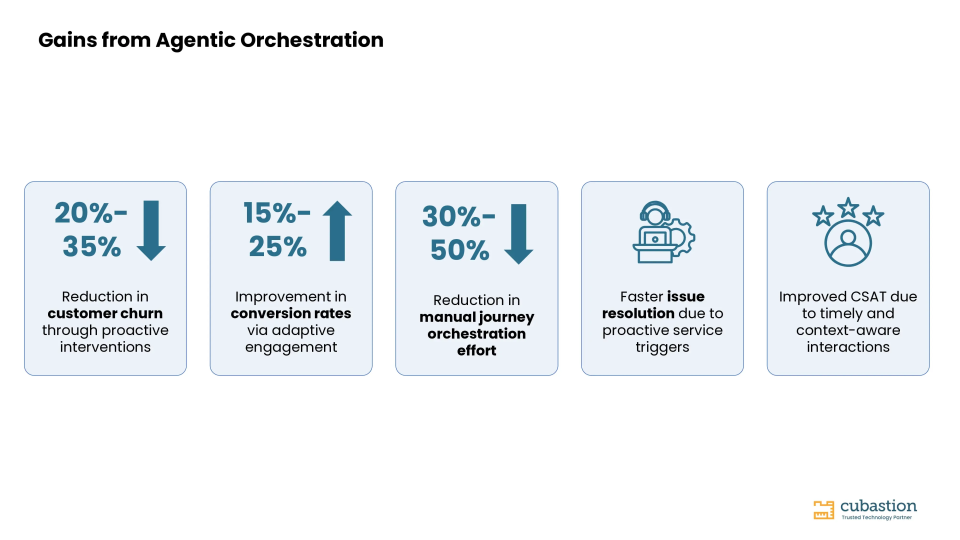
Early enterprise implementations of agentic orchestration demonstrate measurable improvements across key CRM performance indicators. Some observed improvements across the industry are shown in the following image.
Core Capabilities of Agentic CRM
- Goal-Driven Orchestration : Agents operate with objectives such as improving retention, accelerating conversion, or resolving issues proactively. They dynamically determine the next best action based on real-time signals.
- Cross-Channel Coordination: Agents orchestrate actions across email, SMS, in-app messaging, contact centers, and field service—ensuring consistent engagement.
- Real-Time Context Awareness : By ingesting behavioral, transactional, sentiment, and operational data, agents adapt journeys instantly rather than waiting for batch processing.
- Human-in-the-Loop Governance : High-impact or low-confidence decisions trigger escalation to human agents, preserving trust and accountability.
- Continuous Learning : Agents refine decision strategies based on outcomes, improving performance over time.
Measurable Gains from Agentic Orchestration
Early enterprise implementations of agentic orchestration demonstrate measurable improvements across key CRM performance indicators. Some observed improvements across the industry are shown in the following image.

For example, in telecom environments, agentic systems can detect service degradation patterns and proactively notify customers with remediation steps before complaints arise. In automotive aftersales, agents can orchestrate service reminders, parts availability checks, and dealership scheduling dynamically. In BFSI, agents can adjust engagement based on transaction behavior to prevent churn or fraud escalation.
Emerging platforms such as Cubastion’s HukmX demonstrate how enterprises are beginning to operationalize Agentic AI through role-based AI agents that integrate with existing systems and execute real workflows, from service troubleshooting to executive decision intelligence.
These outcomes demonstrate that agentic orchestration moves CRM from reactive engagement to proactive experience management.
Outcome
The adoption of Agentic AI transforms CRM performance across operational, experiential, and strategic dimensions.
Operational Outcomes
- Reduced reliance on manual workflow management
- Lower support volumes due to proactive resolution
- Improved agent productivity through AI-assisted context
Customer Experience Outcomes
- Consistent, omnichannel engagement
- Faster resolution and reduced friction
- Personalized journeys aligned to intent
Business Outcomes
- Increased customer lifetime value
- Improved retention and loyalty
- Better ROI on CRM and marketing investments
Agentic orchestration enables enterprises to scale empathy and responsiveness—two attributes previously constrained by manual processes.
Learning
Implementing Agentic AI in CRM requires more than technology adoption; it demands organizational readiness and governance discipline. The following are some key lessons for enterprises.
1. Start with Clear Objectives
Define measurable goals such as churn reduction or resolution time improvement to guide agent behavior.
2. Prioritize High-Impact Use Cases
Begin with journeys where responsiveness matters most—retention, service recovery, onboarding.
3. Design for Human Oversight
Maintain human checkpoints for sensitive decisions to preserve trust.
4. Invest in Data Readiness
Agentic AI depends on high-quality, real-time data across systems.
5. Establish Governance Early
Define policies, guardrails, and audit mechanisms to ensure responsible autonomy.
6. Measure Outcomes, Not Activity
Evaluate success through customer and business outcomes rather than automation volume.
By approaching Agentic AI as an orchestration capability rather than a standalone tool, enterprises can unlock adaptive, customer-centric CRM experiences that scale with confidence.
If your CRM still relies on rigid rules, manual orchestration, and siloed decision-making, this is the moment to reassess your approach. Begin by identifying high-impact journeys, evaluating data readiness, and defining governance models that enable safe autonomy. Contact Cubastion to begin your autonomous orchestration journey today.