


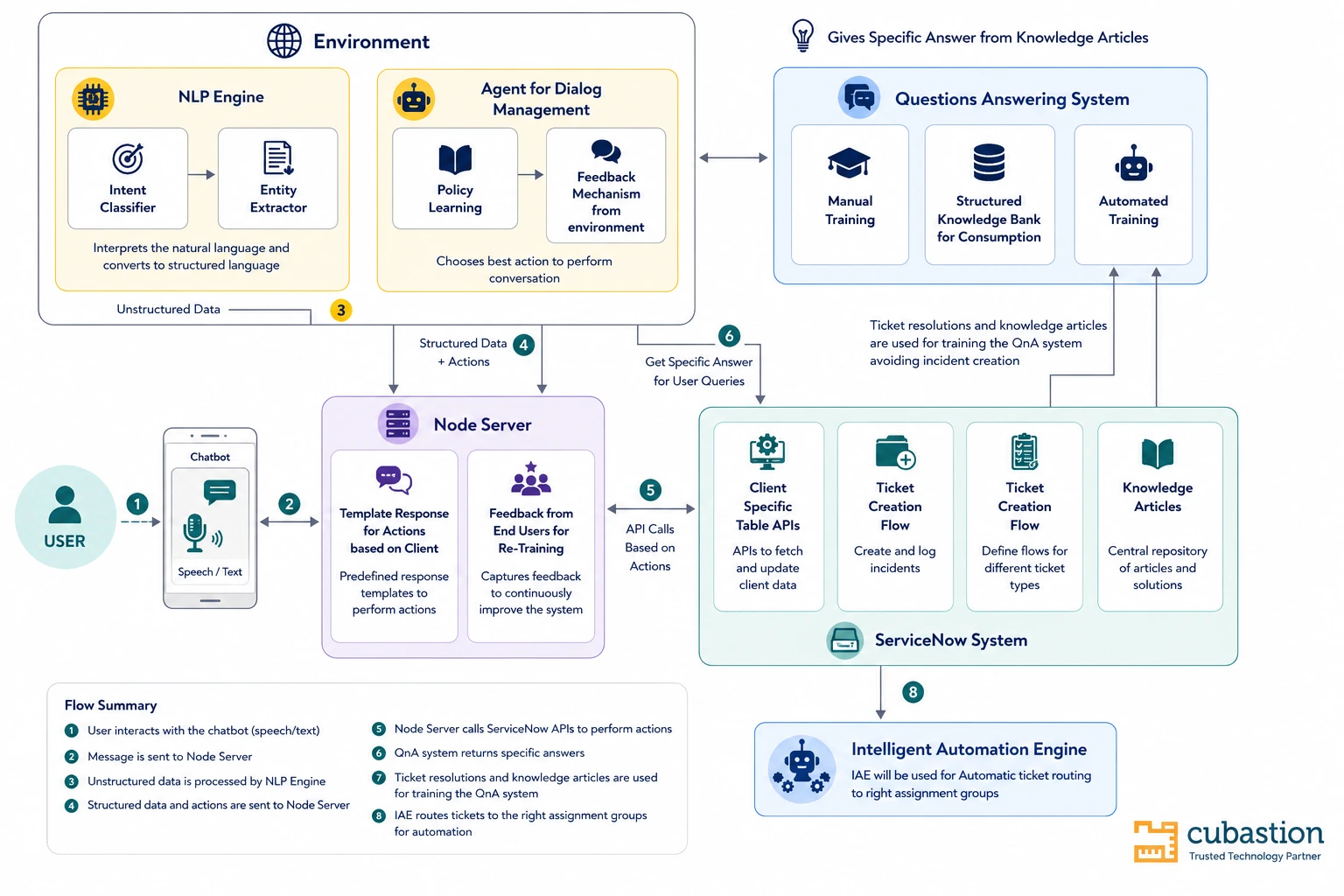

From Digital Access to Intelligent Assistance
Over the past decade, governments worldwide have embraced digital transformation to improve public service delivery. Citizens can now pay taxes online, apply for passports digitally, access welfare schemes through government portals, download official documents, and file grievances without visiting government offices. These initiatives have significantly improved accessibility and reduced dependency on paper-based processes.
However, as digital services expanded, a new challenge emerged. Instead of standing in long queues at government offices, citizens now navigate multiple websites, applications, authentication systems, and departmental portals to complete even simple tasks. While services have become digital, the user experience often remains fragmented.
Consider a citizen trying to determine eligibility for a government welfare scheme. The information may be spread across different departmental websites, eligibility documents, FAQs, and downloadable PDFs. Similarly, entrepreneurs looking for business licenses or students applying for scholarships frequently struggle to identify the correct portal or understand procedural requirements.
The next phase of digital governance is therefore not simply about creating more online services, it is about making those services easier to access. Artificial Intelligence (AI) chatbots are emerging as an important enabler of this transition. Rather than replacing existing government portals, AI-powered conversational interfaces simplify citizen interactions by providing instant assistance, personalized guidance, and round-the-clock support through natural language conversations.
As governments continue to prioritize citizen-centric governance, AI chatbots are transforming public service delivery from information portals into intelligent digital assistants.
When Digital Government Still Feels Complicated
Government portals were designed to improve accessibility by moving public services online. While they successfully digitized many administrative processes, they also introduced new complexities for citizens.
One major challenge is the sheer number of digital platforms. Different government departments often maintain separate websites, applications, and support systems, requiring users to understand institutional structures before accessing services. Citizens may know what service they require but not which department manages it.
Accessibility also extends beyond internet availability. Many users, particularly senior citizens, rural populations, and individuals with limited digital literacy, find navigating complex portals overwhelming. Language diversity further complicates interactions in multilingual countries where official information may not always be available in the user's preferred language.
Another challenge is the growing volume of citizen enquiries. Government helpdesks frequently receive repetitive questions regarding application status, required documentation, eligibility criteria, and procedural guidelines. Responding to these enquiries manually consumes valuable administrative resources while increasing waiting times for citizens.
The evolution of citizen services highlights this transition.
| Traditional Government Services | Digital Government Today |
| Physical office visits | Online portals and mobile applications |
| Paper-based documentation | Digital forms and electronic records |
| Limited office hours | 24×7 access to online services |
| Manual enquiry counters | Self-service portals |
| Department-specific interactions | Integrated digital platforms |
Although digital transformation has improved service availability, it has also shifted the burden of navigating government systems onto citizens. The next stage of e-governance therefore focuses on simplifying interactions rather than merely digitizing processes.
AI Chatbots: Making Government Conversations More Human
Artificial Intelligence chatbots are changing how citizens interact with government institutions. Instead of searching through multiple webpages or waiting for customer support, users can ask questions in natural language and receive contextual responses within seconds.
Unlike conventional rule-based chatbots that rely on predefined scripts, modern AI chatbots leverage Natural Language Processing (NLP) and Machine Learning (ML) to understand user intent, interpret conversational language, and continuously improve through interactions. This allows governments to provide more intuitive and personalized digital experiences.
One of the most significant advantages of AI chatbots is their ability to offer 24×7 assistance. Government offices operate within fixed business hours, whereas citizens often seek information during evenings, weekends, or public holidays. AI chatbots ensure uninterrupted access to public information without increasing staffing requirements.
Multilingual communication represents another important advancement. Countries such as India are characterized by immense linguistic diversity. AI-powered conversational systems capable of interacting in multiple regional languages can significantly improve inclusivity and expand digital access to underserved communities.
Personalization further enhances citizen experiences. Rather than presenting generic information, AI chatbots can guide users based on their specific requirements. A student seeking scholarship information, a farmer exploring subsidy programs, or an entrepreneur applying for business registration can receive relevant recommendations without navigating multiple government websites.

Beyond answering frequently asked questions, AI chatbots increasingly support service completion by guiding citizens through application processes, document requirements, appointment scheduling, and grievance registration. This reduces administrative burden while making government services more responsive and accessible.
Transforming Citizen Services Across Government Functions
Governments around the world are increasingly deploying AI chatbots across multiple public service domains to improve operational efficiency and citizen engagement.
In India, digital initiatives such as UMANG, MyGov, and several state-level government platforms have already introduced conversational interfaces to assist citizens with scheme discovery, service navigation, and grievance redressal. Similar implementations can be observed globally across taxation, healthcare, municipal administration, immigration, education, and public safety.
The versatility of AI chatbots enables their adoption across a wide range of government functions.
| Government Function | How AI Chatbots Add Value |
| Citizen Support | Instant responses to common queries |
| Welfare Services | Scheme eligibility guidance and application support |
| Tax Administration | Filing assistance and procedural clarification |
| Healthcare | Appointment booking and public health information |
| Education | Admission, scholarship, and examination support |
| Municipal Services | Complaint registration and service tracking |
| Public Grievances | Automated ticket generation and status updates |
These applications demonstrate that AI chatbots are not replacing government departments; instead, they function as intelligent digital front desks that simplify communication between citizens and public institutions.
By automating repetitive interactions, government employees can devote more attention to complex cases requiring human judgment while citizens receive faster and more consistent responses.
Measuring Impact: From Automation to Citizen Experience
The value of AI chatbots extends beyond operational efficiency. Their true contribution lies in improving citizen experience while enabling governments to deliver services more effectively.
Several measurable improvements can be observed when conversational AI is integrated into public service delivery.
| Performance Metric | Traditional Service Model | AI Chatbot Enabled Model |
| Average Turnaround Time (TAT) | Longer due to manual processing and queue dependency | Reduced through instant query resolution and automated routing |
| Call Center Dependency | High volume of repetitive citizen queries | Reduced through AI-based self-service |
| First Contact Resolution | Depends on agent availability | Improved through instant information retrieval |
| Service Availability | Limited working hours | 24×7 citizen assistance |
| Employee Productivity | Staff handles repetitive requests | Teams focus on complex/high-value cases |
| Query Routing | Manual transfer between departments | Automated classification and escalation |
| Citizen Experience | Multiple touchpoints | Single conversational interface |
These improvements contribute directly to enhanced citizen satisfaction, improved operational efficiency, and better utilization of public resources.
Furthermore, AI chatbots generate valuable insights through interaction data. Frequently asked questions, recurring complaints, and emerging citizen concerns help governments identify service gaps, improve policy communication, and continuously enhance public service delivery.
Rather than functioning solely as customer support tools, conversational AI is becoming an important source of actionable intelligence for evidence-based governance.
Building Trust in AI-Powered Public Services
Despite their growing adoption, AI chatbots also introduce important governance considerations that cannot be overlooked.
Public trust remains fundamental to successful digital transformation. Citizens must be confident that personal information shared with government chatbots is handled securely and in accordance with applicable privacy regulations. Strong cybersecurity measures, transparent data governance, and responsible AI practices are therefore essential.
Accuracy presents another challenge. AI-generated responses should remain consistent with official government policies and regulations. Incorrect or outdated information can reduce public confidence and create administrative complications. Human oversight and continuous system monitoring remain critical components of successful implementation.
Bias within AI models also deserves attention. Government services must ensure fairness, inclusivity, and equal access regardless of language, region, or demographic background. Similarly, conversational AI should complement—not replace—human public servants. Complex policy decisions, legal matters, and sensitive citizen interactions continue to require human expertise and accountability.
Addressing these challenges requires governments to adopt responsible AI frameworks that emphasize transparency, explainability, privacy protection, and ethical deployment alongside technological innovation.
Balancing Automation with Human Expertise
While AI chatbots significantly improve accessibility and operational efficiency, successful government implementation requires a balanced approach where automation and human expertise work together.
Not every citizen interaction can or should be handled entirely by AI. Complex cases involving policy interpretation, exceptions, grievances, legal matters, or sensitive information require human judgment and accountability.
A human-in-the-loop model ensures that AI chatbots manage high-volume repetitive interactions while seamlessly transferring complex requests to government officials when required.
For example, a chatbot can instantly answer questions about document requirements, application status, or scheme eligibility. However, if a citizen raises a unique grievance or requires case-specific intervention, the system can escalate the conversation to the appropriate department with previous context preserved.
This approach combines the scalability of AI with empathy, decision-making ability, and accountability of human administrators.
The Road Ahead: From Digital Governance to Intelligent Governance
Government digital transformation has progressed from physical offices to online portals and mobile applications. The next phase is increasingly characterized by conversational and intelligent public services.
Future AI systems are expected to evolve beyond answering questions toward proactively assisting citizens. Instead of searching for eligible welfare schemes, citizens may receive personalized recommendations based on life events. Rather than manually tracking applications, intelligent assistants could provide real-time updates and notify users about pending actions or document requirements.
As generative AI, multilingual language models, and digital public infrastructure continue to mature, governments will be better positioned to deliver more personalized, proactive, and inclusive services on a scale.
However, technology alone will not define the success of digital governance. The ultimate objective is to create public services that are accessible, trustworthy, and centered around citizen needs.
AI chatbots represent an important step toward that vision. By simplifying interactions, reducing administrative complexity, and improving access to government services, they are transforming digital governance from a collection of online portals into a more responsive, conversational, and citizen-centric experience. The future of public service delivery will not be measured by how many digital platforms governments build, but by how effortlessly citizens can access the services they need.