



1. Every Enterprise Is Building AI-Few Are Managing It
AI has become a core part of enterprise transformation, embedded into customer service, software development, marketing, finance, HR, operations, and decision-making. What began as isolated chatbot experiments has grown into enterprise-wide AI ecosystems powered by multiple models, copilots, agents, and automation platforms.
Adoption is accelerating fast. According to McKinsey's Global AI Survey 2025, shows 88% of organizations now use AI in at least one business function, up from 78% the year before. Gartner forecasts worldwide AI spending will reach USD 2.59 trillion in 2026, driven by investment in generative AI applications, infrastructure, and enterprise software.
This growth has changed how enterprises consume AI. A single organization may use multiple LLMs-GPT, Claude, Gemini, Llama, Mistral-across departments, processing millions of requests monthly, as employees rely on AI to generate code, draft proposals, summarize documents, analyse data, and support customer interactions.
Yet while organizations have focused on adopting AI, far fewer focus on managing it. Many lack visibility into which models are used, how many tokens are consumed, or which departments drive the highest costs. As adoption scales, the challenge shifts from deploying intelligent systems to managing consumption, controlling costs, governing usage, and ensuring every interaction delivers value.
The next phase of enterprise AI won't be defined by how many applications an organization deploys, but by how effectively it measures, governs, and optimizes AI .

2. Why Enterprise AI Needs a New Operating Model
Unlike traditional software, AI is consumed rather than simply deployed. Every prompt and response adds to an ongoing operational cost. As AI scales across departments, consumption becomes continuous, dynamic, and often invisible-with each team choosing a different model based on its own preferences.
This creates challenges traditional IT governance was never built to handle. Organizations often struggle to answer:
- Which AI models are being used across the enterprise?
- How many tokens are consumed every day?
- Which departments generate the highest AI costs?
- Are premium models used only where they deliver real value?
- Which prompts are inefficient or unnecessarily expensive?
- How can AI spending be linked to measurable business outcomes?
Without centralized visibility, usage becomes fragmented-teams duplicate work, route simple requests to expensive models, or burn more tokens than necessary, eroding returns on AI investment.
Managing enterprise AI requires a dedicated operating model that delivers visibility into consumption, optimizes model selection, controls costs, and establishes clear accountability. That operating model is rapidly emerging as AI FinOps.

3. AI FinOps: The Missing Layer in Enterprise AI
When organizations first moved to the cloud, the biggest challenge was management. Rising costs and unclear ownership gave rise to Cloud FinOps, a discipline that helped businesses monitor consumption, optimize spending, and establish financial accountability.
Enterprise AI is following a similar path. Deploying AI is only the first step; the real challenge is understanding how it's consumed, ensuring the right models handle the right tasks, controlling costs, and measuring the value each interaction generates.
AI FinOps extends financial accountability from cloud infrastructure to enterprise AI-monitoring consumption, optimizing model usage, governing access, allocating budgets, and measuring ROI. It must account for new variables:
· Token Consumption
· Context Length
· Model Choice
· Inference Time
· Usage Frequency Cost
A simple query may need only a lightweight model, while complex research justifies advanced ones. Without visibility into these decisions, organizations risk overspending for little added value.
AI FinOps shifts the conversation from "How much are we spending on AI?" to "How effectively is AI delivering business value?"-balancing cost, performance, governance, and user experience. It is rapidly evolving from a cost-management practice into a strategic capability for governing and continuously improving the AI ecosystem.
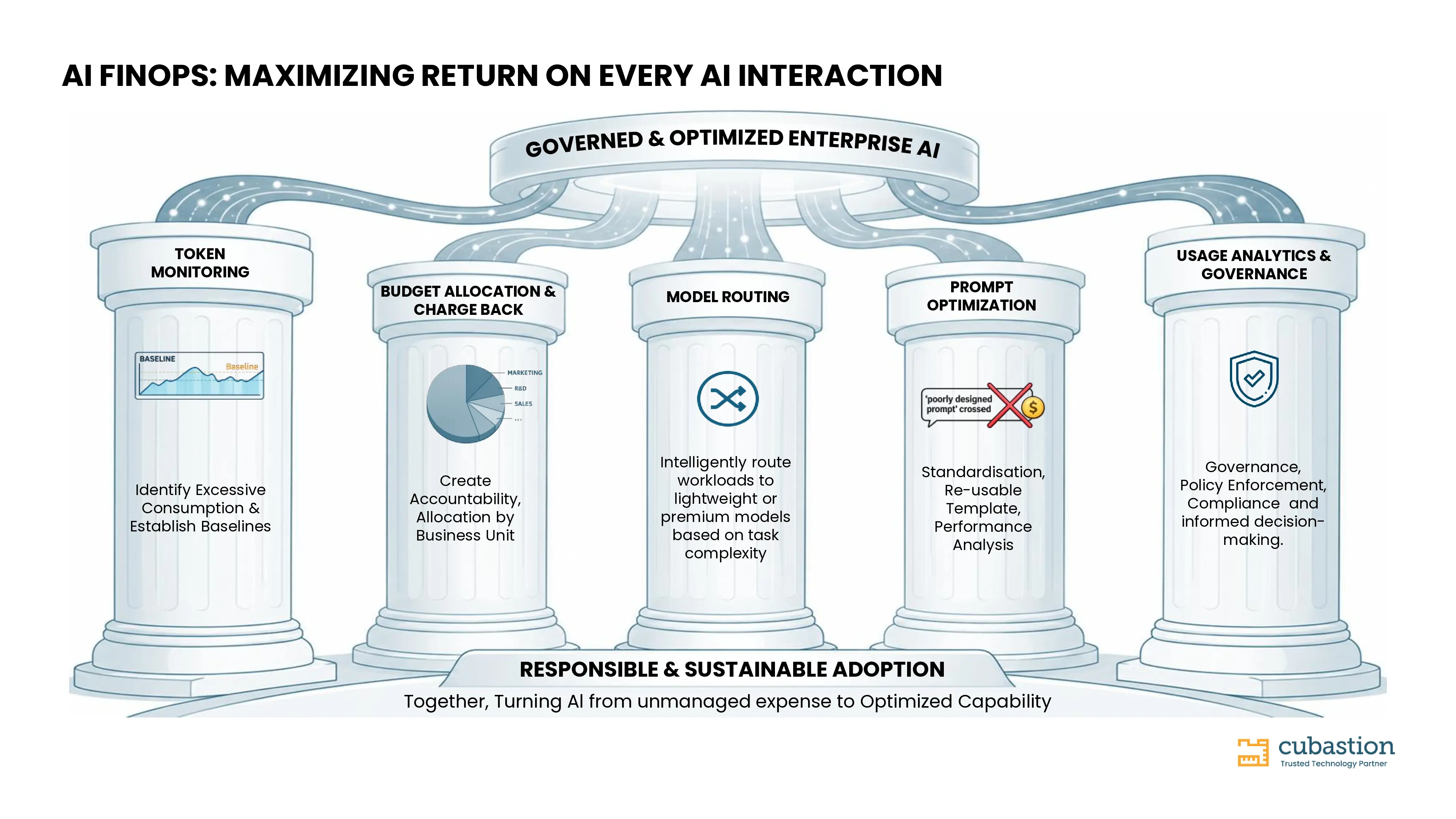
4. The Five Pillars of Enterprise AI FinOps
AI FinOps is a governance framework, not just an expense tracker. Five capabilities are essential:
1. Token Monitoring - Tokens are the fundamental unit of AI cost. Monitoring usage across departments, applications, users, and models helps identify excessive consumption and establish baselines for planning.
2. Budget Allocation & Chargeback - As adoption expands, centralized budgets become hard to manage. AI FinOps enables allocation by business unit, department, or project, with transparent chargeback and showback that create accountability.
3. Intelligent Model Routing - Not every request needs the most expensive model. AI FinOps routes requests by complexity, quality, latency, and cost-sending routine work to lightweight models and complex reasoning to premium ones.
4. Prompt Optimization - Poorly designed prompts waste tokens, slow responses, and produce inconsistent output. AI FinOps promotes standardization, reusable templates, retrieval-based context management, and performance analysis.
5. Usage Analytics & Governance - Managing AI requires understanding value, not just cost. Dashboards track adoption, usage patterns, model performance, and outcomes-supporting governance, policy enforcement, and compliance.
Together, these pillars turn AI from an unmanaged expense into a measurable, governed, continuously optimized capability-maximizing return on every AI interaction while ensuring responsible, sustainable adoption.

5. Cubastion Approach: An Architecture Built to Close the Visibility Gap
Enterprises typically can't answer basic questions about their own AI usage - which models are running, how many tokens are consumed, or which departments drive the highest costs - because consumption is scattered across models, teams, and tools with no common layer connecting them. Cubastion closes this gap at the architecture level: instead of adding another dashboard on top of the chaos, we insert one governed layer between every application and every model. Visibility, cost control, and governance stop being reports generated after the fact and become properties built into how each request is handled.
The architecture works as a single request pipeline, where every AI call passes through six connected layers in sequence:
- Ingestion Layer (Gateway) - Every request, regardless of source application or target model, enters through a central gateway before it ever reaches a model provider. It's tagged with user, department, and application metadata at the point of origin - so consumption is attributable from the first call, not reconstructed later from provider invoices.
- Routing Layer - The gateway scores the request for complexity and sends it to the right model tier: lightweight models for simple tasks, premium models for complex reasoning - with latency thresholds and fallback logic applied automatically, removing the need for manual model selection.
- Policy Enforcement Layer - In that same pass, the request is checked against governance rules - approved-model lists, role-based access, data-sensitivity restrictions - before it's allowed through. Violations are blocked and logged at this layer, not uncovered weeks later in an audit.
- Metering Layer - Once the request completes, token usage and cost post immediately against the originating department's budget, with alerts firing automatically at 70%, 90%, and 100% of the ceiling before spending becomes a surprise.
- Optimization Layer - Running continuously alongside the pipeline, this layer mines usage data for high-cost or repetitive prompts, rebuilds them into standardized templates, and applies semantic caching so repeat queries are served without reprocessing tokens.
- Reporting Layer - Consumption, routing decisions, policy events, and budget status from every layer above converge into a single live dashboard - giving leadership one unified view of cost and business value, instead of piecing it together from six disconnected tools.
This is the foundation that makes the rest possible - once visibility, routing, and governance are built into the architecture itself, organizations can finally shift their attention from managing AI chaos to shaping what AI FinOps makes possible next.

6. The Future of Enterprise AI Will Be Measured, Governed, and Optimized
Enterprise AI is entering a new phase. The conversation is no longer about which model is most capable or which application can be deployed fastest. Organizations are now asking more strategic questions:
- How do we govern AI usage across the enterprise?
- How do we ensure AI investments deliver measurable value?
- How do we control costs without limiting innovation?
- How do we scale AI responsibly across business functions?
These questions mark AI's evolution from experimentation to operational maturity.
Just as FinOps brought financial accountability to cloud computing, AI FinOps is emerging as the discipline that brings visibility, governance, and optimization to enterprise AI-helping organizations move beyond isolated deployments toward a sustainable operating model where every interaction is measurable, and every investment aligns with business outcomes.
The enterprises that succeed with AI over the next decade won't necessarily be those running the largest number of models. They will be the ones that continuously optimize consumption, govern usage, and adapt intelligently as technology evolves.
At Cubastion, we believe AI FinOps is more than a cost-optimization practice-it is the foundation for responsible, scalable, business-driven AI adoption, transforming AI from an experimental technology into a trusted enterprise capability.
The future of enterprise AI won't be defined by how much AI an organization uses-it will be defined by how effectively it governs, measures, and optimizes it.