


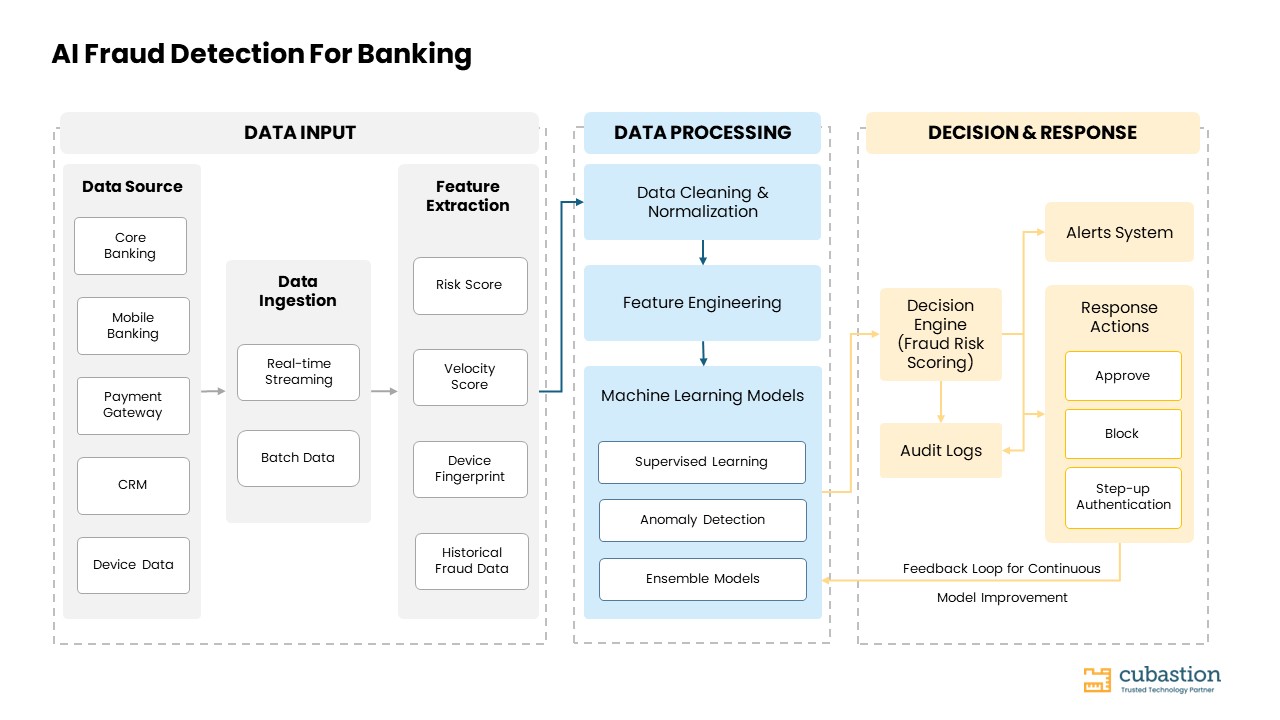

1. The Rising Cost of Banking Fraud in a Real-Time Data Economy
Banking has entered a real-time era. In 2023, global payment fraud losses exceeded $48 billion (Nilson Report). At the same time, India processed over 100 billion UPI transactions annually (NPCI), while instant payment systems expanded rapidly across the US, Middle East, and Asia.
Digital transformation has made banking frictionless - but it has also made fraud instantaneous.
Fraudsters now exploit gaps in streaming Data, system latency, and weak Data governance, operating in milliseconds. This is why AI Fraud Detection for Banking is no longer optional - it is foundational.
Modern fraud prevention is not about reviewing alerts after transactions settle. It is about converting live transactional Data into real-time Data Decisions before funds leave an account.
IBM’s banking research highlights that AI-powered systems analyse massive volumes of transaction Data to detect patterns and anomalies that static rules and human review often miss.
However, AI alone does not solve fraud.
Effective fraud prevention requires:
· Enterprise-grade Data architecture
· Structured Data strategy
· Strong Data governance
· Scalable AI implementation
· Strategic IT Consulting
Without these foundations, AI generates unreliable Data Decisions instead of secure ones.
2. Why Traditional Rule-Based Fraud Systems Fail Modern Banking
Traditional fraud detection systems in banking rely on predefined rules - flagging transactions above certain thresholds, blocking international transfers, or triggering alerts for rapid repeat activity. While these controls once worked, fraud now evolves faster than static rules can adapt. According to the Association of Certified Fraud Examiners (ACFE), organizations lose approximately 5% of annual revenue to fraud, highlighting the scale of the challenge. Rule-based systems also generate high false positives, frustrating customers and reducing operational efficiency. Modern AI Fraud Detection for Banking replaces rigid logic with adaptive models that analyse behavioural Data patterns, device fingerprints, geolocation signals, transaction velocity, and historical risk indicators. However, deploying AI is not just about installing algorithms. It requires strong foundations to ensure accurate and reliable Data Decisions.
For AI-driven fraud detection to succeed, banks must ensure:
· Structured Data ingestion to capture transaction Data in real time
· Clean and labelled Data to train accurate fraud detection models
· Real-time streaming Data architecture to enable instant Data Decisions
· Strong IT Consulting to align AI systems with compliance, governance, and risk frameworks
Banks do not struggle because they lack AI tools. They struggle because they lack disciplined Data strategy and strategic IT Consulting to convert AI capabilities into consistent, explainable, and secure Data Decisions.
3. How AI Fraud Detection Turns Banking Data into Intelligent Data Decisions
At its core, AI Fraud Detection for Banking transforms raw transactional Data into high-confidence, real-time Data Decisions within milliseconds. Instead of relying on static thresholds, AI models continuously evaluate multiple behavioural and contextual signals across large volumes of streaming Data. These systems analyse transaction patterns, device behaviour, login anomalies, velocity indicators, cross-border activity, risk scores, and historical fraud Data to identify suspicious activity before funds are released. Machine learning improves over time by learning from new Data inputs, making fraud detection increasingly precise and adaptive.
Unlike traditional systems, AI-driven models:
· Adapt dynamically to evolving fraud patterns
· Detect hidden relationships across accounts using relational Data
· Identify fraud rings and coordinated attacks
· Reduce false positives to improve customer experience
· Deliver instant, risk-based Data Decisions
However, the effectiveness of AI depends heavily on Data quality. Gartner estimates that poor Data quality costs organizations an average of $12.9 million annually, underscoring the financial risk of weak Data foundations. For AI Fraud Detection for Banking to succeed, institutions must invest in:
· Robust Data governance frameworks
· Scalable Data architecture that supports real-time processing
· Continuous model monitoring and performance evaluation
· Advanced IT Consulting to align AI implementation with compliance and operational standards
AI without structured Data produces unreliable Data Decisions. AI supported by disciplined Data strategy and strong IT Consulting produces measurable business impact.
Key Use Cases of AI Fraud Detection for Banking
AI Fraud Detection for Banking enables multiple high-impact use cases across financial institutions:
1. Real-Time Transaction Monitoring
Streaming Data is analysed before authorization, enabling immediate fraud-blocking Data Decisions.
2. Credit Card Fraud Detection
Behavioural analytics assess customer spending Data patterns to detect anomalies.
3. Account Takeover Prevention
Login Data, device Data, and behavioural biometrics identify suspicious access attempts.
4. Anti-Money Laundering (AML)
AI detects complex transaction networks through advanced relational Data analysis.
5. Loan and Credit Application Fraud
Application Data, financial history, and risk indicators are evaluated for inconsistencies.
6. Insider Threat Detection
Internal system access Data and behavioural monitoring reduce operational risk.
7. Cross-Border Payment Risk Analysis
Geographic and transactional Data patterns are evaluated in real time to generate risk-based Data Decisions.
Each of these use cases depends on:
· Clean and reliable Data
· Secure and scalable Data architecture
· Strong Data governance
· Accurate, explainable Data Decisions
· Strategic IT Consulting to operationalize AI at scale
Without these foundations, fraud detection systems cannot scale securely or sustainably.
4. The Technology Stack That Powers AI Fraud Detection for Banking
AI Fraud Detection for Banking is powered by a layered, performance-optimized technology ecosystem. It combines real-time Data ingestion, machine learning intelligence, explainability tools, and secure infrastructure to generate accurate Data Decisions within milliseconds.
Recent research in real-time payment fraud detection demonstrates that well-designed machine learning frameworks can achieve 92% accuracy, 0.89 F1-score, and 0.94 AUC-ROC, with model training completed in under 1.2 seconds - proving that fraud detection systems can be both lightweight and highly effective in live FinTech environments.
A modern fraud detection technology stack typically consists of the following core layers:
1. Real-Time Data Ingestion & Streaming Layer
Fraud detection begins with capturing transactional Data before authorization.
Common technologies include:
· Apache Kafka
· Apache Flink
· Spark Streaming
· Event-driven microservices
These systems enable continuous ingestion and processing of Data points such as:
· Transaction amount
· Device type
· Velocity score
· Risk score
· Historical fraud indicators
Real-time streaming ensures fraud models can evaluate Data instantly and generate proactive Data Decisions before funds are released.

Figure: Real-time Data streaming performance showing decreasing latency as transaction processing throughput scales.
2. Feature Engineering & Data Preparation Layer
High-performing fraud systems depend heavily on structured Data preparation.
Key processes include:
· Cleaning and normalizing transactional Data
· Handling missing or duplicate records
· Encoding categorical variables
· Transforming behavioural signals into model-ready features
Proper feature engineering improves fraud detection sensitivity while maintaining computational efficiency. Clean, structured Data directly improves the quality of Data Decisions.

Figure: Improved Data quality directly increases model accuracy in AI Fraud Detection for Banking.
3. Machine Learning & Model Intelligence Layer
At the core of AI Fraud Detection for Banking lies machine learning.
Lightweight ensemble models such as Random Forest have demonstrated strong performance in fraud classification due to:
· High interpretability
· Resistance to overfitting
· Fast training cycles
· Balanced precision-recall performance
Research shows that predictive features such as:
· Risk score
· Velocity score
· Past fraud history
· Device type
· Transaction category
play a decisive role in distinguishing fraudulent from legitimate transactions.

Figure: Feature importance analysis showing risk score and velocity score as primary drivers of fraud-related Data Decisions.
More advanced enterprise implementations may also use:
· Gradient Boosting (XGBoost, LightGBM)
· Neural Networks
· Graph Neural Networks for fraud ring detection
· Anomaly Detection models
These systems transform transactional Data into risk-based Data Decisions in real time.
4. Evaluation & Model Governance Layer
Fraud detection systems must be measurable, reliable, and auditable.
High-performing models are evaluated using:
· Accuracy metrics
· F1-score (precision-recall balance)
· AUC-ROC for discrimination capability
· Confusion matrix analysis for false positive/negative control
Strong evaluation ensures that fraud-related Data Decisions remain stable across varying transaction patterns and volumes.
Enterprise-grade systems also include:
· Model performance dashboards
· Drift detection mechanisms
· Threshold optimization tools
· Continuous retraining pipelines
This governance layer protects the integrity of Data Decisions over time.

Figure: ROC Curve illustrating high discriminatory power (AUC ≈ 0.94) of the AI Fraud Detection model in real-time banking environments.
5. Explainable AI & Transparency Layer
Financial institutions operate under strict regulatory scrutiny.
Explainability tools such as:
· SHAP
· LIME
· Feature importance visualizations
ensure that fraud-related Data Decisions can be interpreted and justified.
Transparent AI systems build regulatory confidence, improve compliance readiness, and support internal risk management.

Figure: Explainable AI contribution weights highlighting transparent drivers of fraud-related Data Decisions.
6. Security, Compliance & Deployment Infrastructure
Fraud detection systems must operate in secure, scalable environments.
Infrastructure components typically include:
· Cloud or hybrid deployments
· Encrypted Data pipelines
· Role-based access controls
· PCI-DSS compliance frameworks
· GDPR-aligned Data governance

Figure: Security and compliance coverage framework supporting enterprise-grade AI Fraud Detection for Banking.
Fraud systems must protect sensitive Data while enabling intelligent, real-time Data Decisions.
The Strategic Insight
Technology alone does not deliver fraud resilience.
The true impact of AI Fraud Detection for Banking emerges when:
· Data architecture is scalable
· Data governance is disciplined
· Model evaluation is continuous
· Security frameworks are embedded
· IT Consulting aligns technology with business and compliance goals
Well-architected systems can achieve high accuracy, fast training cycles, and interpretable results - making AI-driven fraud detection both practical and enterprise-ready.

5. The Strategic Role of IT Consulting in AI Fraud Detection for Banking
AI Fraud Detection for Banking is not just a technology upgrade.
It is a strategic digital transformation initiative.
According to PwC, AI could contribute $15.7 trillion to the global economy by 2030, but only organizations with strong Data strategy will capture value.
Effective IT Consulting ensures:
- End-to-end Data governance
- Structured Data architecture
- AI implementation aligned with risk frameworks
- Seamless integration with core banking and CRM systems
- Continuous optimization of Data Decisions
Poor Data Decisions create:
- Regulatory fines
- Customer dissatisfaction
- Financial losses
- Reputational damage
Strong IT Consulting transforms AI into operational capability.
It ensures:
- Clean Data
- Secure environments
- Reliable Data Decisions
- Scalable enterprise AI systems
Without IT Consulting, AI remains experimental.
With IT Consulting, AI becomes enterprise-ready infrastructure.
6. How Cubastion Helps Banks Turn Data into Smarter Fraud Prevention Decisions
Cubastion is a specialized IT Consulting and CRM-focused consultancy serving Financial Services, Automotive, Communication, Consumer Durable, and Telematics industries across India, the US, the Middle East, and Japan. Our approach to AI Fraud Detection for Banking goes beyond implementing algorithms. We focus on building scalable Data foundations, integrating fraud intelligence with CRM ecosystems, and enabling secure, real-time Data Decisions that align with enterprise digital transformation goals. We understand that effective fraud prevention requires a combination of advanced technology, structured Data governance, and strategic IT Consulting to ensure long-term resilience, compliance, and measurable business impact.
Our approach to AI Fraud Detection for Banking includes:
· Designing scalable Data architecture that supports real-time transaction processing
· Implementing structured Data governance frameworks for quality, compliance, and transparency
· Integrating CRM systems with fraud intelligence for unified customer risk visibility
· Enabling real-time, explainable Data Decisions across banking workflows
· Delivering secure and compliant AI implementation
· Aligning fraud prevention initiatives with broader digital transformation strategies
At Cubastion, we recognize that fraud prevention is not just about technology. It is about aligning enterprise Data strategy with operational execution. This requires:
· Structuring enterprise-wide Data strategy
· Optimizing operational workflows
· Enabling transparent and explainable Data Decisions
· Ensuring regulatory compliance and scalability
· Driving measurable ROI through strategic IT Consulting
Through disciplined IT Consulting, Cubastion enables banks to convert raw Data into reliable, explainable, and secure Data Decisions — transforming fraud detection into a scalable competitive advantage.
7. Final Thought
The future of banking will not be defined by transaction speed alone.
It will be defined by the quality of Data, the intelligence of Data Decisions, and the strategic strength of IT Consulting guiding AI implementation.
AI Fraud Detection for Banking is no longer optional.
It is mission-critical infrastructure.
If your organization is exploring enterprise AI, advanced Data strategy, or scalable fraud prevention systems, Cubastion can help you architect secure, intelligent, and future-ready banking ecosystems.