



Governments worldwide are undergoing rapid digital transformation. Tax administration, procurement, welfare programs, infrastructure, and public finance now run on digital platforms that generate enormous volumes of data daily. This shift has improved service delivery, but it has also made government auditing far more complex.
Supreme Audit Institutions (SAIs) and internal audit bodies are no longer reviewing thousands of transactions - they must now oversee millions of digital records across departments and systems. Traditional audit methods built on manual reviews and sampling simply can't keep pace.
The OECD notes that government spending exceeds 40% of GDP across member countries, while the World Bank estimates public procurement alone accounts for 12-20% of GDP. These numbers underscore how vast and complex public expenditure has become - and why smarter audit mechanisms are urgently needed.
The challenge today isn't just verifying compliance after money is spent. Governments must identify risks earlier, detect fraud before losses occur, and give citizens confidence that public funds are managed responsibly.
Artificial Intelligence is emerging as a key enabler of this shift. Rather than replacing auditors, AI helps them analyse larger datasets, uncover hidden patterns, prioritize high-risk transactions, and generate insights manual analysis could never achieve. Institutions like India's Controller and Auditor General (CAG), the U.S. Government Accountability Office (GAO), and several OECD members are already exploring AI to modernize audit practice. The future of government auditing will be defined by continuous monitoring, early risk detection, and data-driven assurance.

1. The New Era of Government Accountability
Governments now operate in one of the most data-intensive environments in the world, processing millions of transactions daily across taxation, welfare, healthcare, infrastructure, customs, and procurement.
This has transformed expectations for auditors. Historically, audits happened periodically - often months after activity occurred - based on sampled transactions and historical evidence. That model is increasingly inadequate for today's high-volume, real-time government operations.
Citizens and oversight bodies now expect greater transparency, reduced financial leakage, and measurable outcomes from public spending. India's CAG has responded by naming AI a key enabler for the future of auditing, with its AI Strategy Framework focused on better risk identification, automation of repetitive tasks, and evidence-based decisions - while preserving auditor independence and judgment.
This marks a shift in the auditor's role: from reviewer of historical transactions to strategic advisor using advanced analytics to flag systemic risk early.
2. The Growing Challenges in Government Auditing
Despite digitized financial operations, audit methodology has lagged. Many organizations still depend on manual document checks, spreadsheets, and sampling - approaches straining under today's data volumes. Key challenges include:
- Explosive transaction growth that makes full manual review impractical
- Sampling-based audits that risk missing irregularities outside the sample
- Fragmented data spread across procurement, ERP, tax, and payment systems
- Delayed risk identification, since most audits happen after the fact
- Growing regulatory complexity, including ESG and cybersecurity requirements
- Limited audit capacity relative to expanding public expenditure

As per report on AI in Government Audit notes, public sector organizations are moving from isolated AI pilots toward enterprise-scale adoption enabling continuous monitoring and faster decisions. The question is no longer whether to modernize, but how fast.
3. The Rise of AI-Powered Government Auditing
AI is turning government auditing from a retrospective compliance exercise into a proactive, intelligence-driven function - enhancing, not replacing, auditors' ability to analyse data and flag anomalies for investigation.

CAG's AI Strategy Framework identifies applications across planning, evidence collection, risk assessment, and reporting - with emphasis on governance and explainability. The GAO's AI Accountability Framework similarly pushes for AI systems that are transparent, reliable, and governed throughout their lifecycle. The result: audit institutions can detect risk earlier and deliver continuous assurance rather than after-the-fact findings.
4. How AI Transforms the Audit Lifecycle - and the Technologies Behind It
AI embeds intelligence across every audit stage, letting auditors focus on high-risk areas while improving coverage and speed:
- Planning & Risk Assessment - prioritizes departments and programs by historical risk and spending patterns
- Data Integration & Validation - unifies data from ERP, procurement, tax, and payment systems
- Continuous Transaction Monitoring - scans 100% of transactions for anomalies in real time
- Evidence Analysis - validates contracts and invoices using machine learning and document intelligence
- Report Generation & Decision Support - drafts summaries and observations while keeping decisions human-controlled
- Continuous Compliance Monitoring - tracks regulatory adherence year-round, not just at audit time

This lifecycle runs on multiple technologies working together, each strengthening a different stage:
- Machine Learning - flags spending anomalies and unusual patterns
- Natural Language Processing - extracts insight from contracts, reports, and regulations
- Generative AI - drafts summaries, reports, and audit query responses
- Graph Analytics - uncovers hidden relationships between suppliers and beneficiaries, revealing collusion
- Computer Vision - digitizes and validates scanned invoices and receipts
- Explainable AI (XAI) - makes AI recommendations transparent and verifiable
5. Building Transparent, Explainable, and Measurable Public Auditing
AI-assisted audits must remain accurate, transparent, and legally defensible. Every recommendation needs supporting evidence and human review. Core principles include:
- Explainable AI - clarifies why a transaction is flagged as high-risk
- Human-in-the-Loop Validation - auditors approve all critical findings
- Complete Audit Trail - records every AI recommendation and data source
- AI Governance & Compliance - aligns systems with regulations and ethical standards
- Bias Detection & Model Monitoring - ensures fairness and consistency
- Citizen Trust & Transparency - makes AI-assisted decisions understandable to the public
Success should be measured by audit quality and public trust, not just automation. Organizations can track this impact through:
- Increased audit coverage - full datasets instead of samples
- Reduced audit cycle time - automated evidence review and reporting
- Improved fraud detection - earlier identification through continuous monitoring
- Higher auditor productivity - less time on repetitive verification
- Stronger regulatory compliance - continuous monitoring of standards
- Greater public trust - transparent, explainable findings
6. Global Momentum Towards AI-Enabled Government Auditing
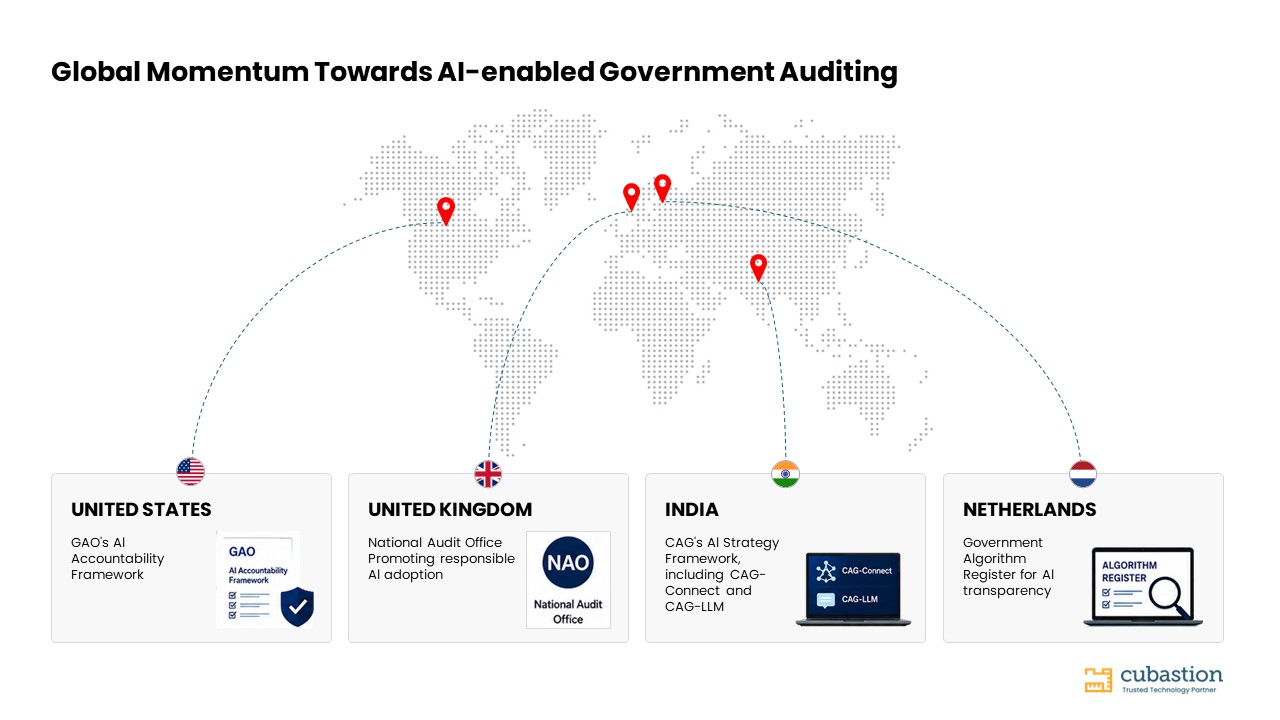
AI is becoming a strategic capability for public oversight worldwide, with governments now building governance frameworks and integrating AI into financial systems:
- India - CAG's AI Strategy Framework, including CAG-Connect and CAG-LLM
- United States - GAO's AI Accountability Framework
- United Kingdom - National Audit Office promoting responsible AI adoption
- Netherlands - Government Algorithm Register for AI transparency
- OECD & INTOSAI - developing global best practices for trustworthy audit AI

7. How Cubastion Reimagines the Future of Government Auditing
As governments embrace digital transformation, auditing must evolve beyond periodic compliance reviews into an intelligent, continuous assurance function. Modern auditors are expected to analyze millions of financial transactions, identify emerging risks in real time, strengthen regulatory compliance, and provide actionable insights that support better governance. Meeting these expectations requires more than automation - it demands an AI-driven platform capable of continuously learning, analyzing, and adapting to an ever-changing financial ecosystem.
Cubastion envisions an AI Audit Intelligence Platform that combines Machine Learning, Natural Language Processing (NLP), Graph Analytics, Generative AI, Explainable AI (XAI), and predictive analytics to create a unified decision-support ecosystem for government auditors. Instead of automating isolated audit tasks, the platform continuously ingests data from ERP systems, procurement portals, financial management systems, tax platforms, contracts, invoices, and audit repositories, transforming fragmented information into real-time audit intelligence.
Using advanced AI models, the platform continuously answers six critical questions throughout the audit lifecycle:
1. Where Should We Audit First?
Machine learning models continuously evaluate historical audit findings, financial transactions, expenditure trends, and operational risks to dynamically prioritize ministries, departments, projects, and public programs that require immediate audit attention.
2. What Doesn't Look Right?
AI-powered anomaly detection and graph analytics identify duplicate payments, procurement irregularities, shell vendors, conflicts of interest, hidden beneficiary relationships, and unusual financial patterns that traditional rule-based systems often fail to detect.
3. Is There Enough Evidence?
Natural Language Processing and document intelligence automatically extract, classify, and correlate information from contracts, invoices, regulations, audit reports, and supporting documents, allowing auditors to validate evidence faster while maintaining complete traceability.
4. What Could Go Wrong Next?
Predictive analytics continuously forecasts emerging financial, operational, and compliance risks by analyzing historical trends, spending behaviour, and policy deviations, enabling proactive audit planning before issues escalate.
5. Are We Continuously Compliant?
The platform continuously compares financial transactions against procurement rules, government policies, regulatory frameworks, and audit standards to automatically identify compliance gaps, policy violations, and control weaknesses in near real time.
6. What Should Leadership Know Right Now?
Generative AI and executive analytics transform complex audit findings into interactive dashboards, AI-generated summaries, risk heat maps, expenditure trends, compliance indicators, and decision-ready recommendations that support faster and more informed leadership decisions.
To ensure trust and accountability, every AI-generated recommendation is supported by Explainable AI (XAI), enabling auditors to understand the reasoning behind risk scores, anomaly detection, and compliance observations. Human reviewers remain in control of every critical decision, ensuring that AI augments professional judgment rather than replacing it.

By integrating intelligent automation, continuous monitoring, explainable AI, and advanced analytics into a single platform, Cubastion envisions a future where government audits become continuous, predictive, transparent, and evidence driven. Rather than simply identifying issues after public funds have been spent, audit institutions can proactively safeguard public resources, improve governance, accelerate decision-making, and strengthen citizen trust through intelligent, technology-enabled oversight.
8. The Future of AI-Powered Government Auditing
Government auditing is moving from retrospective verification toward continuous, intelligent assurance. Future audit ecosystems are expected to include continuous AI-assisted auditing, autonomous audit assistants, predictive expenditure analytics, AI-powered policy impact evaluation, digital twins for public finance, and deeper human-AI collaboration on high-value investigations. The goal isn't to replace auditors, but to equip them with tools that sharpen decision-making and maximize the value of every public investment.
Conclusion
Public sector auditing is entering an era where data, AI, and human expertise work together to strengthen accountability and transparency. Traditional methods alone can no longer keep up with the scale of modern government operations.
AI allows governments to move beyond retrospective review toward continuous monitoring, proactive fraud detection, and evidence-based decisions. Paired with responsible governance, explainability, and strong human oversight, these capabilities can meaningfully improve audit efficiency and effectiveness.
As countries invest further in digital infrastructure and AI-enabled governance, the future of auditing will be smarter, faster, transparent, and citizen-centric - helping governments safeguard public funds while building more resilient, trustworthy institutions.
Want to know more or have any questions? Contact us here