



Discover why AI recommendations work best with human oversight and how enterprises use this balance to improve CX, governance, and outcomes.
AI recommendations are no longer optional tools, they’re strategic assets shaping enterprise outcomes in sales, operations, marketing, and customer experience. But simply deploying AI isn’t enough. To drive measurable value like higher revenue, faster decision cycles, or better customer satisfaction, organizations must combine the speed of AI with the context, creativity, and oversight of human judgment.
This article explains why blending AI recommendations with human expertise matters, how it works in practice, and where proven success is already happening. The goal is not just to inform, but to equip business leaders with a framework to turn AI recommendations into real business impact.
What Are AI Recommendations and Why Enterprises Are Rethinking Them
AI recommendations are suggestions generated by machine learning and advanced analytics based on patterns in data. Examples include:
- Suggested products for customers
- Prioritized sales leads
- Predictive alerts for equipment maintenance
- Personalized content or offers
While AI excels at processing scale and pattern recognition, it lacks domain context, ethical reasoning, and alignment with strategic goals. That’s why forward-thinking enterprises treat AI recommendations as decision support rather than decision authority.
The real value comes when organizations align AI insights with human expertise to make better decisions faster
Where AI Recommendations Drive Value and Where Humans are Essential
AI is outstanding when large data sets are involved:
- Automating repetitive analysis
- Detecting hidden patterns
- Scaling personalization
But human judgment remains essential in scenarios like:
- Interpreting ambiguous or incomplete data
- Balancing ethical considerations
- Applying industry insight to strategic decisions
In practice, AI predicts and prioritizes, humans validate and decide. This shared responsibility builds trust and reduces operational risk.
The Risk of Blind Trust in AI Recommendations
Treating AI recommendations as automatic truths leads to predictable problems:
- Bias amplification: Models can replicate historical inequities
- Context blind spots: Algorithms miss industry nuance
- Delegation fallacy: Teams stop questioning flawed outputs
For enterprises governed by compliance, customer trust, and brand reputation, unchecked AI is not just ineffective, it can be dangerous. This is why governance frameworks that keep humans in control are critical.
Designing Human-in-the-Loop AI Recommendation Systems
A growing best practice across mature AI programs is Human-in-the-Loop (HITL) design.
In this approach, AI recommendations are integrated into workflows where humans:
- Review and validate critical decisions
- Override AI outputs when context demands it
- Provide feedback that continuously improves the model
Human-in-the-loop systems transform AI recommendations from static outputs into learning systems. Every correction, override, or confirmation becomes a data point that strengthens future performance.
For enterprises, this design is essential not just for accuracy, but for governance, compliance, and long-term scalability.
Real-World Use Case: Salesforce Einstein in Action
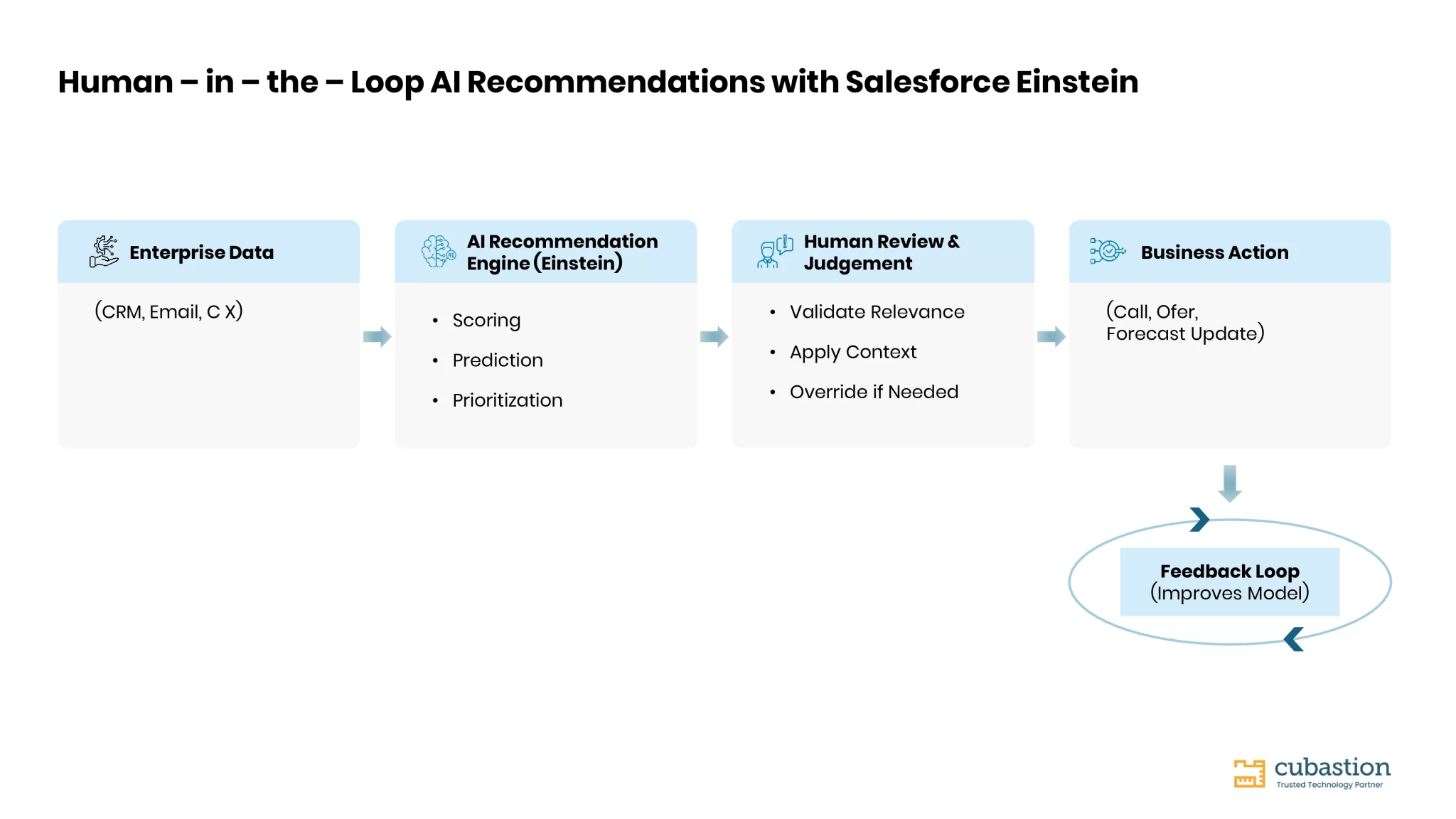
The flow below illustrates how Salesforce Einstein operationalizes AI recommendations within an enterprise sales environment. Customer and CRM data feed the AI recommendation engine, which surfaces predictive insights such as lead priority, deal risk, and next-best actions. These recommendations are then reviewed by sales teams and leaders, who apply contextual judgment before acting. Each decision whether accepted, modified, or overridden, feeds back into the system, continuously improving recommendation quality. This closed-loop model ensures AI accelerates execution while human judgment retains control, creating a scalable and governable approach to improving both customer experience and revenue outcomes.

How to Operationalize Blended Intelligence
To unlock real business impact from AI recommendations:
· Define clear decision ownership: AI suggests, but humans decide who is accountable.
· Measure outcomes, not outputs: Track metrics like conversion lift, time saved, error reduction.
· Build feedback loops: Every human correction should loop back to improve models.
· Invest in governance and explainability: Stakeholders need confidence in how and why recommendations are made.
This approach aligns AI with enterprise risk management, compliance, and long-term strategic goals, making recommendations actionable and safe.
At Cubastion, we see the strongest CX outcomes when AI recommendations are aligned with business strategy, customer expectations, and operational reality, not deployed in isolation.
CX & Revenue Takeaway
When AI recommendations are embedded into customer-facing workflows with human oversight, enterprises unlock measurable CX and revenue gains. Platforms like Salesforce Einstein show that the real advantage is not automation alone, but better prioritization, faster decisions, and more consistent customer experiences at scale. By keeping humans accountable for final decisions while using AI to surface risk, opportunity, and next-best actions, organizations improve conversion rates, protect high-value relationships, and build customer trust without increasing operational complexity.
“AI recommendations deliver real CX and revenue impact when they accelerate human decisions, enabling faster action, better prioritization, and trusted outcomes at scale.”
The Future of AI Recommendations
The goal is not to remove humans from decisions but to augment human capability with AI insights. Businesses that adopt blended intelligence systems outperform those that rely solely on either machines or intuition.
Blending AI recommendations with human judgment isn’t just better practice it’s strategic competitive advantage.