



When reacting faster is no longer enough
In the previous article, When Customer Experience Stops Working — Even When Everything Looks Right, we explored why many CX environments struggle even after modernization. Organizations have invested heavily in CRM systems, automation platforms, and digital engagement tools, yet customer experiences often remain reactive.
The challenge is not simply technological capability. It is architectural design.
Traditional CX systems were built to process requests. Modern customer environments require systems capable of understanding signals, interpreting context, and initiating actions.
This is where Agentic AI begins to reshape how organizations design customer experience platforms. But autonomy in enterprise systems cannot exist without structure. To operate safely and effectively, intelligent CX systems must be designed with clear guardrails, governance models, and operational transparency.
The architectural shift CX teams must make
The transition from reactive service environments to intelligent CX ecosystems begins with architecture.
In traditional systems, customer service platforms are connected through predefined workflows. Requests move from one system to another until a resolution is reached. This model works for predictable processes but becomes fragile when customer journeys grow more complex.
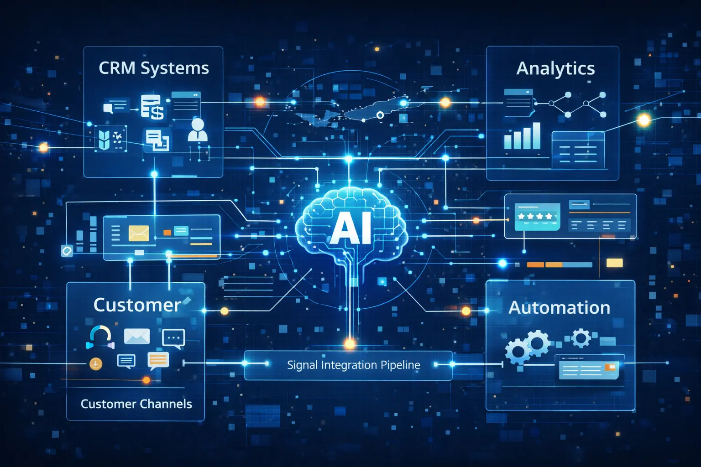
Modern CX environments require systems capable of interpreting signals across multiple platforms.
For example:
- CRM systems capturing customer interaction history
- Operational platforms managing orders and services
- Analytics environments monitoring behavioural signals
- Communication systems supporting omnichannel engagement
Organizations exploring platforms such as Salesforce Experience Cloud: Revolutionizing Digital Engagement have already started building connected digital ecosystems where customers interact across multiple touchpoints.
At the same time, CRM optimization strategies discussed in How Salesforce Consultants Drive Business Growth Through CRM Optimization demonstrate how enterprise platforms can evolve into intelligence hubs rather than static data repositories. The next step is enabling these systems to coordinate actions autonomously.
The risk of autonomy without governance
While autonomous systems offer enormous potential, many organizations hesitate to adopt them fully. The concern is not capability. The concern is control.
Enterprise CX environments operate within strict operational and regulatory boundaries. Intelligent systems must therefore operate responsibly and predictably.
Without governance frameworks, autonomous CX systems may introduce risks such as:
- Inconsistent automated decisions
- Lack of transparency in AI-driven workflows
- Operational disruptions caused by incorrect automation
- Compliance concerns in regulated industries
These challenges are particularly visible when legacy enterprise platforms are involved. Modernization initiatives like Oracle Siebel Modernization Without Business Disruption show how upgrading foundational systems is often a prerequisite for enabling intelligent CX architectures. The goal is not simply to introduce autonomy. The goal is to design autonomy with guardrails.
Designing CX systems that can act intelligently
Organizations implementing Agentic AI successfully follow a design approach that balances intelligence with governance.
At Cubastion, we typically guide enterprises through three foundational design layers.
1. Signal Layer
Customer signals from CRM systems, digital engagement platforms, and operational databases must be unified in real time.
Technologies such as those discussed in Unlocking Real-Time Insights: Why Change Data Capture Is Essential for Modern Enterprises enable organizations to stream operational data continuously, allowing intelligent systems to detect emerging issues early.
2. Decision Layer
AI models interpret signals and determine appropriate actions. These models operate within policy-driven frameworks that define acceptable behaviours and escalation boundaries.
3. Orchestration Layer
Automation engines coordinate actions across enterprise systems. This may include triggering workflows, notifying support teams, or resolving issues automatically.
A similar predictive model is already transforming operational environments. For example, AI-Driven Commerce Operations: Transforming SAP Commerce Reliability with Predictive Insights and AIOps demonstrates how intelligent monitoring systems can detect disruptions and initiate corrective actions before customers are affected.
Applying this orchestration mindset to CX enables organizations to build systems that act intelligently while remaining aligned with business policies.
What well-designed AI-driven CX looks like
When autonomy is implemented with governance, CX environments become significantly more resilient.
| Capability | Traditional CX Systems | Agentic AI CX |
| Decision Context | Limited historical data | Real-time contextual signals |
| Automation Scope | Single tasks | End-to-end workflows |
| Transparency | Manual monitoring | Policy-driven governance |
| Responsiveness | Reactive | Predictive |
These improvements allow organizations to scale customer engagement operations without increasing operational complexity.
The bigger transformation taking shape
As enterprises begin adopting these architectural models, customer experience begins to evolve beyond traditional support structures. Instead of responding to customer issues after they occur, organizations start detecting signals earlier and coordinating actions across systems automatically.
The result is a service environment that feels faster, more consistent, and more personalized. But designing intelligent CX systems is only the beginning. The real challenge lies in turning these architectural concepts into working operational systems inside real organizations. That is the focus of the next article in this series.
In the next chapter, we explore how enterprises can implement Agentic AI in CX through pragmatic pilot programs and controlled experimentation before scaling it across the organization.