


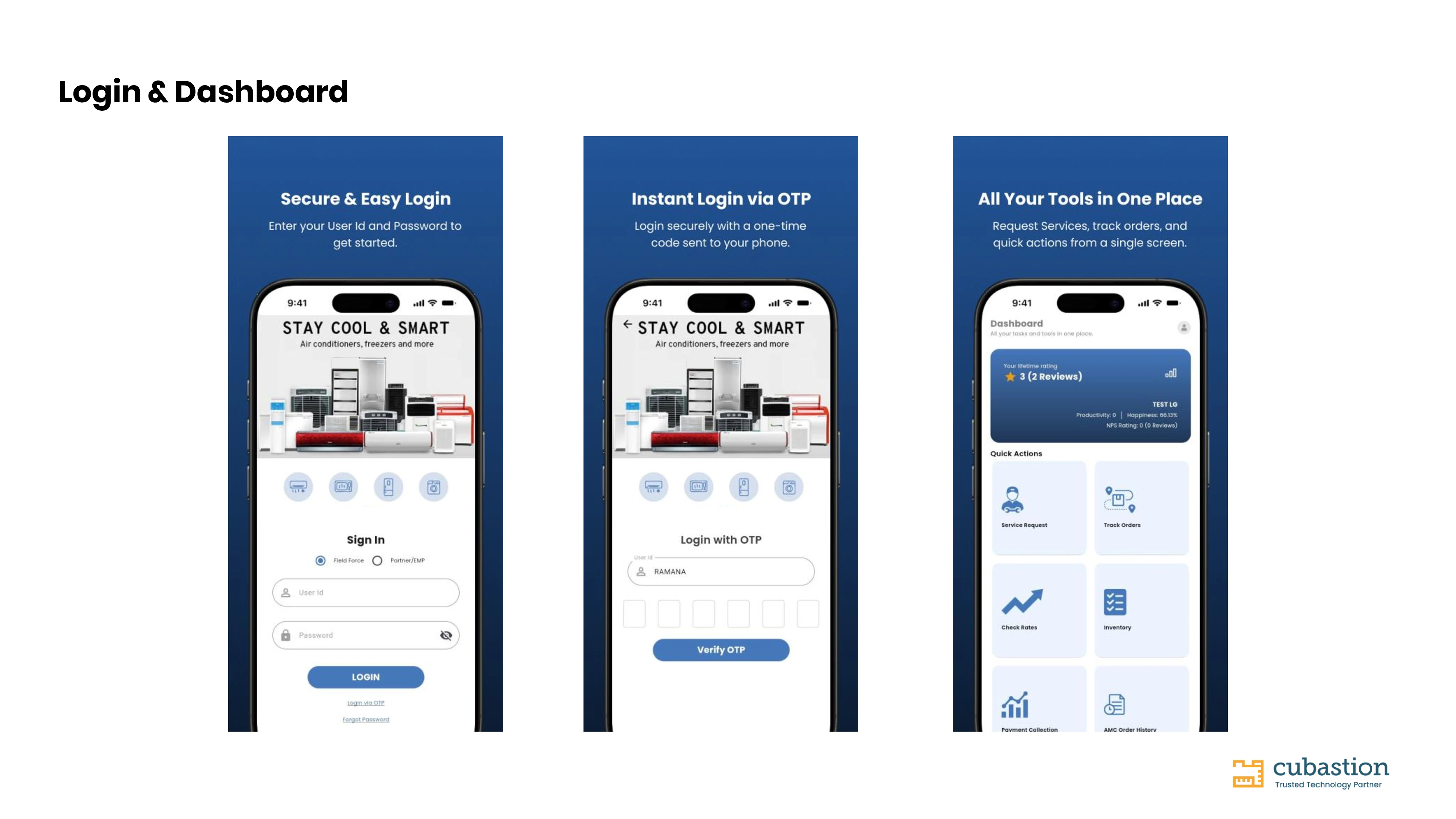

Digitizing Field Service for Consumer Durables
In the consumer durables sector, after-sales service is a critical touchpoint: it shapes customer loyalty, impacts brand reputation, and directly influences repeat business. Yet many organizations still operate field service functions with manual processes—paper forms, delayed reporting, and fragmented workflows—that hamper responsiveness and operational control.
This project set out to replace those legacy practices with a unified mobile application that digitizes the entire field service lifecycle. The objective was clear: move every manual step online so technicians, service franchises, and customers could interact in real time. The result is a single, standardized platform that brings consistency across devices, accelerates service resolution, and introduces operational transparency—from attendance and job assignment to payments and post-service receipts.
The following sections explain what problems the organization faced, how the digital solution addressed them, the new features introduced during migration, and the measurable benefits realized by the enterprise and its customers.

The Legacy Challenges of Manual Field Service Operations
Before digitization, the enterprise relied on manual, paper-driven workflows that slowed down operations and created gaps in service quality. The key challenges included:
• No Real-Time Visibility
- Service updates were shared hours after job completion.
- Service franchises had no live view of technician activity or job status.
- Delays caused inconsistencies between actual work done and reported information.
• Manual Data Entry & Human Error
- Technicians recorded details manually, often forgetting steps or entering incomplete information.
- Photos, notes, and customer details were shared later, leading to inaccuracies.
- Backend teams struggled to reconcile mismatched or missing data.
• Slow Service Request (SR) Closure
- SRs could not be closed instantly because updates were offline or delayed.
- Customers waited longer for confirmation, payment options, and receipts.
- Service centers faced backlog and operational slowdowns.
• Inaccurate Incentive & Travel Calculations
- Incentives were calculated manually, based on subjective inputs.
- Travel distance was self-reported, causing disputes and inconsistencies.
- Technicians lacked visibility into their own earnings and pending payouts.
• No Control Over Technician Movement & Identity
- Multiple logins from the same ID led to proxy attendance.
- No system existed to validate whether the actual technician was performing the job.
- Movement tracking was absent, limiting route optimization and accountability.
• Customer Experience Issues
- Price mismatches occurred due to manual communication of charges.
- Customers lacked transparency in service costs and post-service documentation.
- No platform existed for digital receipts or instant payments.
• Missed Revenue Opportunities
- Technicians had no structured workflow for selling Annual Maintenance Contracts (AMCs).
- Upsell opportunities were frequently lost due to lack of a dedicated module.
The Digital Solution — Building a Unified Field Service Application
To overcome the operational inefficiencies created by manual workflows, the enterprise implemented a unified mobile application designed to digitize the entire field service lifecycle. Rather than functioning as just another app, this platform became the central ecosystem for technicians, service franchises, and backend teams—connecting every step of the service process in real time.
The core philosophy behind the solution was simple: remove all manual steps and replace them with structured, guided, and fully digital workflows. Every action a technician previously performed on paper—reporting, updates, photos, payments, travel logs—was now executed directly through the app, ensuring accuracy and instant visibility.
The app consolidated all technician and service processes into a single interface, enabling consistent user experience across operational teams. From SR assignment to closure, each workflow was digitized to reduce delays, eliminate errors, and maintain transparency. Modules like attendance, travel tracking, AMC sales, and facial authentication were seamlessly integrated to support day-to-day field operations without requiring additional tools or manual intervention.
By becoming the single source of truth for field service data, the application not only improved operational reliability but also empowered the enterprise with real-time insights—leading to faster decision-making, higher productivity, and improved customer satisfaction. This marked a significant shift toward a digitally governed, high-visibility field service environment.
How the Digital App Solved Each Operational Challenge
| Operational Challenge | Previous Problem | Digital Solution Implemented | Outcome / Impact |
| Real-Time Service Updates | Manual data entry, delayed reporting, incomplete details shared with service franchise | Technicians update photos, notes, parts used, and status directly in the app | Real-time visibility, accurate data, zero lag between field and service center |
| Service Request (SR) Closure | SRs not closed instantly; backlog in system; customers waited for confirmation | App enables real-time SR closure with automated workflows | Faster resolution, immediate updates, improved customer experience |
| Pricing & Customer Transparency | Manual price communication led to mismatches and disputes | Automated pricing logic + instant digital receipts inside the app | No pricing errors, higher customer trust, complete transparency |
| Online Payment & E-Receipts | Cash-based or offline payments created follow-up delays | Integrated digital payment options with auto-generated e-receipts | Quick payment collection, instant receipts, smooth checkout for customers |
| Technician Incentive Calculation | Manual tracking resulted in disputes and inaccurate payout | Automated calculation based on SR completion + GPS-based travel | Correct payouts, improved technician morale, complete transparency |
| Travel Expense Tracking | Self-reported distance often inaccurate | GPS tracks actual distance traveled for each job | Accurate reimbursement, no disputes, reliable data |
| Technician Identity Verification | Proxy login, unauthorized usage of technician ID | Facial Recognition login ensures only the real technician logs in | Eliminates proxy attendance, improves field discipline |
| Movement Tracking & Safety | No monitoring of technician travel; over speeding untracked | GPS-based monitoring + overspeed alerts to service franchise | Enhanced technician safety, reduced risk, better governance |
| AMC Selling | No structured way to sell AMCs during visits; revenue lost | AMC module with guided workflow and pricing | Increased AMC sales, informed customer decisions, new revenue stream |
| Customer Documentation | No digital record of work done, only verbal updates or manual slips | App generates digital service summary + receipts | Transparency, customer satisfaction, easy record keeping |
Key Features of the New Mobile Application
The unified mobile application was designed to streamline every stage of the field service lifecycle—from technician assignment to final service closure. Each feature was built to remove manual dependencies, improve accuracy, and enhance transparency for technicians, service franchises, and customers. Below is a clear, professional breakdown of all major features included in the new digital platform.
· Dashboard for Operational Visibility
A centralized dashboard provides technicians and service franchises with a complete snapshot of daily activities, including assigned tasks, pending service requests, earnings, travel distance, and performance metrics. This enables quick decision-making and better planning.
· Enhanced Dashboard (Technician Rating, Happy Score & NPS)
The dashboard displays key performance indicators such as:
o Technician rating
o Customer "Happy Score"
o Net Promoter Score (NPS)
o SR experience feedback
This provides a 360° view of service quality and customer sentiment.
· End-to-End Service Management
Technicians can view, accept, update, and close service requests directly within the app. All details—photos, issue diagnosis, parts replaced, and work notes—are captured digitally and synced in real time.
· Technician Daily Workflow Dashboard
A personalized interface for technicians that displays:
o Assigned SRs
o Job priority
o Customer details
o Planned travel route
o Estimated earnings for the day
This simplifies task management and ensures clarity on daily responsibilities.
· Real-Time Location Monitoring
The app tracks technician movement using GPS and updates the service franchise in real time. This provides:
o Accurate arrival and departure tracking
o Distance-based travel calculation
o Over speeding alerts for safety
o Improved route efficiency
· AMC Sales Module
A dedicated interface enables technicians to explain and sell Annual Maintenance Contracts directly during service visits. It includes:
o Pre-set pricing
o Service terms
o Customer approval flows
o On-the-spot digital processing
This creates an additional revenue stream and enhances customer convenience.
· Travel Expense Automation
Technicians no longer need to manually report distance. The app uses GPS to track and record travel automatically, ensuring transparent and dispute-free expense reimbursement.

· Digital Payment Options
Customers can complete payments instantly through integrated online payment methods. The system also generates e-receipts, ensuring accuracy, transparency, and convenience.
· Automatic SR Closure
When service tasks, notes, and payment steps are completed, the app automatically closes the SR and updates the backend systems in real time—reducing delays and operational backlog.

· Facial Recognition-Based Login
To prevent proxy attendance or unauthorized access, technicians authenticate through a built-in facial recognition feature, ensuring authenticity and eliminating misuse.
· Barcode Scanner Integration
Technicians can scan product barcodes to instantly fetch appliance details, warranty status, and service history.
This reduces manual entry, prevents errors, and speeds up diagnosis.
· Geo-Tagging of Images and Videos
Every photo or video uploaded through the app is automatically geo-tagged.
This ensures:
o Accurate location validation
o Authentic service evidence
o Reliable audit trails for compliance
· Application Walkthrough for First-Time Users
New users receive an interactive walkthrough that explains key features, navigation, and workflows. This reduces onboarding time and ensures technicians start using the app effectively from day one.
· Order & Shipment Tracking
Technicians and service franchises can track the movement of spare parts or shipments directly within the app—ensuring visibility into part availability and delivery timelines.
· Real-Time Estimation & Rate Card
The app includes a live rate card that auto-calculates service charges based on appliance type, part cost, and standard labor rates.
This ensures transparent and consistent pricing at the customer’s doorstep.
· Role-Based Login (RBAC — Role-Based Access Control)
Users log in according to their role—technician, service franchise manager, coordinator, etc.
Each role sees only the relevant modules, ensuring:
o Data security
o Clear workflows
o No information overload
· Assign Unassigned Calls Directly from Mobile App
Service Franchisees can view all unassigned service calls within their designated area directly on the Field Service Mobile Application. They can assign these calls to available technicians without needing to log in to the CRM system on a laptop.
Benefits:
o Faster Response Time: Immediate assignment of calls reduces delays in service delivery.
o Improved Efficiency: Eliminates the need for switching between devices or platforms.
o Enhanced Mobility: Franchisees can manage operations on the go, ensuring flexibility and convenience.
o Better Resource Utilization: Assign calls to the nearest or most available technician quickly.
· Real-Time Technician Tracking
Service franchises can track technicians throughout the day, with visibility into:
o Current location
o Estimated arrival time
o Route taken
o Over speeding or delays
This ensures complete operational transparency and better field governance.
Enterprise-Level Benefits Delivered by the Digital Transformation
The shift from manual processes to a unified digital application brought measurable improvements across operations, customer experience, and internal governance. The following benefits highlight how the digital transformation strengthened the enterprise’s field service ecosystem end-to-end.
Real-Time Operational Visibility
The biggest transformation came from replacing delayed, manual updates with instant, digital information flow.
Service franchises and backend teams can now monitor:
- Live technician location
- Real-time service progress
- Current SR status
- Actual distance traveled
- Daily productivity
This level of visibility was not possible earlier and has significantly improved coordination and planning.
Higher Customer Satisfaction
Transparency and speed in service delivery have increased customer trust. With instant price breakdowns, e-receipts, and real-time updates, customers now have clarity at every step of the service process.
Quick SR closures and digital payments further enhance the experience.
Strong Governance and Accountability
Facial recognition, GPS tracking, and digital workflows have eliminated proxy attendance, inaccurate reporting, and manual manipulation of data.
Every action—from attendance to SR closure—is now tied to the actual technician on the job.
This ensures:
- Accurate reporting
- Better discipline in field operations
- Reliable performance tracking
Enhanced Technician Safety
Over speeding alerts and GPS-based monitoring promote safer travel practices.
Service franchises are notified immediately when risky driving behavior occurs, enabling corrective measures and ensuring technician well-being.
Fraud Reduction and Process Integrity
Manual errors, unauthorized logins, falsified distance entries, and manipulated SR updates have drastically reduced due to:
- Automated data capture
- Authentication-driven login
- GPS-based movement logs
- Digital record keeping
This ensures a clean, auditable record of all field activities.
Revenue Growth Through AMC Sales and Faster SR Closure
The AMC module introduced a structured channel for technicians to explain and sell maintenance contracts during service visits.
Additionally, faster and more accurate SR closure ensures better conversion of paid services, strengthening revenue.
Full Digitization Across Field Operations
Every manual step—notes, attendance, documentation, travel logs, receipts, and payments—is now digitized.
This reduces paperwork, eliminates dependency on physical records, and creates a consistent, efficient system.
Improved Technician Productivity
Technicians now have:
- Clear visibility of daily schedules
- Automated workflows
- Instant incentives and travel tracking
- Reduced administrative burden
This improves focus on core service work, leading to higher productivity across the field force.
Conclusion — Building a Faster, Transparent, Digitally-Driven Service Ecosystem
The shift from manual, paper-driven workflows to a unified digital field service application has fundamentally transformed how the enterprise operates. What once depended on delayed reporting, manual entries, and fragmented communication is now supported by a modern, real-time ecosystem that connects technicians, service franchises, and customers seamlessly.
By digitizing every operational touchpoint—from SR updates and travel logs to payments and AMC sales—the enterprise has significantly improved accuracy, transparency, and speed. Technicians benefit from guided workflows, automated incentives, and safer travel mechanisms. Service franchises gain real-time visibility and better governance. Customers enjoy clear pricing, instant receipts, and a smooth service experience.
Most importantly, the organization now operates on a single source of truth, ensuring reliability across all field operations. The result is a smarter, more efficient, and customer-centric service model suited for the evolving landscape of the consumer durables industry.