



Trust: The Currency of the Digital Age
Every click, payment, application, or online purchase leaves behind a trail of personal data. Whether citizens are booking train tickets, accessing healthcare, shopping online, using digital payment platforms, or applying for government services, personal information has become the foundation of India's rapidly growing digital economy.
India's digital transformation has been remarkable. Initiatives such as Digital India, UPI, Aadhaar-enabled services, DigiLocker, CoWIN, and ONDC have revolutionized how citizens interact with businesses and government institutions. Organizations today rely heavily on customer data to personalize experiences, improve services, and make faster business decisions.
However, as data volumes continue to grow, so do concerns around privacy, misuse, unauthorized sharing, cyber threats, and identity theft. Consumers are increasingly questioning how their information is collected, stored, processed, and protected.
The Digital Personal Data Protection (DPDP) Act, 2023 represents India's response to this evolving digital landscape. Rather than being viewed solely as another regulatory requirement, the Act marks a strategic shift toward responsible data governance, where trust, transparency, and accountability become essential components of every digital interaction.
For businesses, compliance is no longer just about avoiding penalties, it is about building long-term customer confidence in an increasingly data-driven world.
Why Data Privacy Has Become a Business Imperative
For many years, organizations viewed customer data primarily as a business asset. The objective was often straightforward: collect as much information as possible to improve marketing, customer engagement, and operational efficiency.
While this approach helped organizations unlock new business opportunities, it also introduced significant risks. Data breaches, unauthorized access, identity fraud, phishing attacks, and accidental exposure of sensitive information have become increasingly common across industries.
At the same time, customers have become more aware of their digital rights. They expect organizations to clearly explain how their data is collected, why it is being used, and how long it will be retained. Trust has evolved from being a soft brand attribute to a measurable business differentiator.
The DPDP Act reinforces this shift by encouraging organizations to adopt privacy-first practices instead of treating compliance as an afterthought.
| Traditional Data Practices | Privacy-First Approach under DPDP |
| Collect maximum possible data | Collect only data required for a specific purpose |
| Generic or bundled consent | Clear, informed, and purpose-specific consent |
| Limited visibility for users | Transparent data processing practices |
| Compliance after implementation | Privacy integrated into business processes |
| Organization-centric data handling | Citizen-centric data governance |
This transformation signals an important change in mindset. Organizations are no longer custodians of unlimited customer data, they are responsible stewards entrusted with protecting it.
DPDP Act: A New Framework for Responsible Data Governance
The DPDP Act introduces a structured framework that balances innovation with individual privacy rights. While the legislation establishes legal obligations, its broader objective is to create greater trust within India's digital ecosystem.
At its core, the Act is built around a few fundamental principles.
Organizations should collect personal data only for legitimate and clearly defined purposes. Individuals must understand why their information is being collected and provide informed consent before processing begins.
Equally important is the concept of accountability. Organizations handling personal data are expected to implement appropriate security safeguards, prevent unauthorized access, respond to data breaches, and process information responsibly throughout its lifecycle.
The Act also strengthens the rights of individuals by giving them greater control over their personal information. Citizens can seek transparency regarding how their data is processed, request corrections where necessary, and expect organizations to manage their information responsibly.
Rather than limiting innovation, these principles encourage organizations to build digital services that are secure, transparent, and trustworthy by design.

What the DPDP Act Means for Businesses
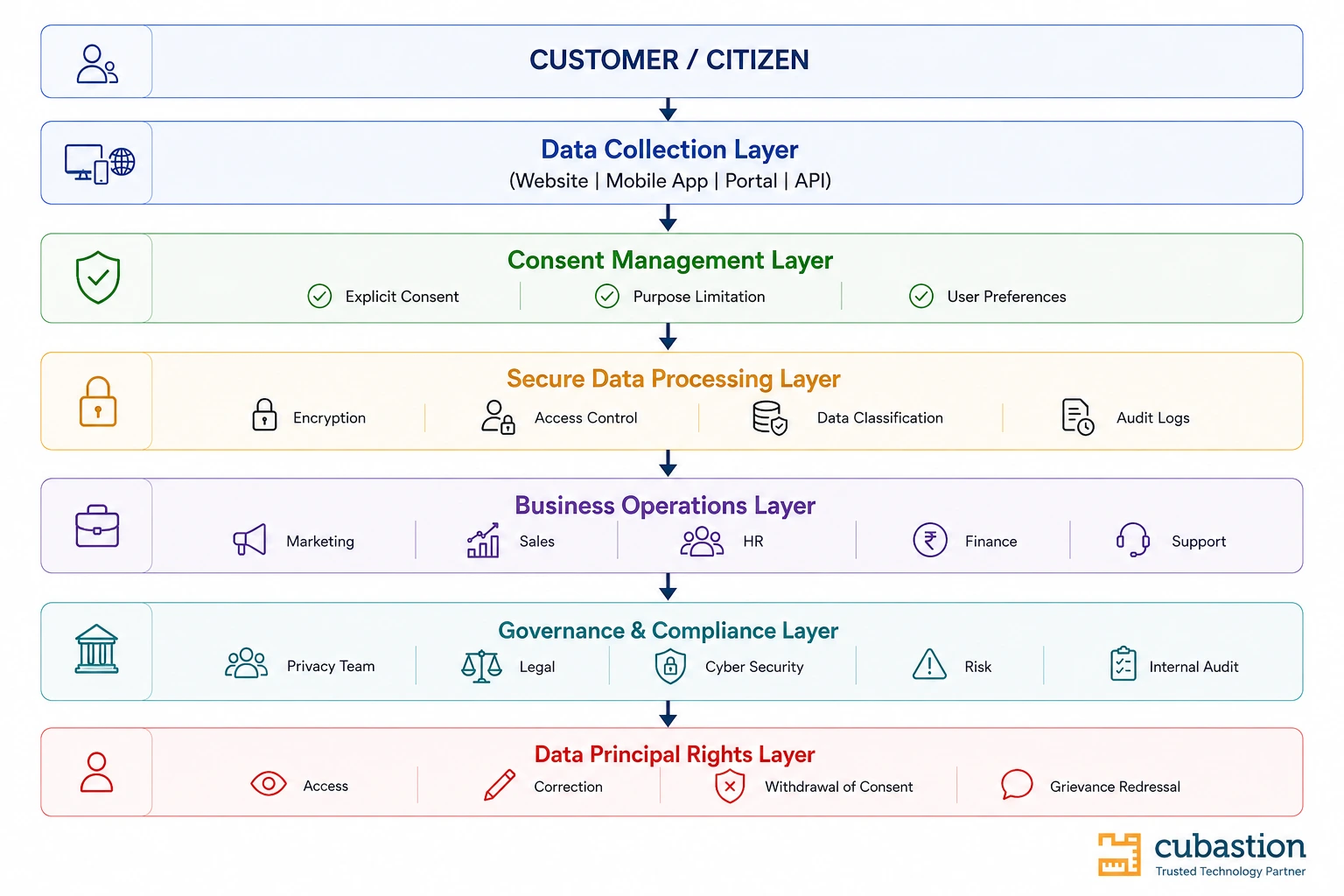
While data privacy is often associated with legal or compliance teams, the DPDP Act has implications across every business function. Compliance is no longer the responsibility of a single department, it requires collaboration between technology, legal, operations, human resources, marketing, and leadership.
Consent Becomes a Strategic Capability
Organizations must move beyond lengthy privacy notices and generic acceptance mechanisms. Consent should be informed, transparent, and purpose-driven, enabling individuals to understand how their data will be used.
Data Minimization Improves Governance
Collecting excessive information increases both operational complexity and security risks. Organizations are encouraged to retain only the information necessary for delivering specific services, improving overall data quality while reducing unnecessary exposure.
Security Becomes a Business Requirement
Protecting personal information is no longer solely an IT responsibility. Businesses must establish robust cybersecurity controls, monitor data access, implement secure storage practices, and prepare structured incident response mechanisms.
Privacy Requires Cross-Functional Collaboration
Successful implementation depends on organization-wide participation.
| Business Function | Role in DPDP Compliance |
| IT & Cybersecurity | Secure infrastructure, access control, monitoring |
| Legal & Compliance | Regulatory interpretation and governance |
| Human Resources | Employee data privacy and awareness |
| Marketing | Consent management and responsible communication |
| Operations | Secure handling of customer information |
| Leadership | Privacy governance and organizational accountability |
This cross-functional approach ensures that privacy becomes embedded within business processes rather than existing as an isolated compliance initiative.
Beyond Compliance: Creating Business Value Through Privacy
Although regulatory compliance often receives the greatest attention, organizations that embrace privacy-first practices can realize significant business benefits.
Customer trust is perhaps the most valuable outcome. Individuals are increasingly willing to engage with organizations that demonstrate transparency and responsibility in handling personal information.
Improved governance also contributes to better operational efficiency. Clearly defined data ownership, standardized processes, and consistent policies reduce duplication, improve information quality, and strengthen decision-making.
Privacy-focused organizations are also better positioned to manage cyber risks. Strong governance frameworks improve incident preparedness, accelerate response times, and reduce the financial and reputational impact of potential breaches.
Furthermore, organizations with mature privacy practices often find it easier to establish partnerships, expand digital services, and adopt emerging technologies because trust has already been embedded into their operating model.
| Business KPI | Traditional Approach | Privacy-Driven Organization |
| Customer Trust | Moderate | Stronger confidence and transparency |
| Compliance Risk | Higher | Reduced through proactive governance |
| Data Quality | Fragmented | More accurate and purpose-driven |
| Incident Response | Reactive | Structured and prepared |
| Brand Reputation | Vulnerable | Strengthened through responsible practices |
The DPDP Act therefore represents an opportunity to transform privacy from a compliance obligation into a strategic business advantage.
The Road to Compliance Will Not Be Without Challenges
While the long-term benefits are substantial, achieving compliance requires organizations to address several practical challenges.
Many businesses continue to operate with legacy systems where customer information is distributed across multiple applications, databases, and third-party platforms. Identifying where personal data resides and ensuring consistent governance can be a significant undertaking.
Managing consent throughout the customer lifecycle also introduces new operational requirements. Organizations must establish mechanisms to record, update, and honor user preferences while maintaining transparency regarding data usage.
Third-party vendors present another important consideration. Businesses increasingly rely on cloud providers, outsourcing partners, payment gateways, and external service providers. Ensuring that these partners maintain comparable privacy standards is essential for comprehensive compliance.
Employee awareness remains equally important. Technology alone cannot guarantee privacy. Organizations must invest in training, awareness programs, and clearly defined governance processes to ensure that employees understand their responsibilities when handling personal information.
Ultimately, successful implementation requires a combination of technology, governance, organizational culture, and leadership commitment.
Building a Privacy-First Digital Future
India's digital economy is entering a new phase where trust will become as important as innovation. As technologies such as Artificial Intelligence, cloud computing, digital public infrastructure, and connected services continue to evolve, responsible data governance will become increasingly central to sustainable growth.
The DPDP Act provides organizations with an opportunity to rethink how they manage personal information, not simply to comply with regulations, but to strengthen customer relationships, improve governance, and build resilient digital businesses.
Organizations that embed privacy into product design, operational processes, and decision-making today will be better positioned to navigate future regulatory developments while maintaining customer confidence.
The true success of the DPDP Act will not be measured by the number of compliance checklists completed or policies updated. It will be measured by the level of trust citizens place in digital services and the confidence with which organizations handle personal information.
In an increasingly connected world, privacy is no longer just a legal obligation,it is a strategic business capability. The organizations that recognize this shift early will be the ones that shape India's next chapter of digital transformation.
Want to know more or have any questions? Contact us here