



Where the journey begins — and where it breaks
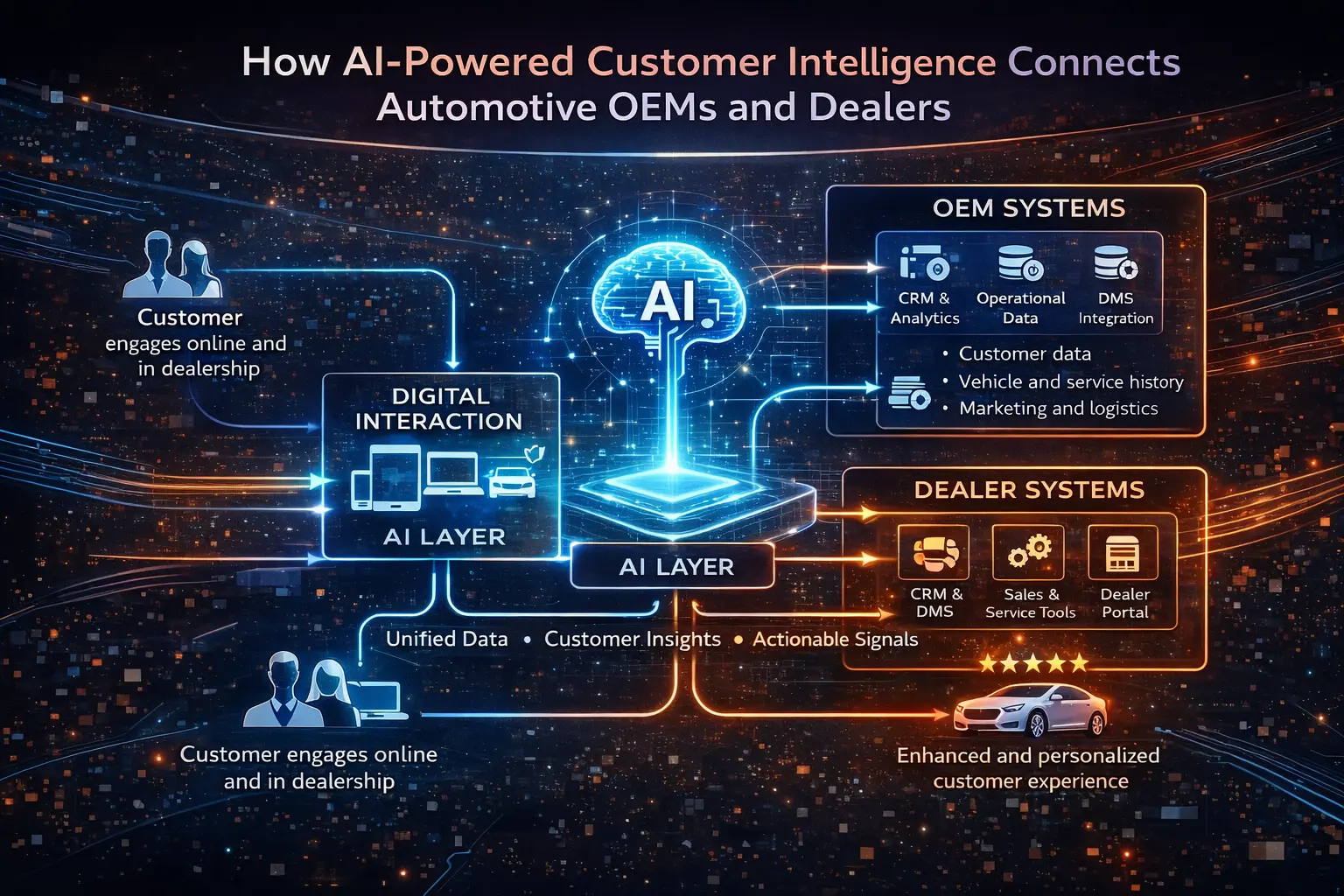
In the automotive industry, customer experience is not owned by a single team or system. It flows between OEMs and dealer networks, often across multiple touchpoints and over extended periods of time.
A customer might begin their journey by exploring vehicles online, comparing specifications, and even configuring their preferred model. When they walk into a dealership, they expect that journey to continue seamlessly.
However, in many cases, it does not.
They are asked to repeat their preferences. Their digital interactions are not visible. The dealership operates as if the journey has just begun.
This disconnect is not due to a lack of technology. Most automotive organizations already have advanced systems in place.
The real issue lies in how these systems operate not as a unified intelligence layer, but as isolated environments.
The gap between OEMs and dealers
Over the years, OEMs and dealer networks have invested significantly in digital platforms, CRM systems, and analytics tools. These investments have improved individual capabilities but have not fully solved the coordination challenge.
OEMs typically maintain centralized customer data and strategic insights, while dealers operate closer to the customer with real-time interactions. However, these two worlds do not always stay connected.
As a result, several challenges begin to emerge:
- Customer interactions captured at the dealership level do not always flow back into OEM systems
- Insights generated at the OEM level are not consistently utilized by dealers
- Customer journeys become fragmented across digital and physical touchpoints
Solutions like Salesforce Experience Cloud: Revolutionizing Digital Engagement have improved how customers interact digitally, while How Salesforce Consultants Drive Business Growth Through CRM Optimization has strengthened CRM-driven engagement.
Despite these improvements, the experience still lacks continuity because intelligence is not shared in real time.
When data exists but intelligence does not
The automotive ecosystem today is rich in data but limited in its ability to use that data effectively.
Customer information is distributed across multiple platforms, including CRM systems, Dealer Management Systems (DMS), service platforms, and analytics tools. Each system captures valuable insights, but they rarely operate in sync.
This fragmentation leads to situations where:
- Customer engagement becomes delayed because systems are not updated in real time
- Communication across OEMs and dealers becomes inconsistent
- Opportunities for personalization and proactive engagement are missed
As explained in Unlocking Real-Time Insights: Why Change Data Capture Is Essential for Modern Enterprises, the real challenge is not collecting data but enabling it to move and be used instantly.
Without real-time data flow, even the most advanced systems remain reactive.
How AI-powered customer intelligence changes the approach

AI introduces a fundamentally different way of connecting systems and understanding customers.
Instead of relying on static data and manual integration, AI continuously reads signals across the ecosystem and transforms them into actionable intelligence.
It brings together multiple dimensions of customer behaviours, including:
- Digital browsing and engagement patterns
- Purchase history and preferences
- Service interactions and maintenance records
- Dealer-level engagement and feedback
By combining these signals, AI enables organizations to understand not just what the customer has done, but what they are likely to do next.
This predictive capability is like what is demonstrated in AI-Driven Commerce Operations: Transforming SAP Commerce Reliability with Predictive Insights and AIOps, where systems move beyond monitoring and begin anticipating outcomes.
In the automotive context, this allows OEMs and dealers to operate with a shared understanding of the customer.
What a connected OEM–dealer ecosystem looks like
When AI-powered customer intelligence is implemented effectively, the relationship between OEMs and dealers becomes more aligned and data-driven.
Instead of operating independently, both function as part of a connected ecosystem where insights flow seamlessly.
| Capability | Traditional Automotive CX | AI-Powered Customer Intelligence |
| Customer Data | Distributed across systems | Unified across OEM and dealer network |
| Insights | Delayed and historical | Real-time and predictive |
| Dealer Coordination | Manual and inconsistent | Data-driven and synchronized |
| Customer Experience | Fragmented across touchpoints | Seamless and personalized |
This shift allows organizations to move from reactive engagement to proactive customer experience management.
Why the underlying systems still matter
While AI enables intelligence, it still depends on the strength of the underlying systems.
Many automotive organizations continue to rely on legacy platforms for critical operations. These systems are stable but often not designed for real-time data exchange or AI-driven workflows.
This is where modernization becomes essential.
Initiatives like Oracle Siebel Modernization Without Business Disruption demonstrate how legacy systems can be upgraded to support modern capabilities without interrupting business operations.
A strong foundation enables:
- Real-time data integration across systems
- Seamless interaction between OEM and dealer platforms
- Scalable AI-driven analytics and decision-making
Without this foundation, AI cannot deliver its full potential.
What changes for customers and for the business
As OEMs and dealers begin operating through a unified intelligence layer, the impact becomes visible across the entire customer journey.
Customers experience continuity instead of repetition. Interactions feel more relevant because they are based on real context. Engagement becomes timely rather than delayed.
From a business perspective, the benefits are equally significant:
- Customer engagement becomes more personalized and effective
- Dealer networks operate with better visibility and coordination
- Opportunities for upselling, cross-selling, and retention increase
- Decision-making becomes faster and more informed
This transformation strengthens not only customer relationships but also the collaboration between OEMs and dealers.
The shift that defines the future
The automotive industry has already taken significant steps toward digital transformation. Systems have been implemented, platforms have been integrated, and processes have been optimized.
The next phase is not about adding more technology.
It is about making existing systems work together intelligently.
The real shift is from fragmented systems to a unified intelligence ecosystem where data flows continuously, insights are shared instantly, and decisions are made proactively.
Organizations that successfully make this shift will not only improve customer experience but will also redefine how OEMs and dealers collaborate in a connected, data-driven future.