



The New Rules of Supply Chain Management
For decades, supply chain success was measured primarily through efficiency. Organizations focused on reducing procurement costs, minimizing inventory levels, and optimizing transportation expenses. While these objectives remain important, today's supply chains operate in a vastly different environment where resilience, agility, and visibility have become equally critical.
Globalized sourcing networks, rapid growth in e-commerce, changing consumer expectations, and increasing market volatility have fundamentally altered the way businesses manage their supply chains. Customers now expect faster deliveries, real-time order updates, and consistent product availability. At the same time, businesses must navigate supplier disruptions, fluctuating demand patterns, geopolitical uncertainties, and rising operational costs.
Recent global events exposed the limitations of traditional supply chain models. Organizations that relied heavily on manual processes and disconnected systems struggled to identify risks, track inventory accurately, and respond quickly to changing market conditions. In contrast, businesses with digitally connected operations demonstrated greater adaptability and resilience.
As a result, supply chain management is undergoing a significant transformation. Organizations are shifting from isolated operational functions toward integrated ecosystems powered by data, automation, and real-time visibility. This shift has elevated Enterprise Resource Planning (ERP) systems from administrative tools to strategic platforms that enable end-to-end supply chain coordination.
Among these solutions, ERPNext has emerged as a compelling option for organizations seeking to modernize their supply chains without the complexity and financial burden often associated with traditional ERP implementations.
Why Traditional Supply Chains Are Struggling to Keep Pace
Many organizations continue to operate with systems that were designed for a different business environment. Procurement, inventory management, warehousing, manufacturing, and finance frequently function in silos, each relying on separate tools and datasets.

This fragmented approach creates several challenges.
| Challenge | Business Impact |
| Information Silos | Limited cross-functional visibility |
| Manual Processes | Increased operational inefficiencies |
| Disconnected Systems | Delayed decision-making |
| Reactive Planning | Difficulty responding to disruptions |
| Inaccurate Data | Inventory and forecasting issues |
| Limited Transparency | Reduced supply chain visibility |
One of the most significant consequences is the inability to make timely and informed decisions. When inventory data is updated manually or reports are generated periodically, management teams often operate using outdated information. This can lead to excess inventory, stock shortages, procurement delays, and customer dissatisfaction.
Traditional supply chains also struggle to scale efficiently. As organizations grow, the volume of transactions, suppliers, products, and customers increases exponentially. Without integrated systems, operational complexity rises faster than organizational capability.
The challenge is no longer simply about improving efficiency. It is about creating a supply chain that can adapt, respond, and recover in an increasingly uncertain business environment.
The Rise of the Digital Supply Chain
The concept of the Digital Supply Chain has emerged as a response to these challenges. Rather than managing individual functions independently, digital supply chains connect processes, people, and data across the entire value chain.

This evolution can be understood through a Supply Chain Maturity Model.
| Stage | Characteristics |
| Manual | Paper-based records and spreadsheets |
| Digitized | Function-specific software tools |
| Connected | Integrated ERP-driven operations |
| Intelligent | Analytics and automation |
| Autonomous | AI-driven decision-making |
Many organizations currently operate between the Digitized and Connected stages. They may have software supporting procurement, inventory, or accounting, but these systems often lack integration.
The objective of digital transformation is not simply to replace spreadsheets with software. It is to establish a unified operational environment where information flows seamlessly across departments, enabling real-time visibility and coordinated decision-making.
This is where ERP platforms become particularly valuable. Rather than serving as isolated applications, they function as operational ecosystems that connect every major business process.
ERPNext as a Supply Chain Operating System
ERPNext's significance lies not in individual features but in its ability to create a single source of truth across supply chain operations.
Instead of viewing procurement, inventory, logistics, manufacturing, and finance as separate functions, ERPNext brings them together within a unified framework. This integrated approach improves collaboration, reduces information gaps, and enables more effective decision-making.
Creating a Unified Data Layer

One of the biggest challenges in supply chain management is ensuring that everyone works with the same information.
ERPNext establishes a centralized data environment where transactions, inventory movements, procurement activities, and operational updates are recorded and shared across departments. This eliminates duplicate data entry and reduces inconsistencies between teams.
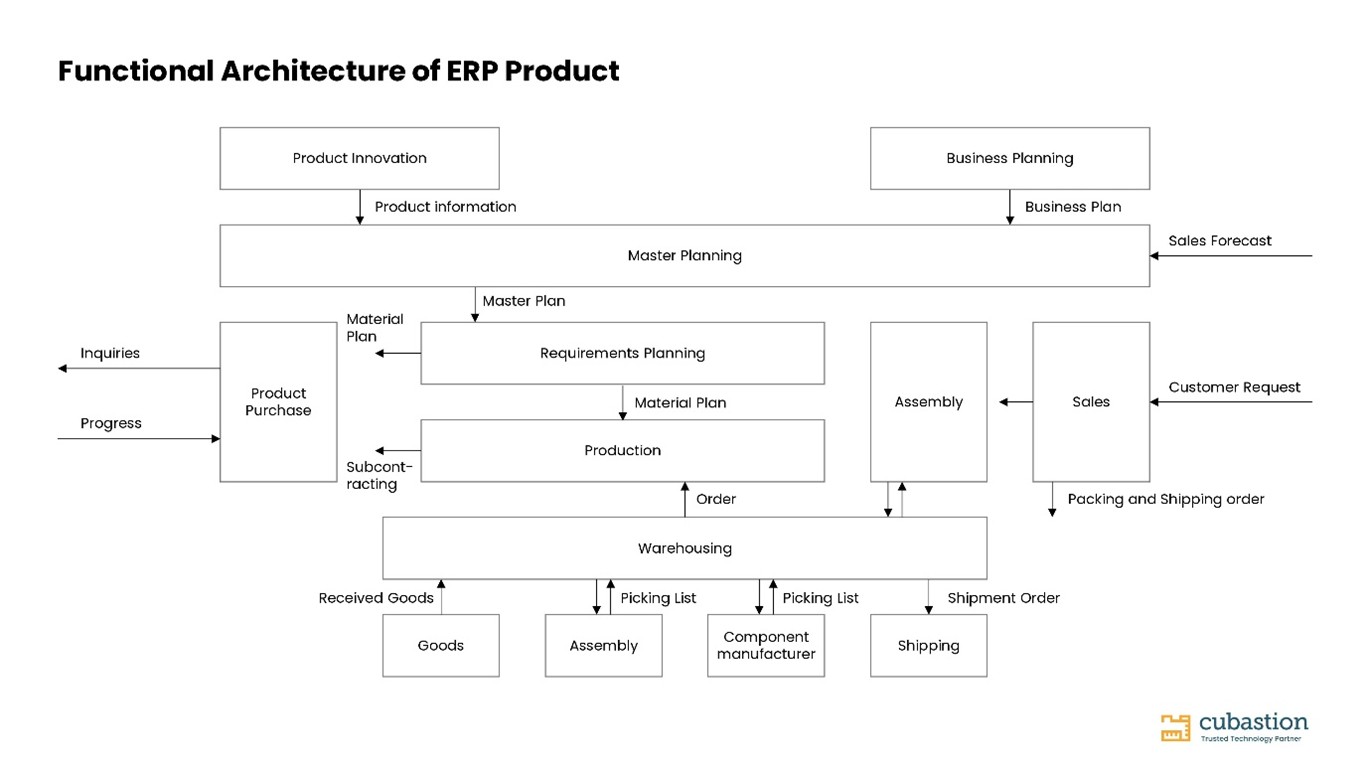
A simplified representation of this ecosystem is shown below:

By connecting these functions, organizations gain greater visibility into the flow of materials, information, and resources throughout the supply chain.
Enabling Real-Time Decision Making
Modern supply chains require decisions to be made quickly and accurately.
ERPNext provides real-time access to operational data, allowing managers to monitor inventory levels, supplier performance, order status, and resource utilization without waiting for manually generated reports.
This capability shifts organizations from reactive management to proactive planning. Instead of identifying problems after they occur, businesses can detect trends, anticipate bottlenecks, and take corrective action before disruptions escalate.
Supporting Cross-Functional Collaboration
Supply chain performance depends on coordination between multiple departments.
Procurement teams need visibility into inventory requirements. Operations teams need awareness of material availability. Finance teams require accurate transaction data. Warehouse personnel depend on updated inventory information.
ERPNext enables these functions to operate from a common platform, reducing communication barriers and improving alignment across the organization.
Improving Supply Chain Visibility
Visibility has become one of the most important capabilities in modern supply chain management.
Organizations must understand:
- What inventory is available
- Where materials are located
- Which suppliers are performing effectively
- How orders are progressing
- Where operational bottlenecks exist
ERPNext consolidates this information into dashboards and reports that provide a comprehensive view of supply chain performance.
ERPNext in Action: Lessons from India's Jute Procurement Ecosystem
While the benefits of ERPNext are often discussed from a technology perspective, its impact becomes more evident when examined through real-world implementations. One notable example is Jute Smart 2.0, a digital procurement platform developed for the Office of the Jute Commissioner, Government of India.
The jute procurement ecosystem involves multiple stakeholders, including procurement agencies, traders, suppliers, transport operators, inspection bodies, financial institutions, and government departments. Historically, many of these processes relied on manual coordination, spreadsheets, paper-based approvals, and disconnected systems, resulting in operational bottlenecks such as delayed inspections, limited logistics visibility, manual payment reconciliation, and fragmented decision-making.
Built on ERPNext and the Frappe Framework, Jute Smart 2.0 transformed these disconnected processes into a unified digital ecosystem. The platform integrated procurement management, inspection workflows, dispatch tracking, transport coordination, billing, payment processing, compliance management, and inventory operations within a single operational framework. Rather than functioning as isolated modules, these processes became interconnected and capable of sharing information in real time.
One of the most significant improvements was workflow synchronization. For example, when a procurement order was generated, the system could automatically initiate inspection activities, dispatch planning, logistics coordination, billing workflows, and payment tracking. This reduced manual intervention while improving operational visibility across stakeholders.

The implementation demonstrates a broader lesson for supply chain leaders: the value of ERP systems extends beyond process automation. When deployed effectively, platforms such as ERPNext can serve as the operational backbone of complex supply chain ecosystems, enabling transparency, faster coordination, and data-driven decision-making across the entire value chain. Jute Smart 2.0 illustrates how a unified digital platform can transform procurement and logistics operations from fragmented activities into an integrated and intelligent supply chain network.
Measuring Impact Beyond Operational Efficiency
The value of digital transformation extends far beyond automation.
Organizations that adopt integrated supply chain platforms often experience improvements across multiple performance dimensions.
| Performance Indicator | Traditional Environment | Integrated ERP Environment |
| Inventory Accuracy | Variable | Significantly Improved |
| Decision Speed | Delayed | Real-Time |
| Process Visibility | Limited | End-to-End |
| Cross-Team Collaboration | Fragmented | Integrated |
| Forecast Reliability | Inconsistent | Data-Supported |
| Operational Agility | Low | High |
Perhaps the most significant improvement is the ability to make decisions based on real-time information rather than assumptions.
When supply chain leaders can access accurate data across procurement, inventory, operations, and distribution, they gain greater confidence in planning and execution.
This creates a ripple effect throughout the organization, improving customer service, reducing operational risks, and supporting long-term growth.
Building Resilient Supply Chains for the Future
Supply chain priorities are evolving. While efficiency remains important, resilience has become a strategic objective.
Organizations must prepare for:
- Demand volatility
- Supplier disruptions
- Regulatory changes
- Sustainability requirements
- Increasing customer expectations
Achieving resilience requires more than contingency plans. It requires visibility, adaptability, and the ability to respond quickly to changing conditions.
Digital platforms such as ERPNext provide the foundation for this transformation by creating connected operations, improving transparency, and enabling faster decision-making.
They also position organizations for future advancements in analytics, automation, and artificial intelligence. As supply chains continue to evolve, businesses with integrated digital foundations will be better equipped to adopt emerging technologies and maintain a competitive advantage.
What Supply Chain Leaders Can Learn from the Shift Toward Digital Operations
The evolution of supply chain management highlights several important lessons for modern organizations.
First, visibility is becoming as important as efficiency. Organizations cannot optimize what they cannot see.
Second, integration delivers greater value than isolated improvements. Connecting procurement, inventory, operations, and logistics creates benefits that individual software solutions cannot achieve independently.
Third, data-driven decision-making is rapidly becoming a competitive differentiator. Businesses that can access and interpret real-time information are better positioned to respond to market changes and operational challenges.
Finally, digital transformation is no longer limited to large enterprises. Platforms such as ERPNext are making advanced supply chain capabilities accessible to organizations of all sizes, enabling them to compete in increasingly dynamic markets.
As supply chains continue to grow more complex, the organizations that thrive will be those that move beyond fragmented operations and embrace connected, intelligent, and resilient business ecosystems. ERPNext represents one pathway toward that future, helping organizations transform supply chain management from a reactive function into a strategic capability.