



Behind Every Government Decision Lies an Ocean of Information
The digital transformation of governments has largely focused on improving how citizens access public services. Online portals, digital payments, electronic records, and integrated service platforms have significantly enhanced service delivery and accessibility. While these advancements have transformed the citizen experience, they represent only one side of government modernization. The real engine of governance operates behind the scenes.
Every policy proposal, procurement request, financial sanction, project approval, administrative order, or inter-ministerial consultation involves a series of structured processes that ensure transparency, accountability, and regulatory compliance. Government officers routinely navigate office memoranda, acts, departmental circulars, financial rules, historical precedents, cabinet notes, audit observations, and numerous approval workflows before reaching an informed decision.
These processes are intentionally designed to safeguard public resources and maintain institutional accountability. However, as the volume of information continues to grow, officers increasingly face a new operational challenge—not the absence of information, but the effort required to locate, interpret, and connect the right information at the right moment.
A significant portion of administrative work today involves searching for relevant documents, verifying whether similar cases have been processed previously, identifying applicable regulations, coordinating with multiple departments, and gathering contextual information before a file can move forward. The challenge is rarely about making the decision itself; it is about assembling the knowledge required to make that decision confidently.
This is where AI Knowledge Assistants are beginning to redefine internal government operations.
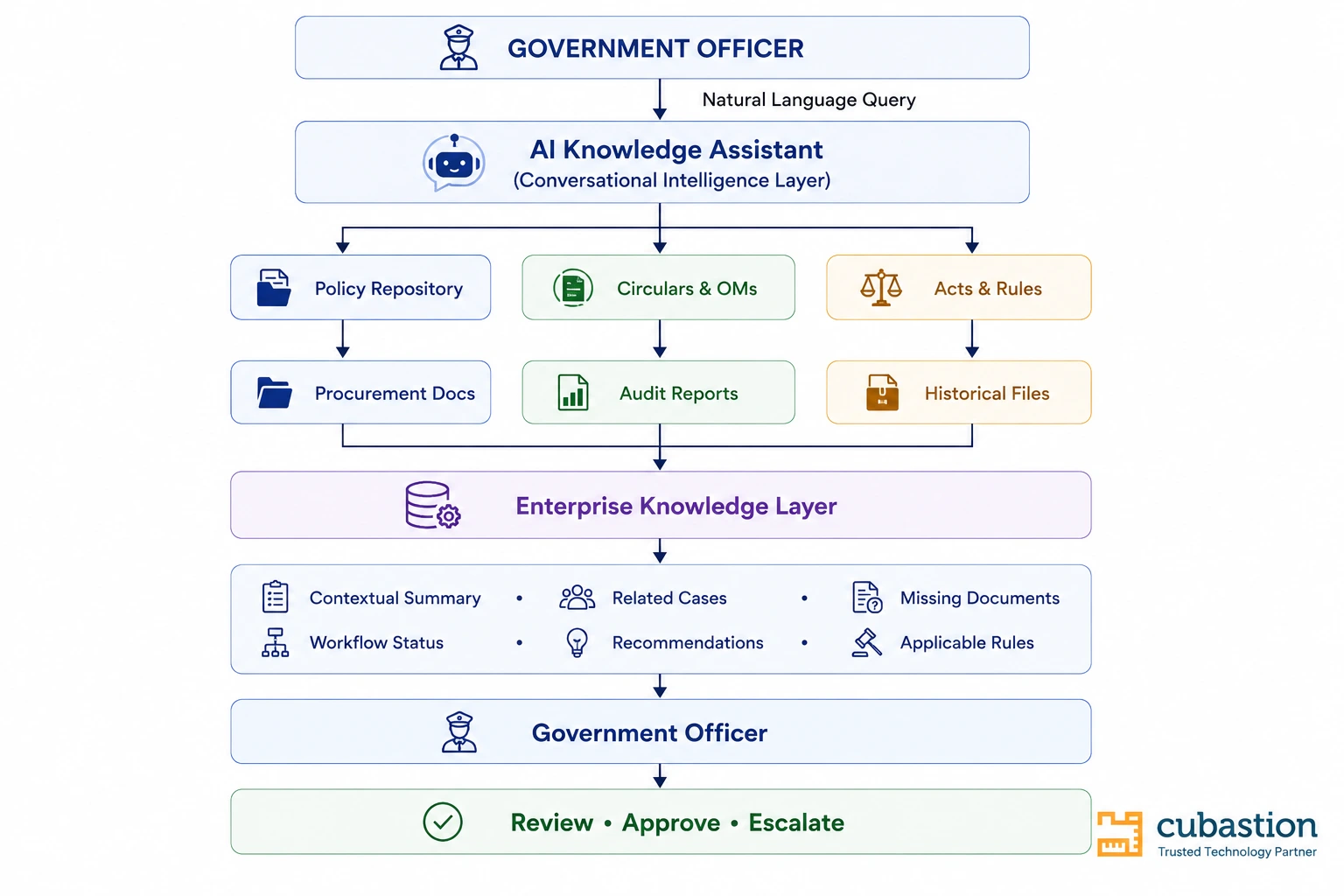
Unlike conventional chatbots designed to answer citizen queries, AI Knowledge Assistants are purpose-built for government officials. They serve as intelligent organizational companions capable of retrieving institutional knowledge, summarizing policies, surfacing historical precedents, tracking workflow status, and connecting information scattered across multiple systems. Rather than replacing administrative judgment, they enable officers to spend less time searching for information and more time exercising informed decision-making.
The next chapter of digital governance is not simply about digitizing files, it is about transforming those files into institutional intelligence.
When Information Becomes the Largest Administrative Bottleneck
Modern ministries generate an extraordinary volume of information every day. Policy frameworks, government resolutions, circulars, notifications, procurement manuals, audit reports, financial approvals, committee recommendations, parliamentary responses, and departmental communications collectively form the knowledge backbone of public administration.
Most ministries have already digitized these assets. Yet digitization alone does not guarantee accessibility.
Consider a procurement officer evaluating a high-value infrastructure proposal. Before recommending the file for approval, the officer may need to review General Financial Rules (GFR), compare similar tenders issued by other departments, verify previous audit observations, examine vendor eligibility conditions, and confirm whether revised procurement guidelines have been issued recently.
Similarly, a policy officer preparing a cabinet note may need to review historical policy decisions, identify implementation outcomes of earlier schemes, analyze committee recommendations, and compare international best practices before drafting recommendations.
Each of these tasks requires navigating multiple repositories, consulting different departments, and manually piecing together fragmented information.
The result is an administrative environment where officers often spend considerable time searching for institutional knowledge instead of applying it.
This is not a weakness of governance; rather, it is a natural consequence of operating within highly regulated, documentation-intensive environments. As governments continue expanding digital records, the need shifts from storing information to making information immediately discoverable and contextually relevant.
Administrative Challenges and AI Knowledge Assistant Opportunities
| Administrative Activity | Current Challenge | AI Knowledge Assistant Capability |
| Policy research | Reviewing multiple circulars, office memoranda, and historical files | Retrieves and summarizes relevant policies, precedents, and recommendations |
| Procurement review | Cross-checking compliance across multiple guidelines | Identifies applicable regulations and highlights missing documentation |
| Budget approvals | Comparing historical sanctions and expenditure patterns | Surfaces similar approvals and financial references |
| File movement | Manual follow-ups across departments | Provides real-time workflow visibility and pending action status |
| Interdepartmental coordination | Email and phone-based clarification | Consolidates organizational knowledge through a conversational interface |
Rather than altering administrative procedures, AI Knowledge Assistants complement existing governance frameworks by making trusted information readily accessible.
From Digital Files to Institutional Intelligence
The first wave of e-Governance focused on digitizing paper-based processes. Physical records became electronic files, enabling easier storage, retrieval, and sharing. This transformation significantly reduced manual paperwork and improved operational efficiency.
However, digital documents alone do not create organizational intelligence.
A ministry may possess decades of reports, notifications, cabinet decisions, project evaluations, audit findings, and operational guidelines. Yet if officers must still manually search hundreds of documents to answer a single question, the full value of digitization remains unrealized.
AI Knowledge Assistants bridge this gap by converting static repositories into dynamic knowledge ecosystems.
Instead of searching folders, officers can ask questions in natural language:
"Which circular currently governs this procurement category?"
"Have similar projects received budget approval in the last three years?"
"Summarize all policy changes related to renewable energy issued after 2022."
"Which observations did the CAG raise during previous project audits?"
The assistant analyzes organizational knowledge across multiple systems, retrieves the most relevant information, summarizes lengthy documents, identifies relationships between policies, and presents contextual insights that support the officer's work.
The distinction is subtle but significant.
Digital files preserve institutional memory.
AI Knowledge Assistants activate institutional memory.
This shift transforms government repositories from passive document stores into active knowledge assets that support faster analysis, improved consistency, and better-informed administrative processes.

Empowering Every Function Within a Ministry
The impact of AI Knowledge Assistants extends across multiple government functions because nearly every department depends on timely access to reliable information.
Policy and Scheme Development
Policy formulation is inherently knowledge intensive. Officers frequently analyze previous government initiatives, committee recommendations, socioeconomic indicators, parliamentary discussions, and implementation reports before proposing new schemes.
An AI Knowledge Assistant can rapidly summarize historical initiatives, identify recurring implementation challenges, compare similar programs across ministries, and surface supporting evidence. This enables policy teams to devote greater attention to analysis and innovation rather than manual document review.
Procurement and Contract Management
Public procurement demands strict adherence to financial regulations, procurement manuals, tender conditions, and departmental guidelines.
Instead of manually reviewing multiple documents, procurement officers can use AI to retrieve applicable clauses, identify compliance requirements, highlight incomplete documentation, and reference similar procurements executed previously.
The objective is not to automate procurement decisions but to reduce the administrative effort involved in preparing them.
Finance and Budget Administration
Budgetary approvals often require officers to examine historical expenditure patterns, compare earlier sanctions, verify funding availability, and review financial observations.
AI Knowledge Assistants consolidate this information from multiple sources, enabling finance teams to focus on financial analysis rather than information gathering.
Administration and Workflow Management
One of the most common questions inside any large ministry is remarkably simple:
"Where is the file currently pending?"
Determining file status often involves multiple follow-ups across departments.
With integrated workflow intelligence, officers can instantly view file location, pending actions, approval timelines, responsible sections, and service-level timelines without disrupting existing approval hierarchies.
Human Resources and Establishment
Government HR functions involve extensive service rules, transfer policies, promotion guidelines, deputation norms, pension regulations, and leave provisions.
Rather than searching through extensive manuals, HR officers can retrieve rule interpretations, compare applicable provisions, and access updated circulars within seconds, improving consistency in administrative decision support.
Keeping Human Judgment at the Center of Governance
One of the most important considerations when introducing AI into government operations is defining its role clearly. AI Knowledge Assistants are not designed to replace officers, bypass approval hierarchies, or make administrative decisions independently. Their primary purpose is to reduce the time spent locating information so that officials can focus on analysis, deliberation, and informed decision-making.
Government decision-making often involves legal interpretation, financial prudence, public accountability, and policy considerations that extend beyond the information available in documents. These responsibilities require experience, contextual understanding, and administrative discretion - qualities that remain firmly within the domain of government officers.
AI Knowledge Assistants therefore function as decision-support systems rather than decision-makers. They retrieve relevant policies, summarize lengthy documents, identify historical precedents, highlight missing information, and present contextual recommendations. The authority to approve, reject, modify, or escalate a proposal continues to reside with the designated officials and approval authorities.
This human-in-the-loop approach ensures that AI strengthens governance without compromising transparency, accountability, or institutional responsibility.
AI Supports Information. Officers Make Decisions.
| AI Knowledge Assistant | Government Officer |
| Retrieves policies and circulars | Interprets policy intent |
| Summarizes lengthy documents | Applies administrative judgment |
| Identifies historical precedents | Considers current context |
| Tracks workflow progress | Exercises approval authority |
| Flags missing information | Makes the final administrative decision |
This collaborative model enables officers to make better-informed decisions while preserving the governance structures that ensure accountability.
Measuring Success Beyond Automation
The value of AI Knowledge Assistants should not be measured solely by the number of queries answered or documents retrieved. Their true impact lies in improving operational efficiency, reducing administrative overhead, and enabling officers to spend more time on strategic work.
Rather than replacing existing systems, AI enhances how officials interact with them, creating measurable improvements across internal operations.
Operational Impact of AI Knowledge Assistants
| Key Performance Indicator (KPI) | Traditional Workflow | AI-Assisted Workflow |
| Time spent searching documents | High due to manual searches across repositories | Significantly reduced through contextual search |
| Duplicate internal queries | Frequent across departments | Reduced through centralized knowledge access |
| File processing turnaround time | Delayed by information gathering | Faster progression through quicker access to relevant information |
| Policy interpretation consistency | Dependent on individual experience | Improved through standardized knowledge retrieval |
| Interdepartmental coordination | Multiple emails and follow-ups | Faster collaboration using a shared knowledge interface |
| Officer productivity | Time divided between research and decision support | Greater focus on analysis, planning, and governance |
Beyond efficiency gains, these improvements contribute to more consistent decision support, stronger institutional memory, and enhanced organizational agility.
Building the Knowledge-Driven Ministry of the Future
The next phase of digital governance will not be defined solely by new portals or additional automation. Instead, it will focus on enabling government institutions to make better use of the knowledge they already possess.
Future ministries are likely to evolve from document-centric organizations to knowledge-centric enterprises, where AI acts as an intelligent layer connecting people, policies, systems, and institutional experience.
Rather than searching across isolated repositories, officers will interact with unified knowledge ecosystems capable of understanding natural language, connecting related information, and presenting contextual insights from multiple government systems.
This evolution may include capabilities such as:
- Enterprise-wide semantic search across government knowledge repositories
- AI-powered policy intelligence for comparative analysis
- Retrieval-Augmented Generation (RAG) for secure access to ministry-specific knowledge
- Workflow intelligence that identifies pending actions and process bottlenecks
- Knowledge graphs connecting policies, projects, approvals, departments, and historical decisions
- Personalized AI copilots tailored to the responsibilities of individual officers and departments
These technologies will not alter governance structures. Instead, they will enhance the ability of public servants to navigate increasingly complex administrative environments while maintaining transparency and accountability.
Conclusion: From Managing Files to Managing Knowledge
Governments have already invested significantly in digitizing records, automating workflows, and modernizing administrative processes. The next opportunity lies not in creating more digital documents but in unlocking the knowledge contained within them.
AI Knowledge Assistants represent a natural progression in this journey. By enabling officers to retrieve institutional knowledge, understand historical context, monitor workflows, and access trusted information more efficiently, these systems reduce administrative friction without changing established governance mechanisms.
The transformation is not about replacing public servants or bypassing administrative procedures. It is about empowering them with faster access to reliable knowledge so they can focus on higher-value responsibilities - policy formulation, strategic planning, financial oversight, regulatory compliance, and informed decision-making.
As ministries continue to embrace digital transformation, the question is no longer whether government information should be digitized. That foundation already exists.
The next question is whether that information can become intelligent.
Organizations that successfully transform files into actionable knowledge will not only improve operational efficiency but also strengthen institutional memory, promote policy consistency, and enable more responsive governance.
The future of government operations will not be powered by AI alone, it will be driven by informed public servants supported by intelligent knowledge systems.