


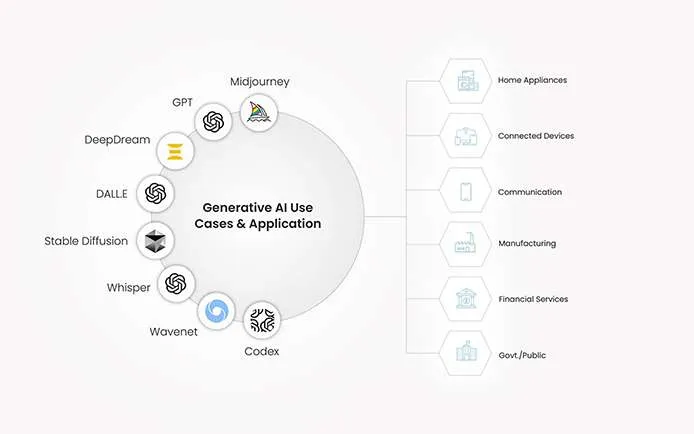

Generative AI is no longer a futuristic concept—it’s a game-changer for enterprises today. By leveraging advanced machine learning models, businesses can automate content creation, enhance customer experiences, streamline decision-making, and drive innovation at scale.
From AI-powered chatbots revolutionizing customer service to intelligent automation optimizing supply chains, Generative AI is reshaping industries like never before. Companies adopting this technology are not just improving efficiency—they’re unlocking new revenue streams and gaining a competitive edge in the digital-first economy.
In this article, we’ll explore the transformative impact of Generative AI on enterprises, key benefits, industry-specific applications, and real-world success stories that showcase its potential.

Why Enterprises Must Adopt Generative AI Now
Generative AI is no longer just a trend—it’s a business imperative. Since 2022, ithas surged in adoption, with platforms like DALL·E and Stable Diffusionrevolutionizing content creation and ChatGPT becoming the fastest-growingconsumer application in history, reaching 100 million users in just two months.
Tech giants like Google, Microsoft, and OpenAI are investing heavilyinGenerative AI to stay ahead in the evolving digital landscape. Google introducedBard, while Microsoft integrated AI-powered search into Bing and Office365,marking a paradigm shift in how businesses leverage AI for efficiency,automation, and innovation.
85% of enterprises are already using Generative AI in at least one function.
AI is no longer just a tool for cost-cutting—it’s a growth driver that unlocks newrevenue opportunities.
Generative AI is transforming entire industries—from customer engagement andpredictive analytics to AI-driven automation and digital assistants.
Why Enterprises Can’t Ignore Generative AI
● Enhanced Productivity: Automates content creation, data analysis, andcustomer interactions.
● Competitive Advantage: Companies adopting AI are innovating faster anddelivering personalized experiences.
● Scalability & Cost Optimization: Reduces operational costs and improvesdecision-making at scale.
As AI continues to redefine digital transformation, enterprises that embraceGenerative AI-powered solutions today will lead the future of intelligentautomation and business innovation.
AI vs. Generative AI: Key Differences
While both Artificial Intelligence (AI) and Generative AI leveragemachinelearning and automation, they serve distinct purposes in business applications.AI excels at data analysis, decision-making, and process optimization,whereasGenerative AI focuses on content creation, automation, and enhancing creativity.
The table below outlines the key differences:
| Feature Artificial Intelligence (AI) Generative AI | ||
| Definition | AI enables machinestoperform tasks thatrequirehuman intelligence, suchasdecision-making and patternrecognition. | Generative AI creates newcontent by learningfromexisting data patterns. |
| Data Usage | Analyzes structuredandunstructured data to make | Uses vast datasets togenerate original text, |

How Generative AI Works: The Technology Behind IntelligentCreation
| predictions and automate images, code, and media.tasks. | ||
| ExampleApplications | Fraud detection,recommendation systems,predictive analytics,andautonomous vehicles. | AI-powered textgeneration, image & videosynthesis, digital art,andsynthetic media creation. |
| Output Type | Provides classifications,predictions, and automation. | Produces creative outputslike articles, marketingcopy, designs, and videos. |
| Industry Impact | Optimizes workflows,enhances efficiency, andsupports data-drivendecision-making. | Drives innovation,accelerates contentgeneration,andtransforms businessoperations. |
Generative AI operates on advanced deep learning models like Transformersand Generative Adversarial Networks (GANs) to process vast amounts of dataand produce high-quality, human-like outputs. These models are trainedtorecognize patterns and generate original content, including text, images, videos,and even code, with remarkable precision.
At the heart of Generative AI lies its ability to learn from existing datasetsandcreate new, meaningful information. By leveraging natural language processing(NLP) and neural networks, AI can generate contextually relevantresponses,making it an essential tool for businesses aiming to enhance automation,creativity, and efficiency.
AI-Powered Knowledge Retrieval: Smarter Search & Insights
One of the most impactful applications of Generative AI is AI-powered knowledgeretrieval, where AI systems:
● Enhance searchability by intelligently indexing vast knowledge bases.
● Automate responses to user queries, reducing manual effort.
● Provide real-time contextual insights, improving decision-making acrossindustries.
The diagram below illustrates how AI-driven knowledge retrieval optimizesenterprise operations by making information more accessible, actionable, andefficient.

AI-Powered Knowledge Retrieval Architecture: How It Works
Generative AI enhances enterprise knowledge management byenablingintelligent search, automated insights, and real-time information retrieval. TheRetrieval-Augmented Generation (RAG) model ensures AI delivers accurate,context-aware responses using up-to-date company knowledge rather thangeneric pre-trained data.
Here’s how the architecture works:
● Private Knowledge Base – AI ingests data from internal sources such asJira, Confluence, APIs, CRM systems, and technical documentation.
● Text Processing – The AI breaks down large datasets into structured textchunks and embeds them for efficient retrieval.
● Vector Database – Using AI-driven vectorization, text is converted intonumerical representations, allowing for faster search and indexing.
● Query Processing – When a user submits a query, AI matches the requestwith the most relevant data from the knowledge base.
● Large Language Model (LLM) – The LLM generates accurate responsesbased on the retrieved context, ensuring precision and relevance.
● Chat Interface – The AI-powered system delivers the response viaaninteractive chat interface, providing seamless user engagement and realtime assistance.
By implementing this AI-driven knowledge retrieval system, enterprises canreduce response times, enhance decision-making, and improve operationalefficiency across departments.
Key Benefits of Generative AI for Enterprises:
Businesses leveraging Generative AI experience a significant boostinproductivity, efficiency, and cost savings, enabling them to scale operations whilefostering innovation and automation.
1. Increased Productivity & Creativity
○ Automates repetitive tasks like content creation,documentprocessing, and data analysis, freeing up human resources forstrategic work.
○ Accelerates design and innovation by assisting in creative processeslike marketing campaigns, UI/UX design, and branding.
2. Enhanced Efficiency & Speed
○ Generates large volumes of high-quality content, reports, and insightsin seconds, drastically reducing turnaround times.
○ Optimizes manufacturing, customer service, and logistics through AI-driven process automation.
3. Scalability & Innovation
○ Powers AI-driven designs, predictive analytics, and intelligentautomation, making business processes smarter and more scalable.
○ Enhances R&D, product development, and market forecasting, drivingdata-driven decision-making.
4. Cost-Effective Solutions (McKinsey Report: AI reduces engineeringtime by up to 38%)
○ Minimizes human labor in content generation, graphic design, andmarketing, reducing operational costs.
○ Implements AI-powered automation, streamlining workflows andoptimizing resource allocation for maximum efficiency.
With enterprises embracing AI-driven transformation, Generative AI is no longeran option—it’s a necessity for staying competitive in the digital-first economy
Risks & Limitations of Generative AI: Challenges to Consider
While Generative AI offers immense opportunities, enterprises mustalsonavigate key risks and limitations to ensure ethical, secure, and responsible AIadoption.
1. Data Privacy & Security Concerns
○ Challenge: Generative AI relies on vast datasets, raising concernsabout data leakage, intellectual property misuse, and regulatorycompliance (GDPR, CCPA).
○ Mitigation: Enterprises must implement robust encryption, accesscontrols, and AI governance policies to protect sensitive data.
2. Bias & Ethical Challenges
○ Challenge: AI models may inherit biases from training data, leadingto unintended discrimination or biased decision-making.
○ Mitigation: Businesses must prioritize diverse datasets, continuous AIauditing, and fairness algorithms to ensure unbiased AI outcomes.
3. Hallucinations & Misinformation
○ Challenge: Generative AI sometimes produces inaccurate,misleading, or fabricated content (AI hallucinations).
○ Mitigation: AI outputs should be verified by human experts, andenterprises should implement fact-checking mechanisms inAIworkflows.
4. High Computational & Implementation Costs
○ Challenge: Training and deploying AI models require significantcomputing power, cloud infrastructure, and skilled AI talent.
○ Mitigation: Businesses can optimize costs by leveraging pre-trainedAI models, cloud-based AI services, and efficient AI architectures.
5. Intellectual Property & Copyright Issues
○ Challenge: AI-generated content may infringe on existing copyrights,trademarks, or intellectual property rights.
○ Mitigation: Enterprises must adopt legal guidelines, AI-generatedcontent disclosures, and licensing frameworks to avoid legal risks
6. Dependence on High-Quality Training Data
○ Challenge: AI models require large volumes of accurate, diverse, andunbiased training data to function effectively.
○ Mitigation: Companies should regularly update training datasets andensure AI systems are transparent and explainable.
Industry-Specific Use Cases of Generative AI:
Generative AI is revolutionizing industries by enhancing automation,personalization, and predictive insights. Here’s how different sectors areleveraging AI-driven innovation:
1. Automotive: AI-Powered Maintenance & Smart Sales
○ Predictive Maintenance: AI analyzes vehicle data to detect potentialfailures, reducing downtime and improving efficiency.
○ Virtual Sales Assistants: Personalized AI-drivencarrecommendations based on customer preferences and browsinghistory.
○ Supply Chain Optimization: AI enhances logistics, inventorymanagement, and demand forecasting for seamless operations.
○ The AI in manufacturing industry is projected to grow from $2.3B(2022) to $16.3Bby 2030.
2. Consumer Durables: Smart AI for Customer Experience
○ AI-Driven Predictive Maintenance: Ensures proactive servicing ofhome appliances, reducing unexpected breakdowns.
○ Automated Customer Support: AI-powered chatbots provide instantresponses for product inquiries and troubleshooting.
○ Personalized Recommendations: Smart AI suggests productsbased on user behavior, enhancing shopping experiences.
○ AI is transforming service fulfillment and customer touchpoints,ensuring seamless post-sales engagement while reducing operationalcosts.
3. E-Commerce: AI-Driven Personalization & Inventory Optimization
○ Conversational AI Chatbots: AI-powered assistants guide shoppers,answer queries, and enhance customer satisfaction.
○ Demand Forecasting: AI predicts market trends, ensuring optimizedinventory management and reduced overstocking.
○ AI-Generated Product Recommendations: Personalizedsuggestions boost engagement and increase conversions.
4. Telecommunications: AI for Smart Connectivity & Security
○ AI Virtual Assistants: Automate billing inquiries, customer support,and issue resolution.
○ Fraud Detection: AI analyzes transaction patterns to prevent securitythreats and unauthorized activities.
○ Network Optimization: AI ensures seamless connectivity bydynamically managing bandwidth and reducing downtime.
○ The AI in telecom market is projected to grow from $1.2B in 2021 to
$38.8B by 2031.
5. Airports & Travel: AI-Powered Passenger Experience
○ Smart AI Assistants: Provide real-time flight updates, gate changes,and travel recommendations.
○ AI-Powered Navigation: Guides passengers through airports for asmoother experience.
○ Data-Driven Resource Allocation: AI optimizes staffing, securitychecks, and baggage handling for efficiency.
Case Study 1: How Cubastion’s AI-Powered ChatbotRevolutionized Mechanic Support at Fuso
The Challenge: Enhancing Mechanic Support & Reducing Call Center Load
Mitsubishi Fuso Truck & Bus Corporation (MFTBC) needed an AI-driven solutionto streamline mechanical support, reduce call center dependency, andimproveservice efficiency. Managing high volumes of service-related queriesmanuallywas time-consuming and costly.
To address this, Cubastion developed TIC—an AI-powered chatbotdesignedspecifically to assist Fuso mechanics in Japan with real-time troubleshooting andexpert guidance.

TIC: More Than Just a Chatbot – A Mechanic’s DigitalCompanion
TIC is an AI-driven virtual assistant that empowers mechanics with instantaccess to technical knowledge, eliminating delays in vehicle maintenance andrepair.
Key Features of TIC:
● Instant Troubleshooting – Provides accurate solutions by analyzingextensive technical manuals, service guides, and historical data.
● Reduced Call Center Dependency – Handles routinequeriesautonomously, allowing human agents to focus on complex issues.
● Seamless User Experience – Mechanics receive real-time AI-generatedresponses, ensuring faster issue resolution.
● Continuous Learning & Adaptation – TIC improves over time, refiningresponses based on user interactions and feedback.
The Impact: Transforming Technical Support with AI
The implementation of AI-powered support has resulted in remarkableimprovements in efficiency, cost savings, and customer satisfaction.
TIC’s Measurable Success:
● 10,000+ conversations handled, covering two-thirds of all customer servicechats.
● TIC performs the equivalent work of 30 full-time agents, significantlyreducing operational costs.
● Customer satisfaction scores are on par with human agents, ensuringseamless AI-human collaboration.
● 75% reduction in repeat inquiries, thanks to improved accuracy introubleshooting.
● Resolution time reduced from 120 minutes to under 1 minute, dramaticallyenhancing service efficiency.
● 24/7 AI availability in Japan, providing round-the-clock support in Englishand Japanese.
● 300+ active users, with plans to scale up to 2,000+ users in the near future.
Case Study 2: AI-Powered Training for Foreign LanguageMechanics
Transforming Automotive Training with Generative AI & Adaptive Learning
With the increasing demand for certified automotive mechanics,especiallyforeign workers in Japan, traditional training methods have struggled to addresslanguage barriers and learning efficiency. To overcome these challenges,aGenerative AI-powered training system has been developed toprovideinteractive, multilingual learning experiences.
This AI-driven platform enhances training efficiency, reduces costs, and boostsexam success rates through automated translations, adaptive questioning, andreal-time feedback.
Challenges in Training Foreign Mechanics
Before implementing this AI-powered training system, foreignmechanicspreparing for Specified Skills No. 2 and Automobile Mechanic Grade 2 examsfaced:
● Language Barriers: Difficulty understanding Kanji-based manuals andtechnical terminology.
● High Training Costs: Expensive and time-consuming manual trainingprograms.
● Limited Accessibility: Inability to study anytime, anywhere, due to rigidclassroom schedules.
● Inefficient Learning Methods: Generic study materials withoutpersonalized learning paths.
How AI Solves These Problems
The AI-powered training platform introduces automated language conversion,spaced repetition, and real-time AI explanations to create apersonalized,interactive learning experience.
Key Features & Innovations
● AI-driven Kanji to Hiragana conversion – Makes complex technical termseasier to understand.
● Multilingual explanations with adaptive learning – Provide tailoredcontent based on user nationality.
● AI-powered spaced repetition (Anki Algorithm) – Reinforces learning byadjusting difficulty based on past performance.
● Smart question generation (FSRS Algorithm) – Dynamically creates 40-question sets based on each user’s weaknesses.
● Real-time AI feedback & explanations – Provides instant responses tohelp users learn from mistakes.
Training Workflow: Step-by-Step Process
● User logs into the AI-powered training system (TFL).
● FSRS Algorithm generates a 40-question set, personalized for each learner.
● User answers questions, with AI-powered explanations provided in realtime.
● AI continuously adapts questions, ensuring efficient knowledge retention.
● After sufficient practice, the mechanic takes the certification exam.
Measurable Business Impact & ROI
● 63M JPY in projected efficiency gains, reducing reliance on manual training.
● 40% reduction in training costs, optimizing resource allocation.
● 500 mechanics expected to adopt the AI-powered system, improvingworkforce readiness.
● Higher certifications pass rates, leading to a skilled and qualified workforce.
● Scalable solution for other industries, expanding beyond automotive training.
Potential Challenges & Mitigation Strategies
● Accuracy of AI Translations: Continuous machine learning model refinementensures precise Kanji-to-Hiragana conversion.
● User Adoption: Training workshops for mechanics ensure smoothonboarding.
● Internet Dependence: Offline functionality and mobile support underdevelopment.
● Model Improvement: AI models are updated regularly with user feedbackand performance data.
Future Roadmap & Enhancements
● AI-powered voice interaction – Voice-to-text capabilities for hands-freelearning.
● Mobile app integration – Expanding accessibility to smartphone users.
● Gamification & AI tutors – Increasing engagement through interactivemodules.
● Expanded language support – Supporting more regional languages forglobal adoption.
Driving AI Transformation with Cubastion
At Cubastion, we empower businesses with AI-driven solutions that enhanceefficiency, customer experience, and business growth. Our expertise inAIautomation, predictive analytics, and intelligent decision-makinghelpsenterprises stay ahead in the digital-first world.
AI-Powered Solutions We Offer:
● AI-Powered Chatbots – Automate customer interactions for instant queryresolution, reduced wait times, and 24/7 support.
● Intelligent Automation – Streamline workflows, eliminate repetitive tasks,and enhance business productivity with AI-driven process optimization.
● Data-Driven Insights – Leverage predictive analytics and AI-powereddecision-making to drive growth and operational efficiency.
● Bespoke AI Solutions – Tailor industry-specific AI models formanufacturing, telecom, e-commerce, automotive, and more.
As businesses accelerate their AI-powered digital transformation, Cubastionensures a seamless AI adoption journey with cutting-edge innovationandindustry expertise.
Ready to revolutionize your business with AI?