



1.1 Introduction
The automotive buying journey is undergoing a fundamental shift from dealership-led interactions to digital-first discovery. Customers today research, compare, and shortlist vehicles online before ever engaging with a showroom. AI is accelerating this transformation by enabling personalized discovery, intelligent recommendations, virtual experiences, and proactive engagement across channels. This blog explores how AI is redefining each stage of the automotive buying journey, the challenges this creates for OEMs and dealers, and how enterprises can design AI-driven, omnichannel experiences that align with evolving customer expectations.
1.2 How AI Is Redefining the Automotive Buying Journey
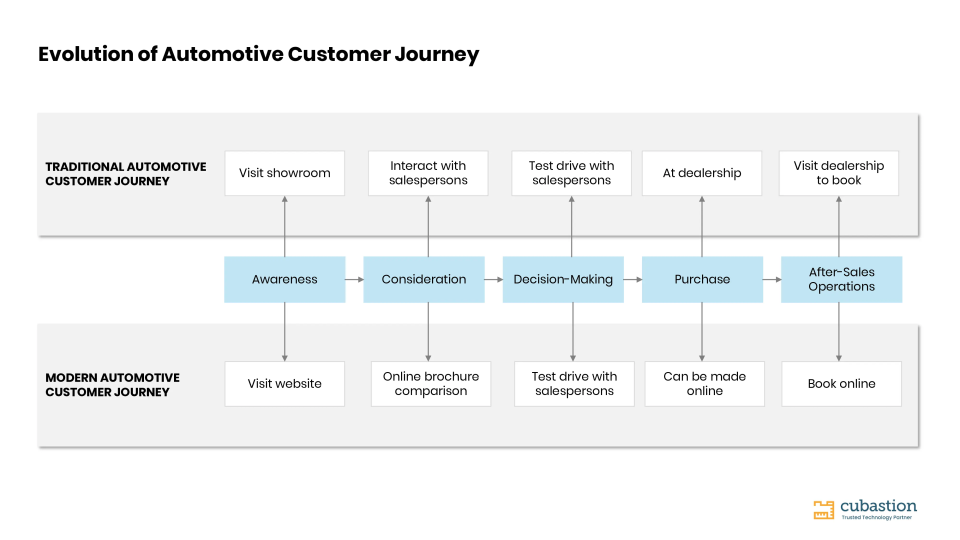
Traditionally, the automotive buying journey was anchored around physical dealerships. Customers visited showrooms to explore options, interact with sales representatives, and make purchase decisions. The process was largely linear, with every stage of the customer journey (awareness, consideration, test drive, negotiation, and purchase) mediated by the dealer.
Over the past decade, digital channels have significantly influenced this journey. Customers now begin with online research by reviewing specifications, comparing models, watching videos, and reading user feedback. However, while discovery has shifted online, decision-making and transactions have remained partially dependent on offline interactions.
The automotive buying journey is no longer just shifting from offline to online. Instead, it is being fundamentally re-engineered by AI. What was once a linear, dealer-led process is now an intelligent, adaptive journey shaped in real time by customer intent.
1. At the discovery stage, AI replaces generic browsing with personalized exploration. Instead of manually filtering through models, customers are guided by recommendation engines that analyze preferences, behavior, budget, and contextual signals. The journey becomes curated rather than self-driven.
2. As customers engage further, AI continuously interprets intent signals such as repeated comparisons, configuration changes, or time spent on specific features, and adapts the experience in real time. This enables systems to surface the most relevant options, highlight meaningful differentiators, and reduce decision fatigue.
3. AI also collapses the traditional gap between digital and physical interactions. Virtual showrooms, intelligent configurators, and conversational assistants allow customers to experience vehicles, understand features, and evaluate options without immediate reliance on dealerships. At the same time, when a transition to offline interaction is required, AI ensures continuity by passing context seamlessly to the dealer.
4. Most importantly, AI shifts the journey from reactive to proactive. Instead of waiting for customer inquiries, systems anticipate needs and suggest upgrades, offer financing options, or prompt test drives at the right moment. The journey is no longer something customers navigate alone; it is actively orchestrated around them.
As a result, the automotive buying journey evolves from a fragmented, channel-dependent process into a connected, intent-driven, and continuously optimized experience where every interaction is informed, relevant, and timely.
1.3 Building a Seamless Customer Journey with AI
AI enables a shift from a fragmented, reactive buying journey to a connected, proactive, and personalized experience, through the following capabilities.
1. Intelligent Discovery and Recommendation: AI analyzes customer preferences, browsing behavior, and contextual signals to recommend vehicles, variants, and configurations aligned to individual needs.
2. Virtual Showrooms and Configurators: AI-powered tools allow customers to explore vehicles through 3D visualizations, AR/VR experiences, and dynamic configuration options, thus replicating showroom experiences digitally.
3. Predictive Lead Scoring and Engagement: AI identifies high-intent customers and triggers timely interventions such as personalized offers, test drive scheduling, or dealer outreach.
4. Conversational AI and Assistants: Chatbots and voice assistants guide customers through queries, financing options, feature explanations, and booking processes.
5. Omnichannel Journey Orchestration: AI ensures continuity across digital and physical touchpoints, allowing customers to move seamlessly between online research and offline interactions.
1.4 Use Case: Vehicle Upgrade Selection
A practical example of AI redefining the automotive buying journey is a use case developed by Cubastion, which focuses on simplifying and personalizing the vehicle upgrade decision.
In this scenario, the journey begins with the customer providing details of their current vehicle, either manually, through VIN decoding, or via integration with service/ownership records. The AI engine analyzes this input across multiple dimensions, including vehicle specifications, usage patterns, ownership duration, and likely upgrade triggers such as mileage, maintenance cycles, or evolving lifestyle needs.
The system then compares the customer’s current vehicle against the OEM’s latest portfolio, identifying relevant upgrade options. Instead of generic recommendations, AI highlights models that offer meaningful improvements such as better fuel efficiency, enhanced safety features, upgraded technology, or improved performance tailored to the customer’s context.
For example, a customer driving a mid-range petrol sedan with moderate annual usage may be recommended a compact SUV with improved ground clearance, advanced driver assistance features, and better resale value.
The experience is further enhanced by presenting side-by-side comparisons, clearly showing the delta between the current vehicle and recommended options. AI also integrates pricing, financing options, and exchange value estimates, enabling the customer to evaluate the upgrade holistically.
As intent strengthens, the system can seamlessly transition the customer into the next stage, triggering personalized offers, scheduling dealership interactions, or enabling digital booking, while passing full context to the sales channel.
1.5 Outcome
The adoption of AI-driven automotive journeys delivers measurable benefits.
AI transforms the buying journey from a fragmented process into a cohesive, intelligent experience.
1.6 What Automotive Enterprises Get Wrong While Augmenting the Customer Journey with AI
Despite digital advancements, most automotive enterprises struggle to deliver a seamless, AI-enabled buying experience due to several structural challenges.
1. Fragmented Customer Journeys: Digital platforms, dealer systems, and CRM tools operate in silos, leading to inconsistent experiences across touchpoints.
2. Limited Personalization: Customers are often presented with generic recommendations rather than tailored options based on preferences, budget, or usage patterns.
3. Over-Reliance on Dealerships: Critical stages such as pricing transparency, availability, and negotiation still depend heavily on physical dealer interactions.
4. Delayed Engagement: OEMs and dealers often react after customer inquiries rather than proactively guiding the journey.
5. Lack of Real-Time Insights: Customer intent signals such as repeated configuration changes or comparison behavior are not effectively captured or acted upon.
These limitations result in lost opportunities, lower conversion rates, and suboptimal customer experiences.
1.7 Learning
The transition to AI-driven automotive journeys requires a strategic approach.
1. Start with High-Impact Touchpoints where AI can deliver immediate value.
2. Integrate Data Across Systems, breaking silos between digital platforms, CRM, and dealer systems to enable real-time orchestration.
3. Balance Digital and Physical Experiences, enhancing and not replacing the role of dealerships.
4. Design for Personalization at Scale, moving beyond segmentation to individual-level recommendations.
5. Continuously Optimize Based on Feedback
As automotive buying continues to evolve, organizations that leverage AI to create seamless, personalized, and proactive journeys will be best positioned to meet customer expectations and drive sustained growth.
By approaching AI as an intelligent discovery and decisioning layer rather than just a digital add-on, automotive enterprises can create buying journeys that are personalized, proactive, and conversion-driven.
If your current customer journey still depends on fragmented touchpoints, generic recommendations, and delayed dealer engagement, this is the moment to rethink your strategy. Connect with Cubastion to design and deploy AI-driven buying journeys that convert intent into action.