



When design meets the real world
In the previous article, we explored how organizations must design Agentic AI systems with clear architectural guardrails. The combination of signal intelligence, decision layers, and orchestration engines creates a powerful foundation for proactive customer experience.
However, architecture alone does not transform customer experience. The real challenge begins when organizations attempt to implement these systems within live enterprise environments.
Customer experience platforms rarely operate in isolation. They interact with CRM systems, operational databases, service platforms, digital engagement channels, and legacy applications. Implementing intelligent CX therefore requires more than technology deployment. It requires a carefully structured transformation roadmap.
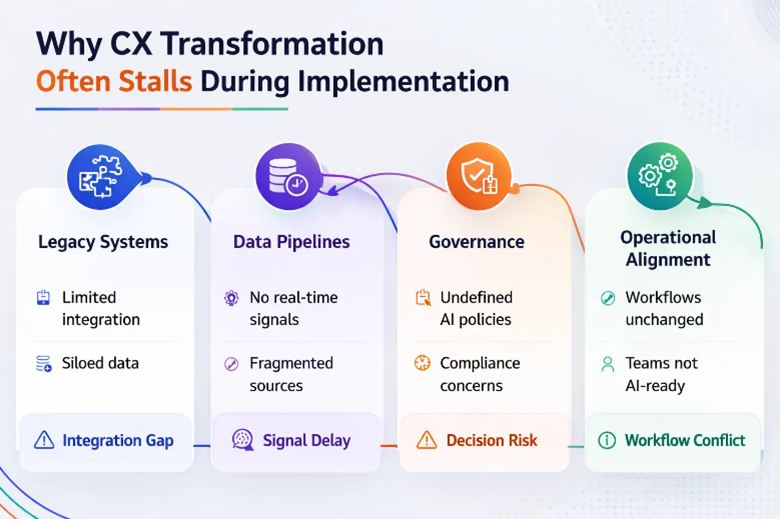
Why CX transformation often stalls during implementation
Many organizations begin their AI journey with ambitious transformation goals. Yet many CX initiatives struggle to move beyond experimentation. The reasons are rarely technical.
Instead, implementation challenges often arise from operational complexity:
- Legacy systems that cannot easily integrate with modern AI platforms
- Data pipelines that do not support real-time signal processing
- Lack of clear governance frameworks for automated decisions
- Difficulty aligning CX transformation with existing service operations
Even organizations that successfully deploy modern engagement platforms such as Salesforce Experience Cloud: Revolutionizing Digital Engagement often discover that enabling intelligent automation across multiple systems requires deeper architectural alignment.
Similarly, CRM modernization strategies discussed in How Salesforce Consultants Drive Business Growth Through CRM Optimization highlight the importance of creating unified data environments before introducing advanced AI capabilities.
Without a structured implementation approach, AI-driven CX initiatives can remain isolated pilot projects rather than enterprise capabilities.
Starting small: The power of CX pilot programs
Successful organizations rarely attempt to deploy AI-driven CX across their entire enterprise immediately. Instead, they begin with focused pilot programs.
Pilot programs allow organizations to test intelligent CX capabilities within controlled environments while minimizing operational risk.
Common pilot scenarios include:
- Automated resolution of common support requests
- Proactive detection of service disruptions
- Intelligent routing of customer inquiries
- Predictive alerts for potential customer issues
These pilots help organizations validate the effectiveness of AI-driven CX systems before scaling them across larger environments. Technologies such as those discussed in Unlocking Real-Time Insights: Why Change Data Capture Is Essential for Modern Enterprises often play a critical role during these pilots by enabling real-time signal processing.
The objective is not to prove that AI works. The objective is to prove that AI works reliably inside the organization’s operational environment.
Turning pilot success into scalable CX capabilities
Once pilot programs demonstrate measurable value, organizations can begin expanding intelligent CX capabilities across additional workflows.
At this stage, orchestration becomes critical. Automation systems must coordinate actions across multiple platforms CRM systems, service tools, operational databases, and communication channels.
This orchestration layer enables CX environments to move from reactive workflows toward intelligent service coordination.
A similar predictive operational model is described in AI-Driven Commerce Operations: Transforming SAP Commerce Reliability with Predictive Insights and AIOps, where AI-driven monitoring systems identify disruptions before customers experience service failures. Applying the same orchestration principles to CX enables enterprises to deliver proactive customer experiences at scale.
What early CX implementations reveal
Organizations that successfully implement AI-driven CX capabilities often see measurable improvements within their first pilot environments.
| CX Capability | Traditional Operations | AI-Enabled CX |
| Issue Detection | Customer reports issue | System detects early signals |
| Workflow Coordination | Manual escalation | Automated orchestration |
| Resolution Speed | Hours or days | Minutes |
| Customer Effort | High | Significantly reduced |
These improvements create momentum for broader CX transformation across the organization.
The implementation insight many leaders overlook
Implementing intelligent CX is not simply about deploying new technologies. It is about building confidence in autonomous systems across the organization.
Service teams must trust automated decisions. Leadership must understand governance mechanisms. Operational workflows must adapt to intelligent orchestration.
Organizations that approach implementation incrementally through pilots, controlled rollouts, and continuous learning are far more likely to succeed.
The next challenge: Scaling intelligence across the enterprise
By this stage, organizations have successfully:
- Identified the limitations of traditional CX systems
- Designed intelligent architectures with governance guardrails
- Implemented pilot programs to validate AI-driven CX capabilities
The next challenge is even more important. How do organizations scale these capabilities across the entire enterprise while maintaining trust, governance, and operational stability?
This is where the real transformation begins to take shape.