



Introduction: Moving from Theory to Execution
Understanding data integration tools is one thing, but the real challenge begins when organizations try to implement them in practical scenarios. This is where decisions are no longer just about features, but about alignment with business goals, existing systems, data volume, and long-term scalability. A well-planned implementation can streamline operations and unlock insights, while a poor one can lead to inefficiencies and rework. The focus of this blog is to bridge that gap by exploring how these tools are actually used in real-world environments.
Choosing the Right Tool Based on Business Context
The selection of a data integration tool is rarely a purely technical decision. It is influenced by the organization’s current ecosystem, budget constraints, and future roadmap. For instance, companies with a strong Oracle ecosystem often lean toward Oracle Data Integrator because it integrates seamlessly and leverages existing database capabilities. On the other hand, organizations that require flexibility across multiple data sources often consider Talend due to its wide connectivity and adaptability.
For cloud-first organizations, the decision typically shifts toward platforms like Informatica Intelligent Cloud Services, which reduce infrastructure overhead and enable faster deployment, or Databricks, which is better suited for handling large-scale data processing and advanced analytics. The key here is not to choose the most popular tool, but the one that aligns best with the organization’s data strategy.
Designing the Data Integration Architecture

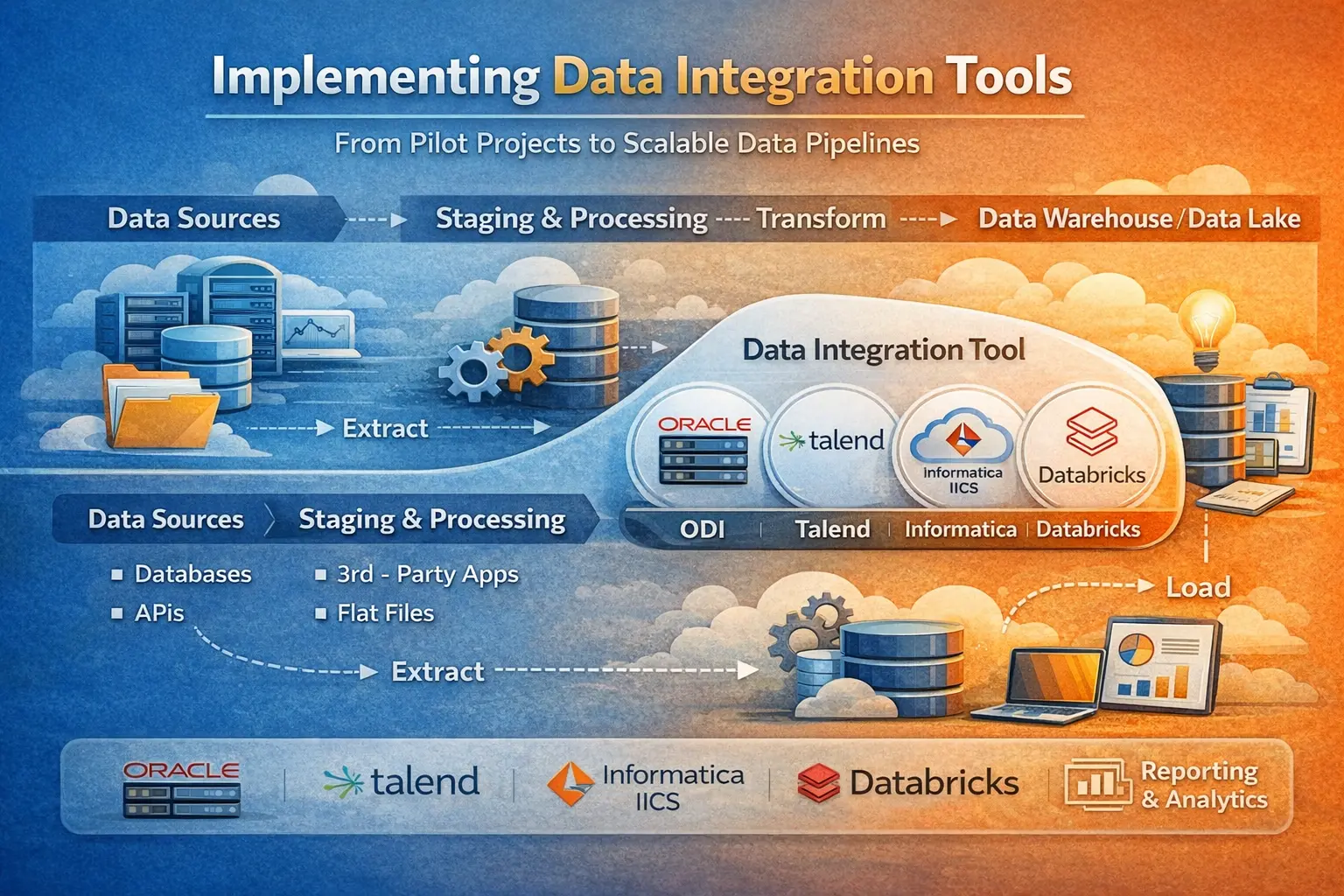
Once the tool is selected, the next step is designing a robust architecture that ensures smooth data flow across systems. A typical data integration setup begins with identifying data sources, which could include databases, APIs, third-party applications, or flat files. This data is then extracted and moved into a staging layer, where initial processing such as validation and cleansing takes place.
From there, the data is transformed into a structured format that aligns with business requirements before being loaded into a data warehouse or data lake. Tools like ODI and Talend are often used in structured environments where transformation logic is well-defined, while platforms like Databricks are preferred when dealing with unstructured or semi-structured data at scale. Cloud-based tools like IICS simplify this entire pipeline by providing managed environments where these steps can be configured with minimal infrastructure concerns.
Implementation Approach: From Pilot to Scale
In real-world scenarios, organizations rarely implement data integration solutions in one go. Instead, they start with a pilot project, focusing on a specific use case such as reporting for a single business function. This allows teams to validate the tool, understand performance limitations, and fine-tune transformation logic.
Once the pilot proves successful, the implementation is gradually scaled across departments and use cases. This phased approach reduces risk and ensures that the system remains stable as complexity increases. It also helps teams build internal expertise, which becomes crucial for managing and optimizing data pipelines over time.
Handling Performance, Scalability, and Maintenance
As data volumes grow, performance and scalability become critical factors in any data integration setup. On-premise tools like ODI rely heavily on database performance, which means optimization often involves tuning queries and improving database configurations. Talend implementations may require efficient job design and resource management to handle increasing workloads.
In cloud environments, scalability is more dynamic. Platforms like IICS handle scaling automatically to a large extent, while Databricks allows organizations to scale compute resources based on workload requirements. However, this flexibility also requires careful monitoring to avoid unnecessary costs. Maintenance in both environments involves regular monitoring, error handling, and updates to ensure that data pipelines continue to function reliably.
Common Challenges and How Organizations Overcome Them
Despite careful planning, most organizations face challenges during implementation. Data quality issues often emerge as one of the biggest hurdles, as inconsistent or incomplete data can disrupt the entire pipeline. Integration with legacy systems can also be complex, especially when dealing with outdated formats or limited connectivity.
To address these challenges, organizations invest in strong data governance practices, including validation rules, data standardization, and monitoring frameworks. Automation also plays a key role in reducing manual effort and ensuring consistency across processes. Over time, these practices help create a more stable and reliable data integration environment.
Conclusion: Turning Integration into a Strategic Advantage
Implementing data integration tools is not just a technical exercise, it is a strategic initiative that directly impacts how effectively an organization can use its data. The right combination of tools, architecture, and approach can transform fragmented data into a powerful asset that drives decision-making and innovation.
While the tools discussed, including ODI, Talend, IICS, and Databricks, each bring unique strengths, their true value lies in how they are implemented and aligned with business needs. Organizations that approach data integration with a clear strategy and phased execution are better positioned to scale, adapt, and extract meaningful insights from their data.