



When Automation Tried to Comfort a Human
The customer had just lost access to something important. It was not dramatic, but it was stressful. They reached out, explained the situation, and waited.
The response came instantly. It was polite. It followed the script. It even included an apology. On paper, it was exactly what should have been said.
But it felt empty.
The words were there, but the understanding was not. The customer was not looking for a procedure. They were looking for reassurance. Instead, they received a checklist.
This is where many modern CX designs quietly fail. They assume that if the right words are delivered in the right order, empathy will automatically be felt. But empathy does not live in structure. It lives in judgment. In timing. In knowing when a person needs more than a response.
Automation tried to comfort a human, and the human felt alone.
This is not because automation is wrong. It is because we asked it to lead in places where it was never meant to.
Why Empathy Cannot Be Automated the Same Way Efficiency Can
Efficiency is predictable. It can be measured, optimized, and scaled. Empathy is not. It changes with context, emotion, and human expectation. Yet many CX redesigns try to treat both the same way. They assume that if processes can be automated, understanding can be automated too.
This is where the disconnect begins.
Automation works best when the path is clear. Empathy is needed most when the path is unclear. Customers reach out when something has gone wrong, when they are confused, or when they feel uncertain. These moments do not follow scripts. They require interpretation, not just execution.
An ideal system understands this difference. It does not try to replace emotional judgment with logic. It supports the flow by gathering context, reducing friction, and preparing the ground for a human response when needed.
Empathy cannot be optimized like speed. It has to be designed for. When we forget this, we build experiences that are efficient but emotionally hollow.
The Mistake Most CX Redesigns Still Make
When organizations talk about redesigning customer experience, the focus often goes straight to automation. Faster resolution. Fewer agents. More self-service. These goals are not wrong, but they are incomplete. The mistake is assuming that removing humans from the flow automatically improves the experience.
In reality, it often does the opposite.
Many redesigns start by asking, “What can we automate?” instead of asking, “Where does the customer need understanding?” As a result, automation is placed at emotionally sensitive points in the journey. Moments that require reassurance, explanation, or judgment are handed to systems built for consistency, not compassion.
An ideal redesign starts from the customer’s emotional journey, not the operational flow. It identifies where customers feel vulnerable, confused, or frustrated and protects those moments instead of optimizing them away.
When empathy is treated as an exception rather than a requirement, the experience becomes efficient but cold. The redesign succeeds on paper and fails in memory.
Where AI Should Listen, Not Lead
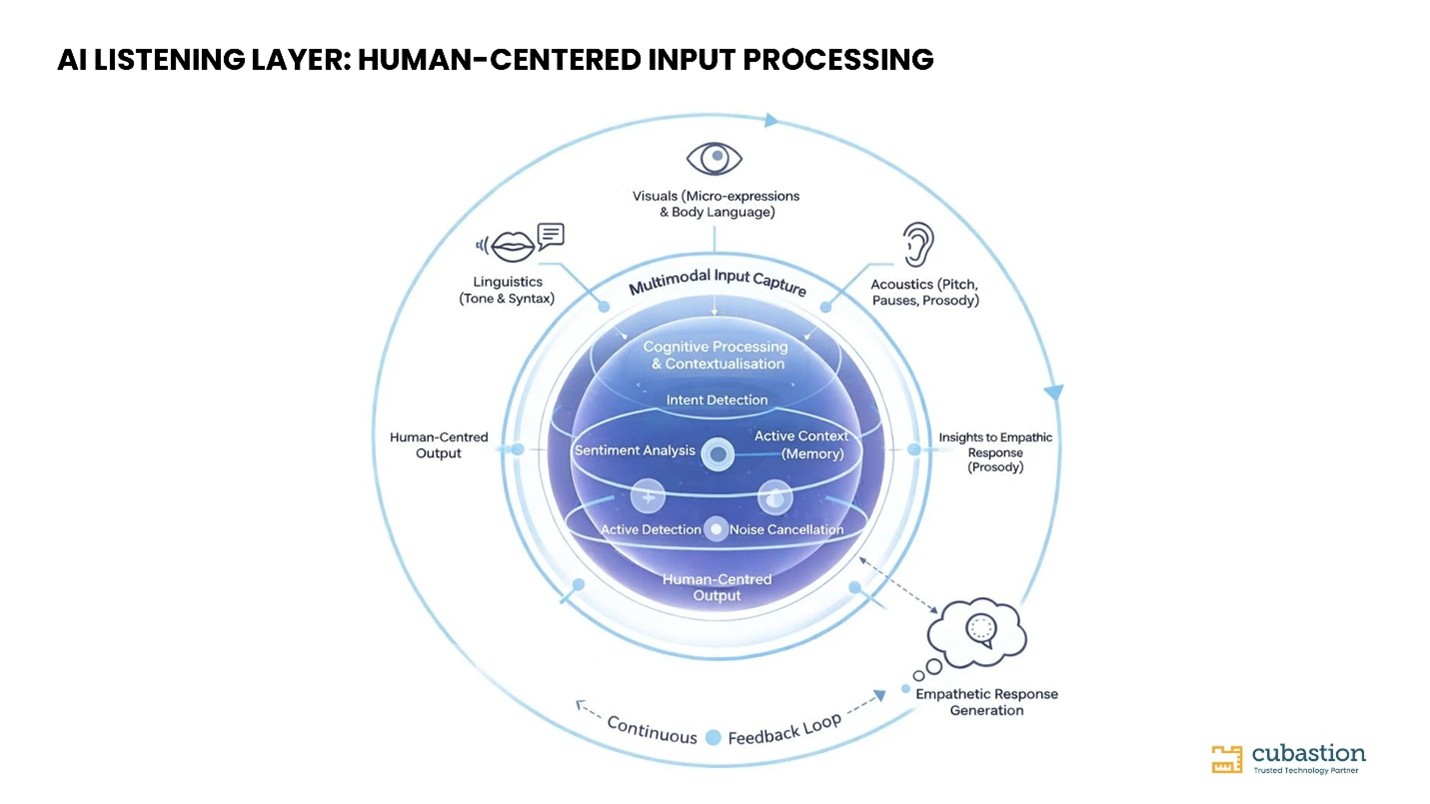
AI is strongest when it is observing, interpreting, and preparing. It is not strongest when it is deciding how a human should feel. In an empathy-led CX design, AI plays the role of listener before it plays the role of actor.
This means AI should focus on:
- Understanding intent
- Detecting shifts in emotion
- Noticing repetition, hesitation, or escalation
- Connecting the dots across interactions
In an ideal system, AI quietly gathers this context in the background. It notices that a customer has contacted support twice in a short period. It recognizes frustration building in the tone. It understands that the issue is no longer just technical. It is emotional.

Instead of pushing forward with another scripted flow, the system slows down. It adjusts its response or prepares the conversation for a human handoff. The customer does not see this decision being made. They simply feel that the experience is becoming more attentive.
AI should not lead empathy. It should enable it. It should listen carefully, remove friction silently, and make it easier for humans to step in when understanding matters more than speed.
Where Humans Should Lead, Not Follow
There are moments in every customer journey where logic is not enough. A billing dispute, a service failure, a delayed delivery, or a personal inconvenience carries emotional weight. In these moments, customers are not looking for process. They are looking for judgment, reassurance, and accountability. This is where humans must lead.
In an ideal system, humans are not brought in as a last resort. They are brought in at the right moment. The system recognizes when emotion is rising or when the conversation is becoming sensitive. It prepares the human agent with full context and then steps aside.

The human does not read from a script. They listen, respond, and adapt. They acknowledge the situation and take ownership. This is not inefficiency. This is precision. When humans lead where empathy is required, resolution becomes meaningful, not just complete.
What an Empathy-Led CX System Looks Like in Practice
Automobile Industry Example: Redesigning Service CX Through AI and Human Collaboration
A large automobile enterprise operating across multiple regions faced growing challenges in its service operations. While digital channels had improved response speed, customer satisfaction scores remained inconsistent. Service advisors were overwhelmed with repetitive queries, while complex service issues still required human judgment and reassurance.
To address this, the enterprise redesigned its service CX around a clear principle: AI would listen and prepare, while humans would lead emotionally sensitive interactions.
AI was introduced as a listening layer across service touchpoints, capturing customer intent, service history, and repeat issues before routing conversations. Routine queries related to service status, appointment scheduling, warranty checks, and spare availability were handled automatically. However, cases involving delays, repeated complaints, or service dissatisfaction were proactively routed to human advisors with full context.
| Aspect | Before Redesign | After Empathy-Led Redesign |
| Customer Query Handling | All service queries followed similar automated flows | Routine queries automated, emotionally sensitive cases routed to humans early |
| Context Availability | Advisors relied on fragmented service history | Full service history, repeat issues, and customer context available upfront |
| Customer Escalations | Escalations occurred late, often after frustration peaked | Early human intervention reduced escalation frequency |
| Advisor Efficiency | Advisors spent time gathering basic information | AI prepared context, allowing advisors to focus on resolution and reassurance |
| First-Contact Resolution | Dependent on customer repeating information | Improved due to better preparation and continuity |
| Customer Satisfaction | Inconsistent, especially during service delays | Noticeable improvement in delay, billing, and repeat complaint scenarios |
Measured Outcomes within 6 months:
1. 22 % reduction in average advisor handle time
2. 17 % improvement in first-contact resolution
3. 15 % reduction in customer escalations
4. 12 % increase in post-service satisfaction scores
Micro-Example: Roadside Assistance and Emergency Support
In a separate scenario, the same enterprise applied empathy-led design to roadside assistance interactions. These moments are inherently emotional. Customers are often stranded, anxious, or pressed for time. Earlier systems treated these cases as logistics problems.
The redesigned experience changed the flow.
AI handled location detection, vehicle details, and service availability in the background. At the same time, it identified emotional urgency based on language patterns and timing. Instead of continuing with automated prompts, the system routed the interaction to a human advisor within seconds.
The advisor joined the conversation already aware of:
1. Vehicle condition
2. Location and response time
3. Previous assistance history
4. Customer urgency level
This allowed the advisor to focus on reassurance and coordination rather than data collection.
As a result:
1. Average roadside resolution time reduced by 18 percent
2. Customer abandonment during assistance calls dropped by 20 percent
3. Satisfaction scores during emergency interactions improved significantly
4. Customers reported feeling “guided” rather than “processed,” even when resolution times were unchanged.
Why This Works: Empathy as a Design Principle
Across both service and roadside scenarios, the success was not driven by adding more automation. It came from redesigning where automation belonged.
AI was positioned to:
1. Listen and prepare
2. Detect emotional signals
3. Reduce friction
Humans were positioned to:
1. Lead emotionally sensitive moments
2. Provide reassurance and judgment
3. Take ownership when trust mattered
This balance transformed service CX from a reactive support function into a calmer, more reliable experience for both customers and advisors.
The automobile industry operates at scale, under time pressure, and with high customer expectations. These examples show that empathy does not slow operations. When designed correctly, it reduces friction, improves outcomes, and strengthens trust without sacrificing efficiency.

How Roles Shift When Empathy Is Designed In
When empathy is intentionally designed into CX, roles change naturally. AI stops trying to sound human. Humans stop being forced to behave like systems. Each does what it is best at.
AI becomes the quiet observer. It watches patterns, tracks history, notices changes in tone, and gathers context. It handles repetition, background checks, and preparation without being visible. Its role is to reduce noise, not replace understanding.
Humans become the emotional leaders. They step into conversations where nuance, accountability, and reassurance are needed. They are no longer burdened with basic data collection or repetitive tasks. Instead, they focus on listening, interpreting, and responding with judgment.
In an ideal setup, this shift feels seamless. The customer does not see a handoff. They simply feel that the conversation is becoming more attentive. This is what happens when AI supports empathy instead of competing with it.
The Business Impact of Letting Humans Lead Emotion
When humans are allowed to lead in emotionally sensitive moments, the impact goes beyond customer satisfaction. Trust strengthens. Escalations reduce. Conversations become shorter because customers feel understood, not because they are rushed.
In an empathy-led system, customers are less defensive. They explain more clearly. They are more open to solutions. This changes the tone of the entire interaction. What could have become a conflict often becomes a collaboration.
From a business perspective, this reduces repeat contacts, lowers complaint fatigue, and improves long-term loyalty. Customers may forget the problem, but they remember how they were treated. When empathy is led by humans and supported by AI, relationships deepen instead of eroding.
Designing for Partnership, Not Replacement
One of the quiet fears around AI in customer experience is the idea of replacement. That systems will take over, and humans will slowly be pushed out. But the most effective CX designs do not think in terms of replacement. They think in terms of partnership.
In a partnership model, AI and humans are not competing for control. They are supporting each other. AI handles scale, consistency, and context gathering. Humans handle interpretation, empathy, and judgment. Each strengthens the other.
In an ideal system, this balance is intentional. AI does not try to sound human. Humans are not forced to follow rigid scripts. The experience flows naturally because each role is respected.
Customers do not care who handled what. They care that the experience felt right. Designing for partnership ensures that intelligence and empathy grow together instead of pulling the experience in opposite directions.
The New Shape of Customer Experience
Customer experience is quietly being reshaped. Not by faster systems. Not by more automation. But by a clearer understanding of where technology should support and where humans should lead.
The future of CX will not be defined by how much we automate, but by how wisely we design. AI will listen more. Humans will lead more. And experiences will feel less like processes and more like conversations.
When empathy is protected in design, trust follows naturally. Customers feel safer. Agents feel more effective. And organizations build relationships instead of transactions.
The new shape of customer experience is not machine-driven or human-only. It is human-centered, with AI working in the background. Listening first. Supporting quietly. And stepping aside when understanding matters most.