


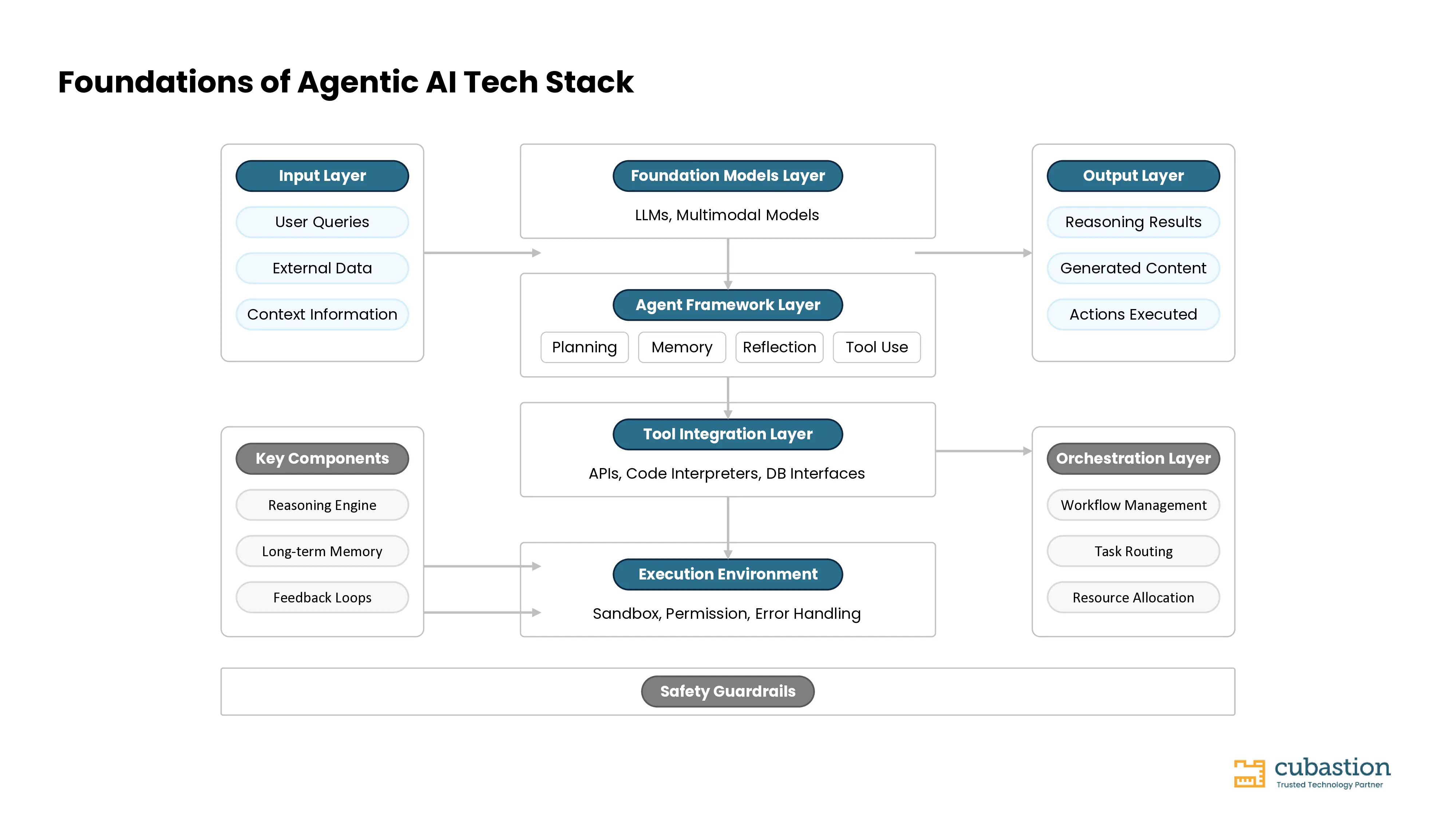

The Customer Experience (CX) landscape is undergoing a paradigm shift from traditional, manual “Systems of Record” to autonomous, AI-driven “Systems of Intelligence”. As enterprises deploy Agentic AI systems capable of complex reasoning, tool execution, and memory manage- ment under lying infrastructures must evolve. Building a scalable infrastructure requires a multi- layered approach that integrates Enterprise PaaS foundations with specialized inference engines, dynamic orchestration, and robust data governance. This strategic alignment ensures ultra-low latency, cost-effective scaling, and secure, hyper-personalized customer journeys.
In 2025, agentic AI adoption in enterprises surged, with 79% of organizations reporting at least some implementation. According to Gartner, by 2029, 80% of common customer service issues will be handled by agentic AI without human intervention. Real-world deployments demonstrate transformative efficiency: a hotel chain handled 70% of investor inquiries autonomously, while a textile agency reduced knowledge retrieval time from 3 minutes to under 10 seconds with 97% accuracy. This article explores the background, challenges, solutions, optimizations, case studies, outcomes, and key learnings for implementing scalable agentic AI infrastructure in CX.

From Passive CRM to Agentic AI: The Evolution of Intelligent Customer Engagement
Customer Relationship Management (CRM) systems have historically functioned as linear, pas- sive tools. Their primary purpose was to record customer information, track sales pipelines, and manage service tickets. However, modern customer behavior has fundamentally changed; clients now demand seamless, personalized, and instantaneous interactions across highly fragmented digital touchpoints.
To meet these demands, enterprises are transitioning toward Agentic AI. Unlike basic chatbots, AI agents do not merely respond to prompts; they break down complex goals, prioritize tasks, access vector databases via Retrieval-Augmented Generation (RAG), and execute multi-step workflows autonomously. Agentic AI represents the next evolution in AI, moving from predictive to proactive systems that can reason, plan, and act independently.
The rise of agentic AI is backed by rapid market growth. In 2025, the agentic AI market reached
$7.92 billion, projected to grow to $236.03 billion by 2034 at a CAGR of 46.5%. Large-scale industries held 65.05% market share in 2025, with 72% of enterprises adopting autonomous AI systems, boosting productivity by 35%. In CRM specifically, agentic AI is transforming sales and service: Salesforce reports a 119% surge in agent creation among first-mover companies in the first half of 2025, with customer service conversations led by agents growing 22 times.
This shift is driven by the need for “Systems of Intelligence” that leverage LLMs like GPT-4 or Gemini to handle dynamic customer interactions. However, successful deployment requires robust infrastructure to support real-time inference, data integration, and scalability. As per IBM’s report, 85% of advanced organizations have scalable infrastructure for complex AI work- loads, compared to 52% of less advanced peers.

Furthermore, agentic AI enables enterprises to handle increasing interaction volumes. For in- stance, McKinsey highlights that agentic AI can orchestrate multiple AI agents at scale, trans- forming customer experience. Genesys emphasizes the need for robust data infrastructure to support real-time access to customer history and signals. Vonage notes that agentic AI in con- tact centers routes requests, solves issues in real-time, and reduces wait times. Cisco’s research shows agentic AI provides scalability, personalization, and increased uptime in B2B tech.
Architectural and Operational Bottlenecks in Scaling Agentic AI
Deploying Agentic AI at an enterprise scale introduces severe architectural and operational bottlenecks:
- Data Silos & Rigidity: Traditional CRMs suffer from isolated data across marketing, sales, and service departments, preventing the unified customer view required by This leads to incomplete context for agents, resulting in inaccurate responses.
- Computational Intensity: Large Language Models (LLMs) and multi-agent systems re- quire massive computational power. Interactive CX applications demand strict real-time responsiveness, making high latency For instance, recalculating KV vectors in long-context interactions can cause delays of seconds, frustrating users.
- The KV Cache Bottleneck: In long-context customer interactions, recalculating the Key and Value (KV) vectors for historical tokens during autoregressive decoding causes unbearable computational overhead and consumes massive GPU Without optimization, mem- ory usage scales linearly with sequence length, limiting context windows to a few thousand tokens.
Security & Compliance Risks: Passing sensitive customer data to external, general- purpose LLMs via shallow API integrations exposes enterprises to data sovereignty violations, privacy breaches, and model “hallucinations”. In regulated industries like finance, this can lead to fines exceeding millions.
Additional challenges include cost escalation LLM inference can cost $250,000 monthly for high- volume apps and integration complexity with legacy systems. Gartner notes that by 2025, 40% of enterprise workflows will include agentic AI, but only those with scalable infrastructure will succeed. Forbes emphasizes purpose-built AI infrastructure for scaling, addressing integration, reliability, and performance. IBM highlights the need for secure, open frameworks for orches-tration and scalability. McKinsey points out the need for right infrastructure to implement agentic AI at scale. Genesys stresses composable tech stacks for adaptability. Vonage discusses scalability issues in contact centers.

Designing AI-Native Infrastructure for Enterprise Agentic AI Systems
To overcome these challenges, organizations must adopt a 7-layered, AI-Native infrastructure stack. This architecture shifts from a “bolt-on” AI approach to a native ecosystem where models, data, and business logic are deeply intertwined.
The 7-Layer Infrastructure Stack
LLM, Triton for batching and quantization; Model Registries (Hugging Face, MLflow) for lifecycle management.
This stack integrates seamlessly, with data flowing from user inputs through agents to hardware- accelerated inference. Cisco’s architecture maps agentic AI to infrastructure, emphasizing com- pute, network, and data. Oracle’s OCI provides tools for agentic AI deployment.
User Interaction Layer: The entry point for multi-modal customer requests (e.g., web, mobile, CLI). Tools: Web UI, APIs, SDKs. Ensures stable, low-latency connections to
API&OrchestrationLayer : Manages user requests and orchestrates Tools: API Gateways like NGINX, Envoy, Kong for routing, authentication, rate limiting; Agent Frameworks like LangChain, CrewAI, KAgent for dynamic task management.
Data & Memory Layer: Provides context Tools: Vector Databases (Pinecone, Weaviate, Qdrant, Chroma) for RAG; Caches (Redis, SQL DBs) for session data.
ModelServiceLayer : Handles high-throughput Tools: vLLM, TGI, TensorRT-
Orchestration & Runtime Layer: Abstracts Tools: Kubernetes for con- tainer management; Airflow, Prefect, Dagster for workflows.
Hardware Layer: Compute Tools: NVIDIA GPUs, AWS Inferentia, Google TPUs; High-speed networks like NVLink, Infini Band.
Monitoring&ObservabilityLayer : Ensures Tools: Prometheus/Grafana for metrics; Loki for logs; Tempo/OpenTelemetry for tracing.

Advanced Inference Optimization
To ensure low-latency CX, optimize model serving:
KV Cache Management: Stores computed KV vectors, reducing complexity from quadratic to linear. Benefits: 2-4x throughput increase; challenges: high memory us- age for long sequences, addressed by eviction or NVIDIA’s Dynamo evicts KV cache parts, reducing TCO by 35%. Hugging Face explains KV caching for efficiency. NVIDIA’s DMS compresses KV cache by up to 8x.
Model Quantization: Reduces precision (e.g., INT8/INT4), cutting memory by 2-4x with <5% accuracy loss.
CostOptimizationStrategies : Use spot instances for 50-90% savings; semantic caching bypasses GPUs for repeated queries. Deloitte discusses recalculating infrastructure for inference Cloudkeeper suggests tagging, rightsizing, automation.

Native PaaS Base & Data Governance
A unified PaaS foundation enables metadata-driven data flows. Hybrid AI Strategy: Route non- sensitive tasks to public LLMs, core logic to private models in secure sandboxes. Salesforce’s Hyperforce provides scalable cloud for agentic AI.
The inference process from user prompt to response involves:
Optimization Strategies
Model-Level Optimizations
Inference-Level
Cost Strategies
Infrastructure: Auto-scaling, spot instances. AWS Bedrock strategies include model selection, prompt engineering.
Access via API Gateway (Kong).
Agent orchestration (KAgent) parses
RAG: Embed prompt, query vector DB (Pinecone).
Cache check (Redis).
Routing to inference server (vLLM) on Kubernetes pods with NVIDIA
Response generation and post-processing.
Monitoring
Distillation: Train smaller models from large ones, reducing size by 95% and costs by
Pruning: Remove redundant
Batching: Process multiple requests simultaneously, 2-4x
KV Caching: Linear complexity, but manage memory with offloading (e.g., NVIDIA Dynamo for 35% TCO reduction).
Flash Attention and Paged Attention: Optimize attention
Prompt Optimization: Reduce tokens by 20-40%.
Model Routing: Save 37-46% by selecting optimal

Enterprise Adoption and Real-World Results of Agentic AI
Market Adoption and Strategic Momentum
Independent research from Gartner projects that by 2029, approximately 80% of common customer service issues will be resolved without human intervention through AI-enabled automation. This reflects a broader structural shift in enterprise workflow design, where AI agents increasingly orchestrate routine decision-making and customer interaction processes.
Operational Efficiency Gains
Research from McKinsey & Company estimates that generative AI can automate 60–70% of time spent on customer service workflows. Enterprises deploying AI-assisted contact centers report reductions of up to 30% in average handling time and cost reductions ranging between 20–45% in customer operations.
Infrastructure and Inference Performance Validation
The computational demands of long-context interactions introduce a critical bottleneck: Key-Value (KV) cache memory growth during autoregressive decoding. Without optimization, memory scales linearly with sequence length, restricting context windows and increasing GPU costs.
Enterprise Deployment Case Evidence
Real-world implementations across industries validate the architectural principles outlined in this paper:
Outcome
By implementing a scalable Agentic AI infrastructure, enterprises achieve:
Learning
Transitioning to Agentic AI is an architectural challenge, not just a software update. Key takeaways include:
- Balance Immediate Needs with Scalability: Organizations should start with mature, con- cise solutions and incrementally increase system
- Infrastructure is a Strategic Asset: Efficiently managing hardware constraints specifically mastering KV Cache management and model quantizationis the dividing line between a slow, expensive prototype and a production-grade enterprise system.
- Security Must be Native: The success of AI in CX relies heavily on trust. Fine-grained access control, continuous monitoring, and strict data sovereignty must be built directly into the foundation of the architecture.
- Readiness Assessment: Evaluate data, governance before
In conclusion, scalable infrastructure is key to unlocking agentic AI’s potential in CX. With tools like vLLM, Kubernetes, and vector DBs, enterprises can achieve efficient and secure deployments.
If you are planning to transform your enterprise with proven agentic AI today, schedule a personalized demo and see how we can deploy a secure, scalable AI assistant tailored to your operations in weeks, not months.