



Self-Learning AI Agents for Customer Service Automation
Executive Summary:
Why Static Automation Is No Longer Enough
Customer service automation has matured significantly over the past decade. Enterprises now rely on chatbots, virtual assistants, and workflow engines to manage high volumes of customer interactions. While these systems have improved efficiency, reduced response times, and lowered operational cost, most remain fundamentally static in design.
Traditional automation operates on predefined logic, structured training cycles, and manual updates. As customer behavior evolves across channels, products, and service expectations, these systems struggle to keep pace. The result is rising repeat contacts, intent misclassification, increasing escalations, and additional correction workload for service teams.
Self-learning AI agents introduce structured adaptability into automation ecosystems. By continuously detecting interaction patterns, refining classification accuracy, predicting escalation risks, and improving response relevance within defined guardrails, these systems evolve responsibly.
When implemented with governance and operational oversight, self-learning AI agents reduce friction, improve first-contact resolution, and strengthen service reliability at scale. The next generation of automation is not just faster. It is adaptive.
Background:
The Evolution and Limits of Traditional Customer Service Automation
Over the last decade, customer service automation has shifted from experimental to essential. Enterprises across industries have deployed chatbots, virtual assistants, automated ticketing systems, and AI-driven routing engines to manage increasing interaction volumes. In many organizations, automation now handles between 40 to 70 percent of inbound service requests.
The initial impact was significant. Response times decreased. Operational costs stabilized despite growing demand. Service teams were freed from repetitive queries such as order tracking, appointment scheduling, password resets, and policy clarifications. Automation brought consistency and scale.
However, the architecture behind most of these systems remained static.
Traditional automation relies on structured intent models, rule-based workflows, and periodic retraining cycles. Improvements are typically scheduled. Knowledge bases are manually updated. Intent classifications are refined after performance drops are detected. Adaptation happens reactively, not continuously. Meanwhile, customer behavior evolves rapidly.
Product portfolios change. Policies are updated. Marketing campaigns influence language patterns. Regional slang and abbreviations shift. Customers move fluidly between chat, voice, email, and social channels. Expectations for instant, context-aware responses continue to rise.
This mismatch creates gradual performance degradation. Intent accuracy slowly declines. Customers rephrase queries more frequently. Escalations increase. Agents spend time correcting automated outputs. By the time manual retraining cycles are triggered, friction has already accumulated. The limitation is not automation itself. It is the absence of adaptive intelligence within the automation layer.
To move beyond incremental updates and periodic corrections, enterprises require systems that learn continuously within controlled boundaries. This shift marks the transition from static automation to structured self-learning AI agents.
Problem Statement:
The Performance Ceiling of Static AI Systems
Despite widespread deployment of automation, many enterprises are encountering a predictable challenge: performance plateaus.
At launch, automation accuracy is high. Intent models are well-trained. Knowledge articles are current. Routing flows are optimized. But over time, subtle gaps begin to appear.
Customers rephrase the same query in new ways that the system does not immediately recognize. Product updates introduce new terminology not reflected in the training data. Policy changes create confusion that existing scripts do not address clearly. As these gaps widen, service friction increases.

This friction manifests in measurable ways:
· Rising repeat contact rates for the same issue
· Increased escalation to human agents after failed automation attempt
· Growing agent correction workload
· Higher interaction abandonment rates
· Declining customer confidence in self-service channels
· The core issue is latency in adaptation.
Traditional systems depend on manual performance reviews, retraining cycles, and structured release schedules. By the time updates are deployed, customer behavior may have already evolved further. Automation remains efficient in handling volume, but it struggles to maintain relevance.

This creates a performance ceiling. Even with expanded automation coverage, resolution quality does not proportionally improve. In some cases, expanding automation without adaptability amplifies frustration instead of reducing it.
Enterprises require a model where automation does not wait to be updated. It must detect, analyze, and refine patterns continuously — while remaining governed and compliant.
Breaking this ceiling requires rethinking automation architecture itself.
Solution:
Architecting Structured Self-Learning AI Agents
Learning Overcoming the limitations of static automation requires more than adding advanced algorithms. It requires rethinking how automation learns, adapts, and operates within enterprise governance frameworks.
Structured self-learning AI agents are designed around three core principles: continuous observation, controlled refinement, and accountable evolution.
1. Continuous Observation of Interaction Outcomes
Instead of relying solely on scheduled retraining cycles, self-learning agents monitor live interaction signals, including:
· Repeated rephrasing of the same query
· Escalation triggers following automated responses
· Customer abandonment after specific reply patterns
· Repeat contacts within short timeframes
· Agent correction of automation outputs
These signals act as performance indicators. The system identifies patterns across interaction volumes rather than reacting to isolated events.

2. Controlled Refinement Within Guardrails
Learning does not equate to unrestricted change. Structured self-learning systems refine behavior incrementally based on confidence thresholds.
Examples of refinement include:
· Improving intent classification accuracy as new language patterns emerge
· Reordering response flows to address common clarification gaps
· Predicting escalation probability earlier in the interaction
· Adjusting routing decisions for high-risk queries
All changes operate within predefined boundaries:
· Brand tone and compliance language remain fixed
· Confidence scoring prevents low-certainty adjustments
· Human validation layers review structural modification
· Escalation logic ensures risk containment
· Adaptation is gradual, measurable, and reversible if required.

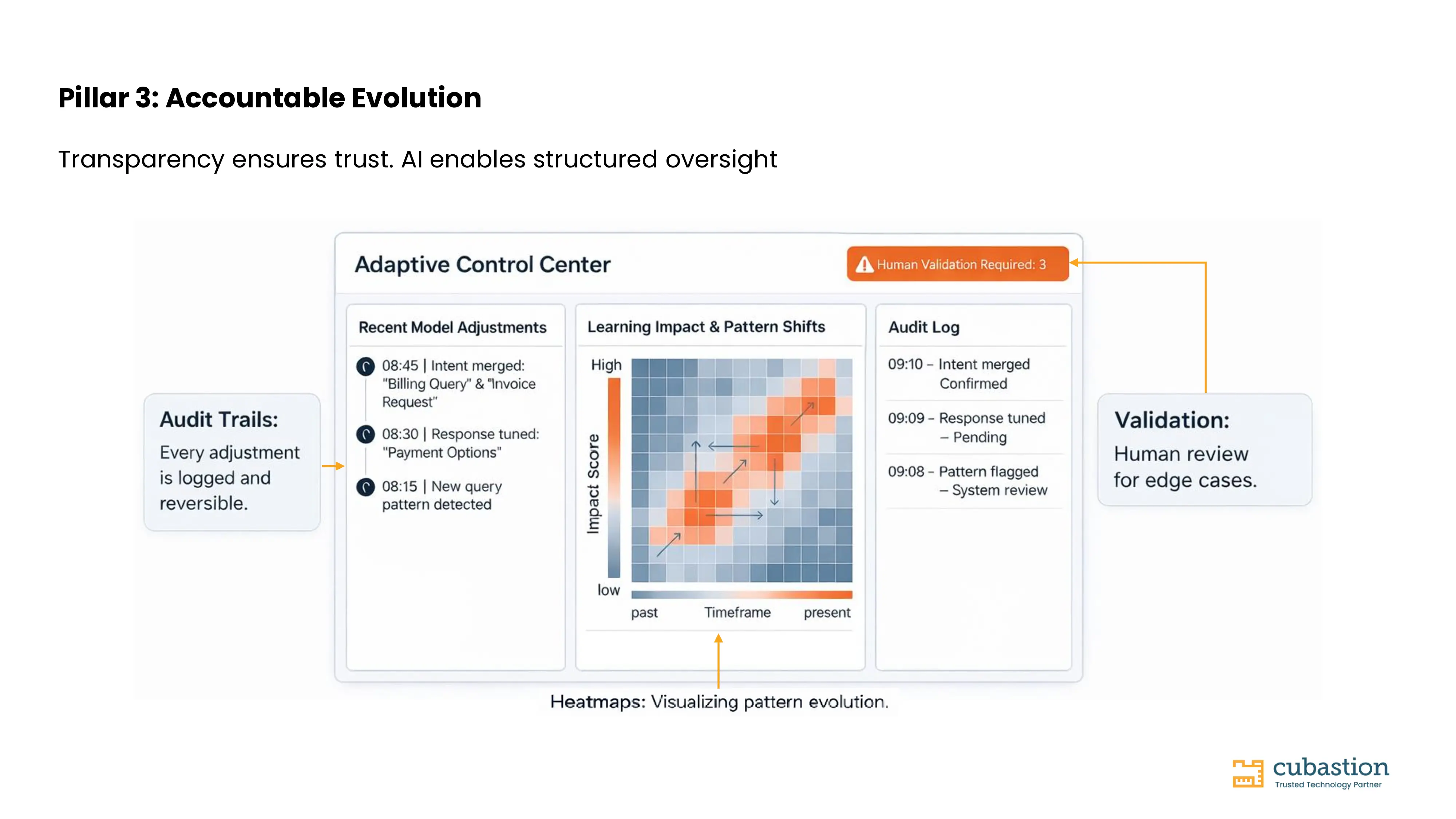
3. Accountable Evolution with Operational Oversight
Self-learning must remain transparent. Enterprise-grade systems include:
· Audit trails of model adjustments
· Performance dashboards tracking learning impact
· Escalation heatmaps highlighting pattern shifts
· Periodic governance reviews to validate alignment with business objectives
This ensures that learning enhances service reliability rather than introducing volatility.
The result is automation that does not wait for manual intervention to improve. Instead, it evolves responsibly — reducing friction while maintaining stability.
Structured self-learning is not about autonomy replacing oversight. It is about embedding adaptability into automation architecture without compromising control.
Result / Proof:
Measurable Business Impact of Adaptive Automation
To validate the effectiveness of structured self-learning AI agents, Cubastion has worked with a high-volume enterprise support operation and implemented the model across its digital service channels. The environment included chat, email, and assisted service routing, handling hundreds of thousands of interactions monthly.
Prior to implementation, automation coverage exceeded 60 percent. However, repeat contacts and escalations were steadily increasing. Intent recognition accuracy had declined due to evolving customer language patterns, and agents frequently corrected automation outputs during handoffs.
Over a six-month period following the deployment of structured self-learning capabilities, measurable improvements were observed:
- 18 percent reduction in repeat contacts for the same issue
- 21 percent improvement in intent recognition accuracy as new language patterns were incorporated dynamically
- 14 percent decrease in unnecessary escalations, driven by earlier risk detection
- 11 percent increase in first-contact resolution rates
- Noticeable reduction in agent correction effort, improving productivity and reducing interaction fatigue
Importantly, these improvements were achieved without expanding headcount or increasing automation aggressiveness. Automation coverage remained stable, but quality improved through adaptive refinement.
Operational dashboards indicated faster detection of knowledge gaps and emerging service patterns. Supervisors were able to intervene proactively rather than reactively. Escalation trends became more predictable, improving workforce planning.

The data demonstrates that the value of self-learning lies not in higher automation volume, but in improved automation intelligence. Adaptive systems reduce friction, improve resolution outcomes, and stabilize service performance without increasing operational complexity.
Outcome:
Operational Stability and Customer Experience Transformation
Beyond performance metrics, the introduction of structured self-learning AI agents created measurable shifts in operational stability and overall customer experience quality.
1. Improved Customer Experience Consistency
Customers experienced fewer repetitive exchanges and more accurate responses during initial interactions. Because intent recognition improved dynamically, customers were less likely to rephrase queries or abandon conversations. Escalations, when required, occurred earlier and with better-prepared context.
The overall experience became smoother, even when resolution time remained unchanged. Reduced friction translated into higher confidence in digital service channels.
2. Reduced Operational Volatility
Service leaders observed greater predictability in interaction patterns. Instead of sudden spikes caused by outdated automation logic, adaptive monitoring enabled earlier detection of emerging trends. Knowledge gaps were identified before they escalated into systemic issues.
This predictability improved workforce planning and reduced reactive firefighting within support teams.
3. Increased Agent Effectiveness
Agents benefited from fewer correction-driven interactions. When cases were escalated, they arrived with richer contextual data and clearer classification. This reduced the cognitive load on agents and improved confidence during resolution.
Lower correction effort also contributed to reduced emotional fatigue, particularly in high-volume environments.
4. Enhanced Leadership Visibility
Supervisors and CX leaders gained actionable insights into interaction patterns, escalation triggers, and behavioral shifts. Instead of reviewing isolated cases, they analyzed structured trend data surfaced by the learning layer.
This elevated CX management from reactive issue handling to proactive experience optimization.
In essence, self-learning AI agents did not merely improve automation performance. They strengthened the entire service ecosystem — stabilizing operations, supporting agents, and reinforcing customer trust.
Key Learnings:
Designing Responsible AI Evolution in Customer Service
The implementation of structured self-learning AI agents revealed several critical insights for enterprises seeking to modernize their automation strategies.
1. Adaptability Must Be Designed, Not Assumed
Learning does not happen automatically simply because AI is deployed. Enterprises must intentionally design feedback loops, pattern detection mechanisms, and validation processes. Without structure, adaptation either stalls or becomes unstable.
Self-learning capability is an architectural decision, not a feature toggle.

2. Guardrails Are as Important as Intelligence
Uncontrolled adaptation introduces risk. Confidence thresholds, human validation layers, and compliance boundaries ensure that learning enhances reliability rather than undermines it.
Organizations that balance adaptability with governance achieve sustainable performance improvements.
3. Performance Signals Extend Beyond Speed
Traditional metrics such as response time and automation rate are insufficient indicators of service health. Self-learning systems rely on deeper signals, including repeat contact frequency, escalation probability, abandonment behavior, and agent correction patterns.
These signals provide early warnings of friction before customer dissatisfaction escalates.
4. Human Expertise Remains Central
Self-learning agents reduce friction, but they do not eliminate the need for human judgment. Instead, they elevate the role of service professionals. Agents shift from correcting automation to resolving complex, meaningful interactions.
The goal is not to replace human involvement but to make it more impactful.
5. Continuous Improvement Creates Competitive Advantage
Enterprises that adopt adaptive automation move from reactive maintenance to proactive optimization. As customer expectations evolve, their systems evolve in parallel.
This capability becomes a long-term differentiator in competitive service environments.
Structured self-learning AI is not about accelerating automation blindly. It is about building systems that mature responsibly over time.
Call to Action:
Building Adaptive Customer Service with the Right Partner
Transitioning from static automation to structured self-learning AI requires more than deploying new technology. It demands architectural redesign, governance alignment, operational integration, and continuous monitoring.
Many enterprises already have automation in place. The challenge is not starting from zero. The challenge is evolving responsibly without disrupting existing service ecosystems.
This is where strategic design and implementation expertise become critical.
Cubastion supports organizations in:
- Assessing automation maturity and identifying adaptation gaps
- Designing self-learning AI frameworks with embedded guardrails
- Integrating adaptive layers into existing CX platforms
- Establishing confidence thresholds, validation workflows, and compliance controls
- Building performance dashboards for continuous monitoring and refinement
The objective is not to increase automation volume indiscriminately. It is to enhance automation intelligence while preserving stability and trust.
Customer expectations will continue to evolve. Enterprises that rely on static systems will face recurring friction. Those that build adaptive, governed AI ecosystems will create durable service advantages.
Self-learning AI agents represent the next stage of customer service automation. The question is not whether systems should evolve. It is whether they are designed to do so responsibly.
Organizations ready to move beyond static automation can begin by evaluating where adaptability fits within their CX strategy and building the right foundation to support it.