



The wins nobody announces
In the last article, (Why Enterprises Buy AI but Don't Use It) we looked at why enterprises buy AI but don't use it: technology-first thinking, tools outside the workflow, unready data, untrusted answers, and pilots with no path to production.
That raises the obvious question. If the ambitious programmes struggle, where is AI working inside enterprises today?
The honest answer is unglamorous. The AI initiatives delivering real, repeatable value are rarely the ones on stage at conferences. They don't promise to reinvent the business. They quietly remove friction from work that happens hundreds of times a day and because that work is repetitive and measurable, the value compounds week after week.
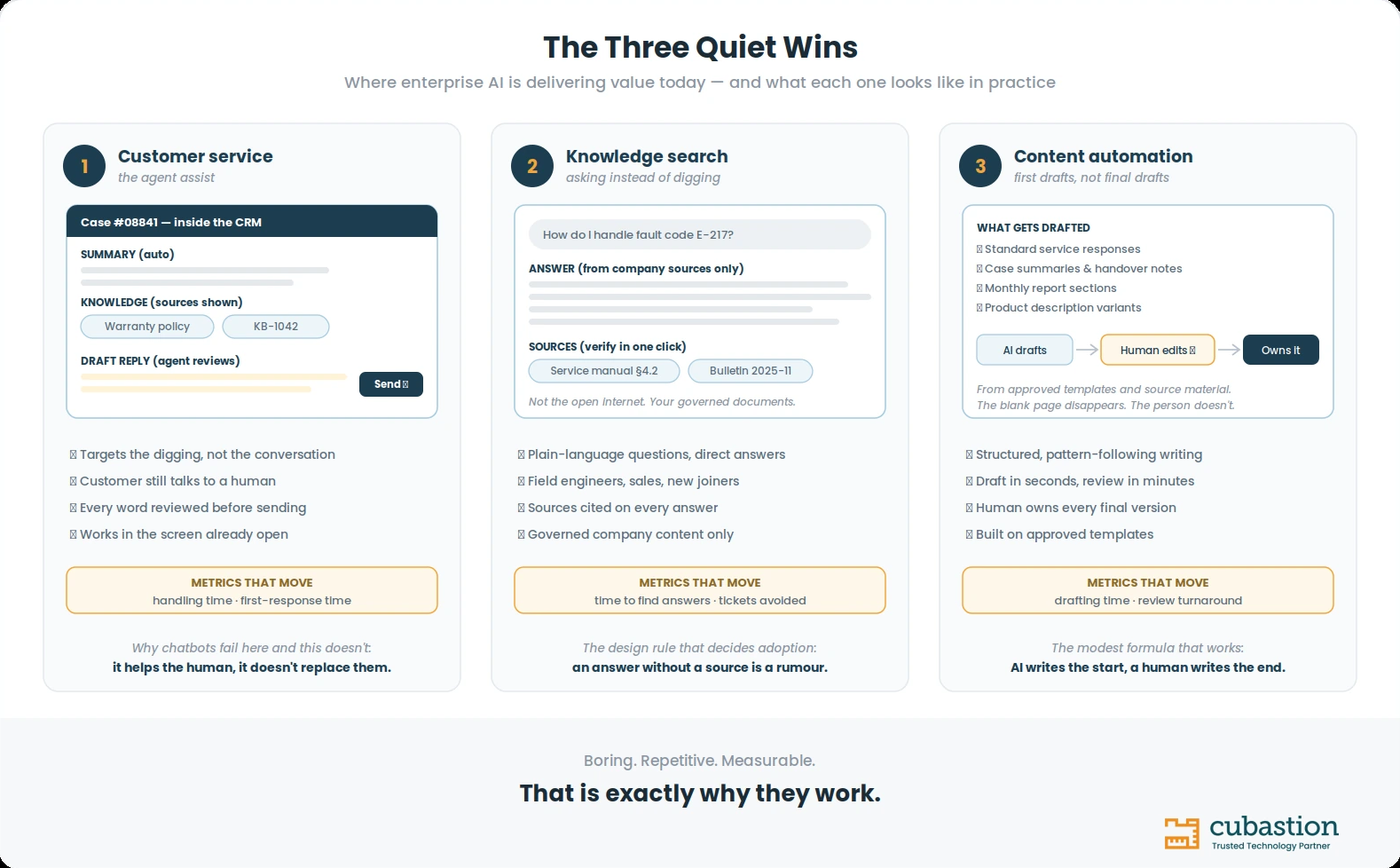
In our enterprise transformation work, three areas stand out consistently: customer service, knowledge search, and content automation. None of them sounds revolutionary. That is exactly why they work.

The three quiet wins in practice
Win 1: Customer service - the agent assist
Customer service is where enterprise AI earns its keep first, for a simple reason: the work is high-volume, repetitive, time-pressured, and fully measurable.
Consider what a service agent actually does on every case: read the history, search for the relevant policy or troubleshooting steps, figure out what to do next, and write a response. Each step is a place where minutes leak away and where AI can help without taking over.
A well-built agent assist works inside the case screen the agent already has open. When a case arrives, it summarises the history, retrieves the most relevant knowledge with sources shown, and drafts a response for the agent to review, edit, and send. The agent stays in control of every customer-facing word.
Why does this quietly win where chatbots loudly fail? Because it targets the agent's real bottleneck i.e. finding and assembling information, instead of trying to replace the conversation. The customer still talks to a human. The human is simply no longer digging through five systems to answer.
And the value is visible: handling time per case, first-response time, and how often an answer is right the first time, are numbers every service leader already tracks.
Win 2: Knowledge search - asking instead of digging
Every large enterprise runs on accumulated knowledge: policies, product documentation, past decisions, technical guides, contract terms. And in every large enterprise, that knowledge is scattered across intranets, shared drives, wikis, and inboxes.
The old answer was keyword search, which returns forty documents and leaves the reading to you. The quiet AI win is retrieval-based question answering: an employee asks a question in plain language, and the system answers from the organisation's own approved documents, with the sources cited, so the answer can be verified in one click.
The pattern shows up everywhere once you look for it. A field engineer asking how to handle a specific fault code. A salesperson checking what the standard warranty terms allow. A new joiner asking how a process works instead of interrupting a colleague. Individually, each search saves minutes. Across thousands of employees, it changes how fast the organisation moves.
Two design choices separate the versions that get used from the ones that get abandoned: the system must answer only from governed, current company sources, not the open internet and it must always show where the answer came from. An answer without a source is a rumour with good formatting.
Win 3: Content automation - first drafts, not final drafts
The third quiet win is the least discussed: the enormous volume of routine writing that enterprises produce. Standard service responses. Case summaries and handover notes. Product description variants. Report sections that follow the same structure every month. Internal documentation.
None of this is creative writing. It is structured content that follows patterns which is precisely what AI drafts well.
The winning formula is deliberately modest: AI produces the first draft from approved templates and source material; a human reviews, edits, and owns the final version. The draft is a starting point that removes the blank page, not a finished product that removes the person.
Teams that adopt this pattern report the same experience: the work doesn't disappear, but the slowest part of it does. Review takes minutes; drafting from scratch took the hour.
What the three wins have in common
Put these side by side and a pattern emerges - the same pattern, inverted, as the failures from Part 1: (Why Enterprises Buy AI but Don't Use It)
The scope is narrow. Each win targets one specific, repetitive task, not “transformation.”
The AI is embedded. It works inside the case screen, the search bar, the document tool, never in a separate portal.
A human stays in the loop. The AI assembles and drafts; a person decides and sends.
The sources are governed. Answers come from curated company knowledge, and they are always shown.
The result is measurable. Minutes per case, time to find an answer, drafting time - numbers that existed before the AI arrived, so improvement is undeniable.
Quiet wins are not small wins. They are wins designed to survive contact with the enterprise.

Anatomy of a quiet win vs. the moonshot
How to choose your first
If you are deciding where to start, ask three questions of your own organisation:
Where do employees spend the most time searching for information they know exists? That points to knowledge search.
Where is response time visibly hurting customers? That points to agent assist in service.
Where is routine writing the bottleneck in a process? That points to content automation.
Pick the one with the clearest owner and the most measurable pain. One team, one workflow, one metric - then expand from evidence, not ambition.

Which quiet win first: the decision guide
The catch and the next article
There is one requirement all three wins share, and it is the one most enterprises underestimate: every one of them is only as good as the information underneath it.
An agent assist that retrieves an outdated policy gives confident, wrong answers. A knowledge search across conflicting documents returns conflicting truths. A drafting tool built on stale templates produces polished mistakes at speed.
The quiet wins run on trusted data - curated, owned, current, and access-controlled. Which raises the question the next article will answer in depth: what does it actually take to make enterprise data and knowledge AI-ready? That is Part 3.
Want to know more or have any questions? Contact us here