



Executive Story
In 2011, IBM's Watson beat the world's best Jeopardy! champions on live television, and the modern era of enterprise AI began. IBM then poured billions into Watson Health, promised to transform oncology, and signed marquee partnerships with world-leading cancer centres. A decade later the ambition had quietly unwound flagship partnerships ended, the promised clinical revolution never scaled, and in 2022 IBM sold off its Watson Health assets. The technology was extraordinary. The outcomes were not. Watson did not fail because the science was weak. It failed because brilliant capability was never converted into changed clinical work. That distance between capability and use is the defining enterprise story of the AI era, and today it is repeating at unprecedented scale.
Executive Summary
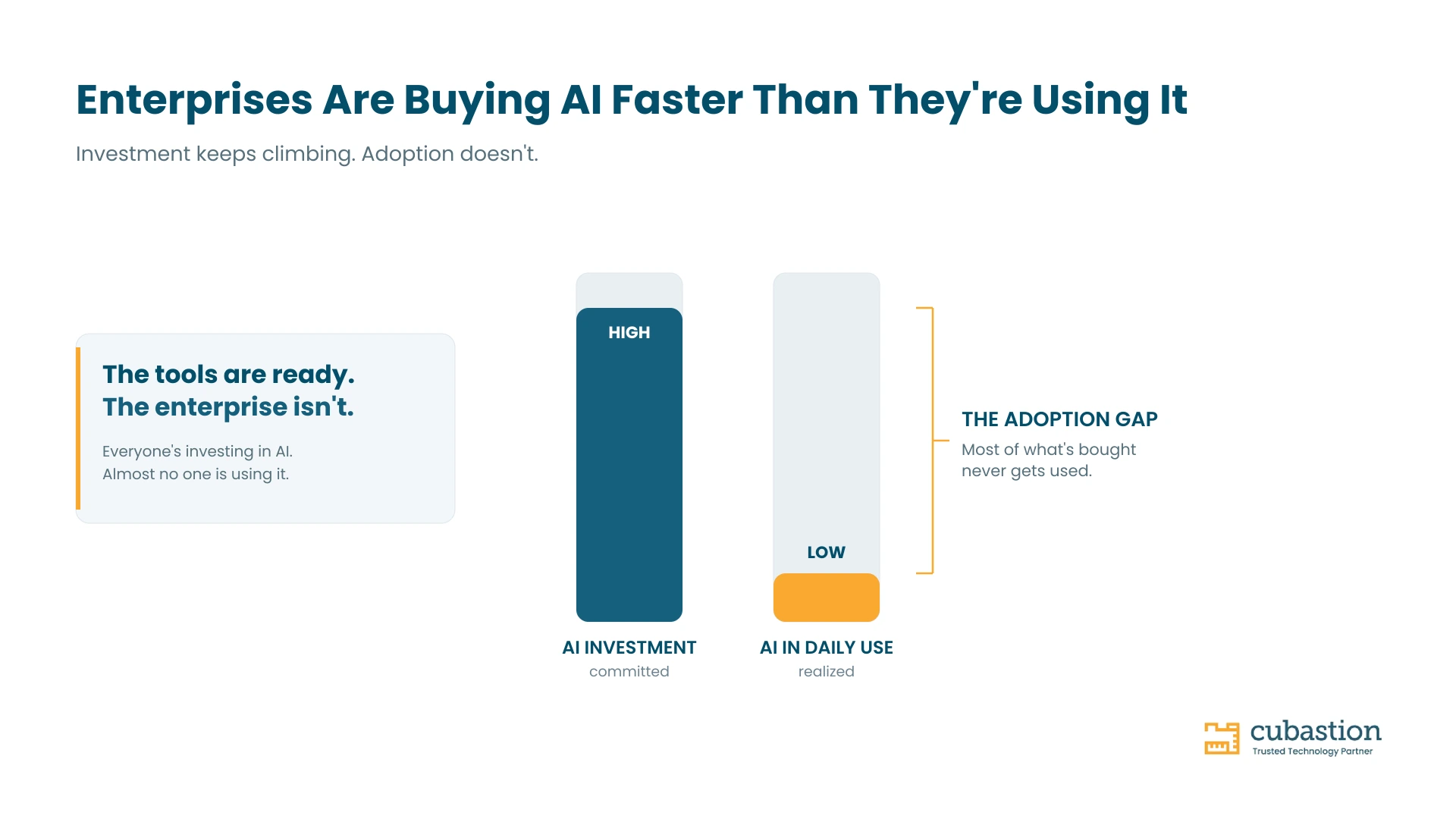
Enterprises have never invested more in AI or captured less from it. Adoption is now near universal, yet measurable value remains rare. MIT's 2025 research found that 95% of enterprise generative-AI pilots produce no measurable bottom-line impact. McKinsey's 2025 survey found that 88% of organizations use AI, but only 39% can attribute any profit to it. This is not a technology failure. It is an adoption and operating-model failure. What follows is a diagnosis of why the gap persists, a framework for closing it, and the executive priorities that separate the few who convert from the many who stall. The organizations that win will not be those with the most pilots, but those that redesign work, govern trust, and treat AI as an operating capability rather than a purchase.

Figure 1. Investment in enterprise AI is near-universal; measurable value is not.
The Paradox: Adoption Without Impact
The narrative around AI has been one of acceleration: more capable models every quarter, budgets approved with unusual speed, and boards demanding an AI strategy. McKinsey reports adoption climbing from 78% to 88% of organizations in a single year. Yet in most enterprises, adoption means experimentation, a model running in one corner of the business, a copilot licensed, a proof-of-concept demoed. Near-universal usage has been misread as near-universal transformation.
Three numbers puncture that illusion. MIT's State of AI in Business 2025 found that despite an estimated 30 to 40 billion dollars in enterprise investment, 95% of generative-AI pilots delivered no measurable profit impact, and only 5% created significant value. McKinsey found that only about one-third of organizations have begun to scale AI enterprise-wide, and just 6 to 7% qualify as high performers with material profit impact. Gartner projects that more than 40% of agentic-AI projects will be cancelled by the end of 2027. The more revealing story is what these averages hide: a widening gap between a small cohort of leaders compounding returns and a long tail stuck in experimentation. When nearly everyone uses AI, using AI stops being an advantage. The common thread is not capability. It is conversion.
Why the Traditional Playbook Fails
Enterprises have defaulted to a software-procurement playbook: buy the license, deploy the tool, expect value to follow ownership. AI breaks that model. Value comes not from owning a capability but from embedding it into how specific work gets done, repeatedly, by real people.
There is a deeper mismatch beneath the surface. Enterprise software is deterministic: install it, and it behaves the same way every time. AI is probabilistic: it improves with feedback, degrades without oversight, and behaves differently as data and context shift. A procurement mindset treats it as the former and is blindsided by the latter. MIT's researchers named the symptom a learning gap, tools that demo well but never adapt to workflows, and organizations that never adapt around the tools. Gartner reaches the same verdict from a different angle, attributing the coming wave of agentic-AI cancellations to escalating costs, unclear value, and weak controls, not to model limits. Compounding it, money flows to the wrong place: most generative-AI spend targets sales and marketing, while MIT found the highest returns in back-office and operational automation. Enterprises are buying capability where it is visible, not where it pays.

Figure 2. The five organizational gaps between buying AI and capturing value from it.
The Strategic Shift: The Value Conversion Model
Leaders that cross the divide make one decisive shift. They stop asking which AI to buy and start asking what has to change around it. That reframes AI from a procurement decision into an operating-model decision, touching data, workflow, governance, skills, and accountability. McKinsey's analysis of more than 200 at-scale transformations is blunt: the gap is a leadership and operating-model problem, not a technology one.
We frame the work as the Value Conversion Model, five dependencies that turn capability into results. First, focus: start from a costly, repeatable business problem, not a capability in search of one. Second, data readiness: clean, governed, accessible data, without which models produce confident error. Third, workflow redesign: rebuild the process around the AI rather than bolting it on. Fourth, trust and governance: clear rules for risk, oversight, and accountability, so deployment neither freezes nor breaks. Fifth, adoption and enablement: a named owner, change management, and measurement. These are not five parallel initiatives but a sequence of dependencies. Data readiness precedes meaningful workflow redesign; governance must be defined before autonomy is granted; enablement decides whether any of it survives contact with daily work. Most programs invert that order, rushing to deploy before the foundation exists, which is exactly why they stall at the pilot stage. A weak link at any stage caps the value of all the others. The constraint is organizational, not algorithmic.

Figure 3. The Value Conversion Model: the five capabilities that turn AI from a purchase into an outcome.
What It Looks Like in Practice
The pattern holds across sectors. In banking and financial services, institutions with mature data governance operationalize AI in fraud, risk, and service, while those without it stall in pilot purgatory. In automotive, the shift to software-defined vehicles rewards firms that rewire engineering and data operations, not those that merely add AI features. In the public sector, modernization succeeds where legacy processes are redesigned, not digitized in place.
The sharpest signal of the gap is MIT's shadow-AI finding: roughly 90% of employees already use personal AI tools for work, while only about 40% of their employers run official deployments. The demand is proven, and the tools clearly work; what is missing is the enterprise wrapper around them. MIT also found that externally built tools succeed roughly twice as often as internal builds, a strong argument for partnership over do-it-yourself. Across every data source, the differentiator between the winning minority and the stalled majority is execution discipline, not access to better technology.
Business Impact and Risks
The cost of the gap compounds in four ways. Capital is committed to idle capability. Opportunity erodes as competitors who did the conversion work pull ahead. Credibility is spent when leaders who championed AI cannot show what changed, hardening the board against the next request. And talent disengages when the promise of better tools meets dashboards no one opens.
This is why the gap is self-reinforcing. Value captured funds the next use case, data improves with use, and capability compounds, while laggards face a distance that grows harder to close each quarter. AI advantage, once earned, is unusually durable. The prize is real and concentrated: McKinsey sizes generative AI's long-run potential at 2.6 to 4.4 trillion dollars annually, value that accrues to the few who convert. Capturing it means avoiding four traps: chasing tools instead of outcomes, pilot purgatory where proofs-of-concept never graduate, governance done so heavily it strangles use cases or so lightly that one failure poisons trust and treating adoption as automatic. As autonomy rises with agentic AI, these risks sharpen. An ungoverned agent acts at machine speed, turning a control weakness into an operational event.
Recommendations
For executives, five priorities separate conversion from stagnation:
● Reallocate to value, not visibility. Move investment toward operational and back-office use cases with measurable return.
● Fix the data foundation first. Treat data readiness as a prerequisite, not a parallel workstream.
● Fund workflow redesign, not just tools. Budget the process change, which is where value is realized.
● Install proportionate governance early. Define risk, oversight, and accountability before scaling, especially for autonomous use.
● Name an owner and measure adoption. Assign accountability and track leading indicators alongside business KPIs.
Future Outlook
The next phase raises the stakes rather than lowering them. Gartner projects that by 2028, agentic AI will drive 15% of day-to-day work decisions, up from zero in 2024, and appear in a third of enterprise applications. Autonomy does not forgive the shortcuts that today's pilots survive; it makes weak data, absent governance, and poor process instantly consequential. It also rewards the same disciplines that separate today's winners: focus, data, workflow, governance, and adoption. The enterprises that master conversion now will compound their advantage as autonomy scales. Those still buying capability will fall further behind.
Key Takeaways and Conclusion
The essentials are simple to state and hard to execute: adoption is near-universal but value is not, the constraint is organizational rather than technical, spend should follow value rather than visibility, governance enables scale rather than blocking it, and the winners redesign work while the rest accumulate pilots.
IBM's Watson proved that extraordinary capability, left unconverted, produces headlines rather than results. A decade on, the enterprises repeating that mistake are doing so at scale, buying AI faster than they can absorb it. The paradox resolves the moment leaders stop treating AI as a purchase and start treating it as an operating capability to be built, governed, and adopted. At Cubastion, this is the work we do with enterprise leaders: closing the distance between what AI can do and what it actually delivers. The first question is no longer what to buy. It is where AI actually pays off today, the subject of the next article in this series.
Want to know more or have any questions? Contact us here