


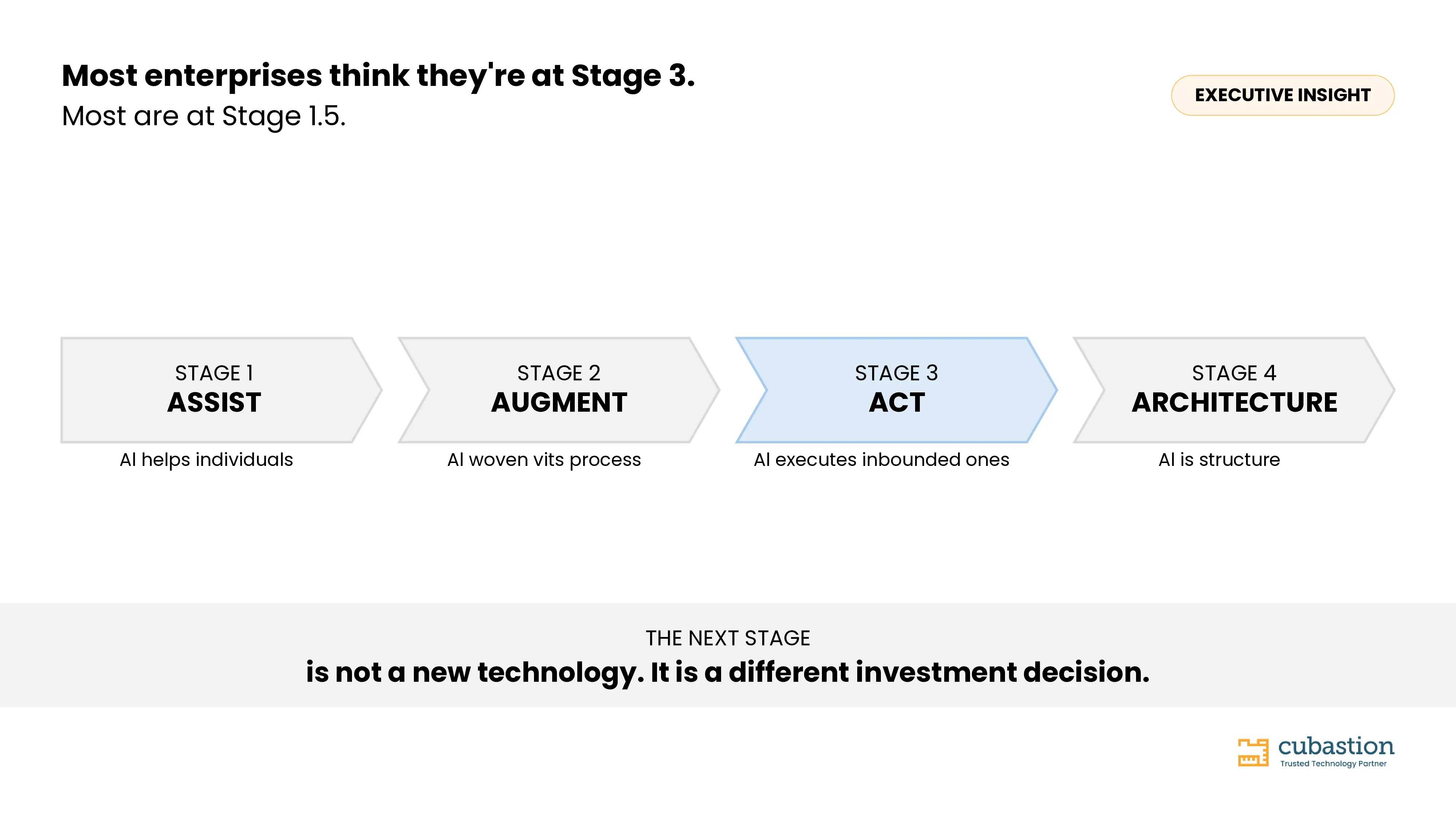

In a Tokyo conference room last quarter, a CIO told me his company was at Stage 3 of enterprise AI. Thirty minutes later, I told him ,honestly, that they were at Stage 1.5.
He did not push back. That is what made the conversation worth having.
Most of what is discussed as "enterprise AI maturity" today is measured by the wrong unit. The dominant frameworks count use cases. They count pilots. They count models deployed. None of these are wrong to track, but none of them measure the thing that actually determines whether an enterprise's AI will be working two years from now.
What I have come to use, after five years of building AI programmes in Japan, is a simpler four-stage map. It is not novel as a list. It is novel in what each stage actually requires to be reached and in how honestly most enterprises confront where they are.
The four stages
Stage 1 : Assist: AI helps individuals do tasks they were already doing. Drafting, summarizing, searching. The change is personal productivity. The operational system is untouched.
Stage 2: Augment: AI is woven into a process. The process gets faster. Individual roles get amplified. The system of record is still where it was.
Stage 3 : Act: AI executes specific operational actions inside bounded zones. Operational systems begin to be redesigned around what AI can and cannot do. Accountability and governance start to be the binding constraint, not technology.
Stage 4 : Architecture: Operations are designed AI-native. AI is structural - assumed, bounded, governed as a first-class component of the operating model. The enterprise has revised what operations excellence means in the presence of AI.
Most enterprises I work with believe they are at Stage 3. Their AI may be at Stage 3 - there are agents, there are autonomous actions, there are tools that do things. But their operations discipline around AI is still at Stage 1. The foundation has not been touched. The data layer still does not consistently feed agents the current state. The governance still treats AI as a project category, not as a structural capability.

Figure 1 · AI capability and operations discipline diverge - the gap is where AI fails.
That gap between AI capability and operations discipline is what produces the reliability incidents, the stalled pilots, and the executive doubts that follow.
The next stage is not a new technology
Here is the part that surprises the executives I talk to most. The next stage is not a new technology. It is a different investment decision.
The enterprises that will be ahead in 2028 are making that decision now. They are not investing in the highest number of AI use cases. They are investing in the deepest architectural foundation - the data layer, the governance posture, the operations-excellence discipline applied to AI itself.

Figure 2 · Three principles for the next-stage investment decision.
In practical terms, that means three things.
Architecture over use cases: If the foundation is right, fifty use cases follow naturally. If the foundation is wrong, the five working use cases will not survive their second year.
Foundation over features: Most AI investment today is feature investment - visible, demonstrable, board-friendly. The investment that matters less visibly is in the foundation: data quality, integration, evaluation pipelines, governance. That is the investment that compounds.
Compound over quick win. A quick win this quarter that doesn't survive into next year is a loss disguised as a win. The discipline of enterprise AI is the discipline of choosing investments that compound.
Closing
The Tokyo CIO and I ended that conversation in agreement. He went back to his team not with a longer list of pilots, but with a question. What would Stage 3 actually require us to do that we have not yet done?
That question, asked honestly, is what separates the enterprises that will be ahead in 2028 from the ones still measuring themselves by pilot count.
I would rather be at Stage 1.5, honestly, than at Stage 3 in self-assessment alone. The first leads somewhere. The second leads to last year's pilots.