



How FUSO Uses Three Powerful Applications to Unify CX Across 170+ Markets and What Japanese Enterprises Must Do to Keep Up.
Being a global successful brand takes more than traditional service in today’s world. It means that you are taking your CX (Customer Experience) to the next level. Why? Because CX is the sum of every single interaction, emotion, and perception a customer has with your brand. It doesn’t just mean changing your website design or doing surface level interaction. It is the complete feeling your brand leaves behind.
And that’s where FUSO has successfully broken the code and have globalised their brand in more than 170 countries. Their commercial vehicles have diverse customers that range from a fleet manager in Indonesia, a dealer network in Japan, to a logistics operator in Europe. People from different corners of world interact with the same brand, same digital infrastructure without a compromise in service quality. So how did FUSO make this situation possible?
Because Consistency is not the branding exercise. It is an application architecture challenge. Branding gets you the audience, but it’s your application and your consistent service that makes them loyal.
A successful architecture plays out across three distinct types of enterprise applications. Each one has a different function, a different set of users, and a different role for AI.
Over the past three articles, we explored how to evaluate applications for AI readiness, how to keep humans in control as AI moves from assistance to action, and where agentic AI earns the right to act. April brings the question that follows:
When the applications are ready, and the people are ready: how do you scale it globally without losing what made it work?
This article answers that question through the lens of three application types Cubastion has built and operates for FUSO and what every global enterprise can take from that pattern.
"The Enterprise AI Map: Three Application Types, Three Distinct Roles.”
Global enterprises are run on a complex application landscape. When we look at our client base, be it automotive, manufacturing or enterprise services, we consistently see three categories of application, each with a distinct global scaling challenge and a distinct role for AI.
| Application Type | Global Challenge | AI Role | Cubastion Example |
| 1 — Customer Experience Platforms | Fragmented touchpoints — customers interact with multiple disconnected apps across markets | Unified personalisation, predictive service scheduling, intelligent engagement across channels | CCP: Central Customer Portal — FUSO / MFTBC (Salesforce, Truckonnect, FUSO Shop, invoice, fleet & service) |
| 2 — Dealer, Sales & Content Operations | Inconsistent dealer processes; manual, error-prone document and content workflows across global markets | Intelligent document processing, AI-driven content automation, consistent operational quality at scale | Salesforce CRM + DMS + AI-enabled Content Management System — 7 live AI use cases |
| 3 — Data Intelligence Platforms | Disconnected data, no single source of truth, insights too slow for operational decisions | GenAI on data — natural language querying, predictive analytics, automated data quality, real-time decisioning | ICDB Data Lakehouse + GenAI solution — enterprise data intelligence at global scale |
Understanding which type of application, you are dealing with is the first step to applying AI correctly. A GenAI capable of making your documents process smarter in a CMS (type 2) is not the same as the AI that makes your customers feel seen (Type 1). And neither is the same as the predictive AI intelligence layer on a data lakehouse (type 3) that tells you what is going to happen in your business before it happens. Apply the wrong one to the wrong problem, and the result is not transformation. It is expensive confusion.
Type 1: Customer Experience Platforms: Building the Portal That Makes Complexity Invisible
For most global enterprises, their customer facing layer is the most visible part. These types of applications allow the customers and fleet operators to interact directly. But they face a major challenge of “fragmentation” at the global scale. This results to customers usually interacting with multiple disconnected applications across the lifecycle, each with its own login, its own data model, and its own experience quality. All of these activities increase agitation and reduces collaboration.
In FUSO, the problems were same. fragmentation was identified as the starting point to upgrade their CX because Customers needed to navigate separate touchpoints for vehicle information, service booking, telematics data, invoicing, and fleet management. Each interaction was functional. The overall journey was not.
The CCP Solution
Cubastion responded the problem of fragmentation by building the Central Customer Portal (CCP) for MFTBC: a unified Salesforce Experience Cloud platform that consolidates the complete customer journey into a single, coherent digital experience. Our solution delivered CCP Phase 2 using an Agile framework with six development sprints. CI/CD pipelines enabled rapid, reliable deployments across environments. This contained:
· FUSO Shop which handles service booking and parts purchasing, integrated directly into the portal so customers never need to leave to complete a transaction.
· Truckonnect, powered by Daimler Truck Connect, delivers live telematics data giving fleet operators real-time visibility of every vehicle in their fleet from within the same environment they use for everything else.
· Invoice Management that gives customers complete access to their financial documents, removing the need to contact support or navigate separate finance systems for something as fundamental as retrieving an invoice.
· Fleet and Service Management which consolidates vehicle registration, maintenance scheduling through a calendar-based interface, and lease and finance cost management, giving fleet operators a single operational view of their entire relationship with FUSO.
· Unified Customer Identity meaning that Vehicle history and finance information are synchronised with internal SFA systems, connecting eight enterprise systems through secure APIs meaning that every part of the portal draws from a single, consistent view of the customer, regardless of which underlying system is actually serving the interaction.
This is not a portal that links to other applications. It is a platform that makes those applications invisible to the customer, replacing navigation friction with a coherent, branded experience regardless of which underlying system is serving the interaction. The result?
| 30% reduction in maintenance scheduling time | 80% reduction in manual errors through automated data sync | 20% projected increase in lead conversion | 8 enterprise systems connected via secure APIs | FUSO CCP |
For a brand like FUSO, operating across 170+ markets with customers ranging from individual owner-operators to large fleet management enterprises, that coherence is not a feature. It is the foundation on which global trust is built.
The lesson for other global enterprises is clear: fragmentation at the application layer is not an internal IT problem. It is a customer experience problem. And until it is treated as one, no amount of investment in marketing, product quality, or brand strategy will fully close the gap between the experience you intend to deliver and the one your customers receive.
Type 2: Dealer, Sales & Content Operations: The Hidden Cost of Running a Global Brand on Manual Processes
If the customer experience layer is the face of a global brand, the operational layer is its backbone. This application connects the dealers, sales teams and content operations to serve the customers consistently across every market. For global automotive brands, this is where fragmentation has the deepest operational impact.
And it rarely announces itself dramatically. In a product-intensive industry like commercial vehicles, technical content such as manuals, specifications, regulatory documents exist in hundreds of versions across markets and languages, maintained largely by hand.

Figure 1. Application's Landscape
Salesforce CRM and DMS
Cubastion's response to the dealer and sales challenge begins with Salesforce CRM, deployed and managed across FUSO's global sales and dealer network. Rather than allowing each market to operate from its own local tools and workflows, Salesforce provides a unified view of the dealer network, standardised sales processes, real-time pipeline visibility, and consistent performance data across every market FUSO operates in.
The Dealer Management System (DMS) sits alongside this, managing the operational rhythm of dealer points: inventory, service scheduling, compliance tracking, and performance reporting.
Together, these form the backbone of consistent dealer operations. But if CRM and DMS bring order to dealer operations, it is the content management layer where the most transformative AI investment has been made.
Digital Service Centre (DSC)
DSC has always been a central hub for efficient service operations. But it faced major challenges in managing more than 165 branches and 90,000 monthly job cards. This problem rose because of poor adoption and operational inefficiencies.
For a new overhaul and efficient output, Cubastion introduced a strategic blend of DevOps implementation, real-time DSC-FORCE integration, targeted technical enhancements, and process optimization, is needed to effectively address the application's core technical challenges and streamlining operation.
The technical challenges of recurring system errors, poor UI/UX, and synchronisation deficiencies was dealt with demonstrated expertise which resulted in:
| 90% Faster load speeds enabled 5,000 more daily transactions | 7400% Increase in job card efficiency | 70% Reduction in communication delays | 45% Increase in resource allocation | FUSO DSC |
AI-Enabled Content Management System
FUSO's content operations involve something that is easy to underestimate from the outside: the continuous creation, comparison, translation, and global distribution of highly technical product documentation. What was previously a heavily manual, error-prone workflow is being systematically automated through a suite of seven AI use cases, each addressing a specific, high-frequency operational challenge.
| AI Use Case | Technology | What It Does |
| PDF Comparison & Draft Markup | Python + Azure Document Intelligence | Compares source and target manuals, automatically marks changes and generates annotated draft |
| Change Analysis Report | Python + Document Intelligence | Captures exact changes between versions; generates structured change summary with before/after text highlighted |
| PNC Creation & Reuse | Python (POC — GPT models as fallback) | Generates new PNC numbers or identifies reusable ones from historical data using defined business rules |
| Multilingual Translation | Python + Azure Translation + LLM | Takes analysis report as input; generates context-preserving translated output in target language |
| Model Description Generation | Python + Hybrid RAG | Generates accurate model descriptions using project naming sheets and historical documentation data |
| Initial Document QC | Python + LLM Models | Validates table of contents, bookmarks, and structural parameters of uploaded documents automatically |
| Auto GLMC Capture | Python + Azure GPT-5 | Automatically captures base and target model identifiers from uploaded PPL and DR sheets |
These seven use cases are not experimental pilots or proof-of-concept projects. They represent a structured, production-grade programme of AI-augmented content operations where every step in the document lifecycle, from initial quality check to final translated output, is supported by a purpose-built AI capability selected for that specific task.
The architecture is deliberate: Python orchestration, Azure Document Intelligence for structural analysis, Hybrid RAG for context-aware generation, Azure GPT-5 for complex document understanding, and Azure Translation Services for linguistically reliable output. Each tool is chosen for the specific demand of its use case, not applied uniformly across the workflow.
The principle that underpins FUSO's content AI programme is straightforward: content operations at global scale are as much a data problem as they are a language problem. AI does not replace the domain expertise required to produce reliable technical documentation. What it does is remove the manual overhead that prevents that expertise from scaling across markets, across languages, and across the continuous cycle of documentation that a global product brand demands.
Type 3 — Data Intelligence Platforms: ICDB and the GenAI Data Lakehouse
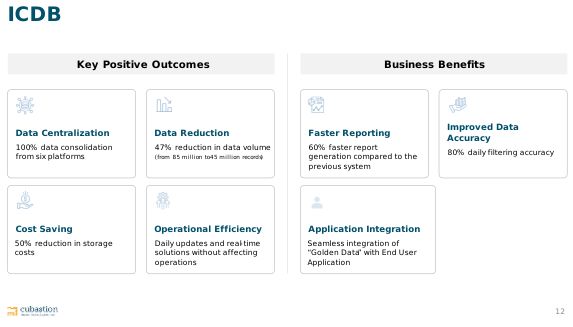
Of the three application types that define global enterprise CX, the data intelligence layer is the one most consistently underestimated. Not because enterprises lack data (most have more than they know what to do with) but because having data and having intelligent, accessible, decision-ready data are two entirely different things.
The pattern is familiar: years of investment in CRM, ERP, and operational systems have produced vast quantities of data. That data sits in multiple warehouses, marts, and operational databases. Extracting insight requires specialist skills, significant lead time, and often produces analysis that is already outdated by the time it reaches the decision-maker.

Figure 2. ICDB outcomes
From Data Warehouse to Data Lakehouse: Why distinction matters
The shift to a “data Lakehouse” architecture changes what is fundamentally possible. A Lakehouse combines the structured query performance of a traditional data warehouse with the flexible, large-scale storage of a data lake, thus creating a single environment where real-time analytics, AI model training, and generative AI applications can all operate on the same underlying data, without the complex, time-consuming ETL pipelines that previously acted as bottlenecks between systems.

For FUSO, this materialises in the ICDB platform and an integrated GenAI layer. The data infrastructure connects operational data from vehicle telematics, dealer systems, service records, and customer interactions, providing a single, trusted foundation for analytics and AI applications across the business.
What Generative AI Makes Possible on a Mature Data Foundation
With a mature data Lakehouse in place, the role of GenAI moves from insight generation to conversational intelligence. Business users can query operational data in natural language rather than waiting for analyst-built reports. Predictive models can draw on the full history of vehicle performance, service patterns, and dealer behaviour across markets. Anomalies surface automatically before they become operational problems.
The AI capabilities that run on top of this infrastructure connect directly to the applications above:
• The CCP’s predictive service scheduling draws on fleet telematics and service history data from the Lakehouse.
• The CMS translation and model description generation uses product and document history stored in the data layer.
• Dealer performance analytics aggregate operational data from DMS and CRM to give leadership consistent visibility across the global network.
Cubastion’s Force chatbot has successfully assisted the users by answering operational queries, guiding them through common tasks, and helping them resolve issues in real time. The bot simplifies troubleshooting by explaining errors clearly, identifying workflow bottlenecks, and providing step-by-step instructions.
Another successful chatbot called HR chatbot acts as a bilingual assistant for people to understand the process in their native language, making the process much faster and better as a whole experience.
Data intelligence is not a separate initiative that sits alongside customer experience and operational efficiency. It is the foundation that both of them depend on. when the data layer is unified and AI-ready, every application built on top of it becomes significantly more capable, not because the application has been rebuilt, but because the intelligence flowing into it has fundamentally improved.
The enterprises that understand this are not just building better applications. They are building a platform that gets smarter across every market, every interaction, and every decision over time.
How Cubastion Builds and Maintains This at Global Scale: AI-Augmented SDLC
Most conversations about enterprise AI focus on what the technology does for the end user. The customer portal that personalises the journey. The content system that automates translation. The data platform that surfaces predictive intelligence in real time.
What those conversations rarely address is the question that determines whether any of it works in practice: how do you build, deploy, and maintain complex enterprise applications consistently across 170 markets and what role does AI play in that delivery process itself?
Because the product is only half the challenge. The other half is the programme.
| SDLC Phase | Global Rollout Risk | AI-Augmented Cubastion Approach |
| Requirements | Lost in translation across markets | AI-assisted documentation review; market-specific gap flagging before build begins |
| Build | Quality drift across distributed teams | AI code review and quality gates enforce consistent standards regardless of team geography |
| Test | Coverage gaps across 20+ market configurations | AI-generated test scenarios per market variant; automated regression across localisation and integration layers |
| Deploy & Operate | Incidents escalate before local teams can respond | AIOps predictive monitoring — detect before customer impact, as applied in FUSO's SAP Commerce platform |
| Knowledge Transfer | Build knowledge lost after handover to local teams | AI-powered knowledge capture and on-demand access; expertise preserved for local ramp-up across markets |
This AI-augmented delivery approach is what made it possible to build and deploy the CCP, the CRM and DMS, and the AI-enabled CMS as a coherent programme rather than three separate, disconnected projects. The SDLC disciplines are the invisible layer that keeps global deployments consistent, not just at launch, but as they evolve.
What Good Looks Like at Global Scale
There is a version of global enterprise CX that most organisations aspire to, and few actually achieve. Not because the technology does not exist, and not because the ambition is absent, but because the conditions that make it possible are harder to build than any individual application.
Across all three application types, the pattern that determines success is the same: the application was built with global scale in mind from the start, the data connecting the applications is unified and trusted, and AI was introduced at the point in the workflow where it removes the most manual overhead without requiring human judgment to be replaced.
For a FUSO customer, this looks like:
• One login, one portal: vehicle data, service scheduling, invoices, telematics, all in one place, in their language. A fleet operator managing vehicles across multiple markets, interacting with the brand every week across multiple touchpoints, the experience of a well-architected global platform is deceptively simple.
• Every dealer interaction, whether it takes place in Japan or Germany, runs on the same CRM and dealer management system with standardised processes, consistent data quality, and a shared operational language that makes the brand feel the same regardless of the market delivering it.
• Technical documentation is current, correctly translated, and structurally validated before it reaches the teams and customers who depend on it, not because the manual review team has become larger, but because AI has absorbed most of the taxing work efficiently and at a large scale.
• Leadership visibility across the global network, in real time, drawn from a single trusted data foundation.
None of this requires a different AI strategy for each application. It requires a coherent architecture across all three types and an approach to delivery that can maintain that coherence as the business and its markets evolve.
If you are a global enterprise looking honestly at your current application landscape, the question this article is really posing is a direct one.
Not "Are we using AI?" Almost every enterprise can answer yes to that.
But: "Are we using AI coherently across the right application types, on a unified data foundation, with a delivery approach that can maintain that coherence at scale?"
Conclusion: Three Applications, One Operating Model. One standard of Excellence.
The enterprises that achieve consistent, world-class customer experience at global scale are not the ones with the most AI features. They are the ones who are consistent in running all of their engagements competently.
Cubastion's work with FUSO is not three separate engagements. It is one operating model, expressed across three application types. The Central Customer Portal, the Salesforce CRM and DMS, the AI-enabled Content Management System, and the ICDB Data Lakehouse are not independent investments pointing in broadly similar directions. They are components of a single, coherent architecture designed to connect, built to share data, and augmented by AI at the specific points where it delivers the most meaningful impact.
These methods are applied consistently across customer experience, dealer operations, content management, and data intelligence.
That is what scalable AI looks like in practice. Not a transformation programme. A discipline, applied repeatedly, across every application type, in every market.
The enterprises that internalise this are not chasing AI. They are building something more valuable and more durable: a platform that gets smarter, more consistent, and more capable with every market it enters and every application it connects.