


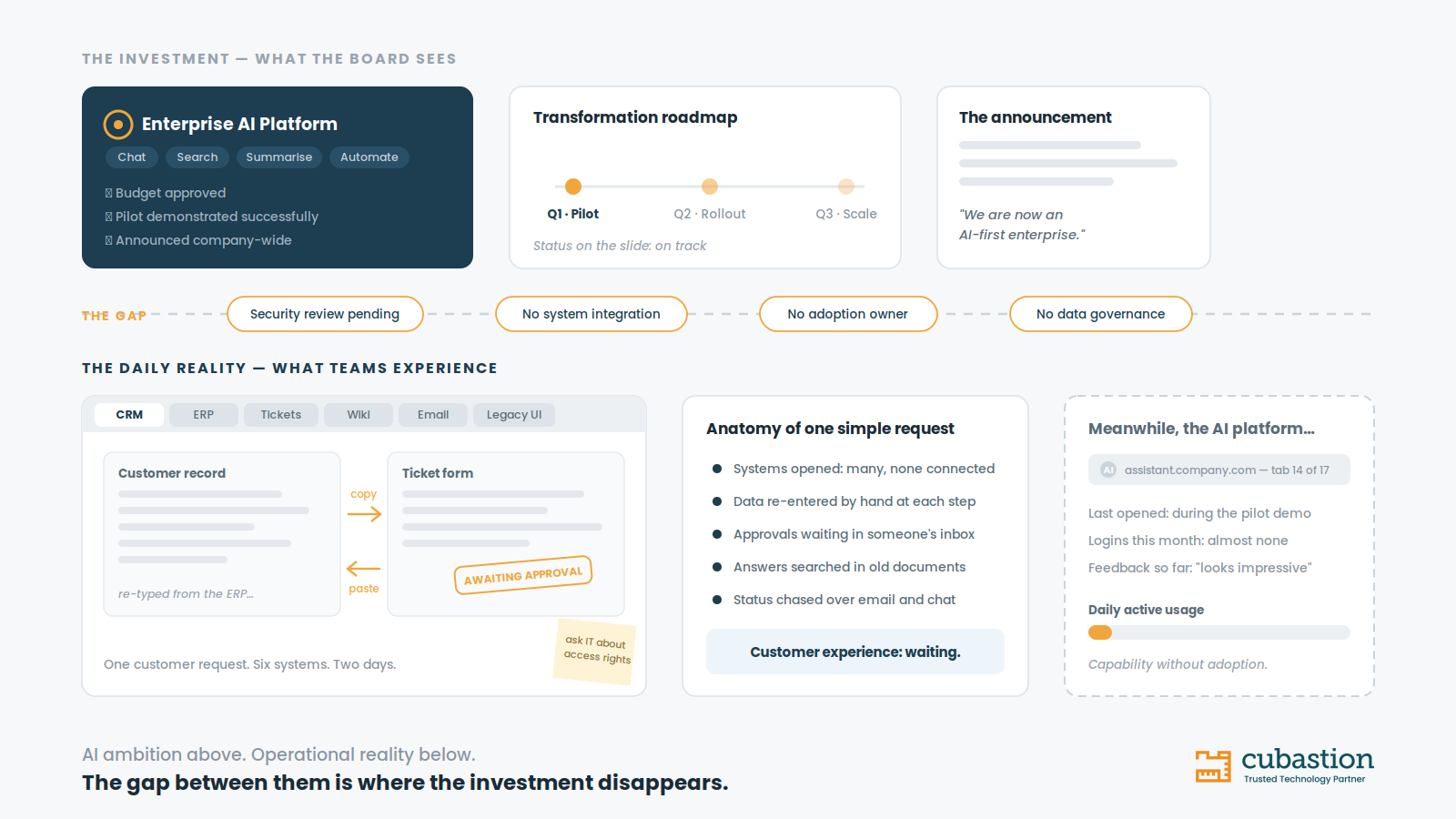

The enterprise AI contradiction
Walk through almost any large enterprise today and you will see two realities existing side by side.
In the boardroom, AI is everywhere. Budgets have been approved, platforms have been purchased, pilots have been demonstrated, and transformation roadmaps feature AI prominently. On paper, the organisation has adopted AI.
On the floor, very little has changed. Service agents still search across disconnected systems to answer a customer question. Teams still prepare reports manually. Approvals still crawl through the same chains they always did. The AI tool that impressed everyone in the demo sits in a browser tab that rarely gets opened.
This is the enterprise AI contradiction: the technology is increasingly ready, but many enterprises are not operationally ready to use it at scale.
If AI is becoming so capable, why is it still not being used consistently inside enterprises? In our experience working on enterprise transformation, the answer almost never lies in the model. It lies in six organisational gaps.

Visual 1 — The investment vs. the daily reality
Buying AI is easier than changing the enterprise
Procuring an AI platform is a purchasing decision. Running a proof of concept is a project. Neither requires the organisation to change how it works.
Integrating AI into real business processes is a different challenge entirely. It runs into everything that makes enterprises complex: fragmented applications and legacy systems that don't talk to each other, approval processes with many stakeholders, legitimate security, privacy, and compliance concerns, and unclear ownership between business, IT, data, and security teams. Add the natural resistance of teams who have refined their workflows over years, and the friction becomes obvious.
None of these barriers appear in the pilot. All of them appear in production. That is why so many AI initiatives look successful right up until the moment they need to matter.
Starting with technology instead of a business problem
Many AI programmes begin with the question, “Where can we use generative AI?” It sounds strategic. In practice, it produces solutions searching for a problem.
Consider the difference:
A generic enterprise chatbot is a technology-first initiative. It has no clear owner, no specific user, and no obvious measure of success. Reducing the time service agents spend searching for troubleshooting information is a problem-first initiative. It has a defined user, a visible pain point, and a number that can move.
Similarly, “introduce AI-generated content across the organisation” is vague ambition. “Automate the first draft of standard service responses, with human review before sending” is a concrete improvement that a team can feel within weeks.
Adoption follows visibility. When AI solves a problem people experience daily and the improvement can be measured, usage takes care of itself.

Visual 2 — Technology-first vs. problem-first
AI is added outside the workflow
Even a well-targeted AI capability fails if it lives in the wrong place.
Employees under time pressure will not consistently open a separate portal, log into another application, and copy information back and forth. A standalone AI destination becomes one more window to ignore.
AI delivers value when it is embedded where people already work: inside the CRM platform, the service-management application, the contact-centre desktop, the employee portal, the collaboration tools, and the knowledge-management systems that structure the working day.
A practical example is agent assist. When a customer case opens, the AI summarises the history, retrieves the most relevant knowledge, and recommends a next action - directly inside the service interface the agent is already using. No new destination, no context switching, no habit to build. The best enterprise AI is almost invisible.

Visual 3 — Outside vs. inside the workflow
Data and knowledge are not ready
AI systems answer from the information they are given. In many enterprises, that information is not in a state to be trusted.
Multiple documents contain conflicting guidance. Knowledge articles have no owners and no review dates. Customer data is fragmented across systems that disagree with each other. Access permissions are unclear, so it is uncertain what the AI should even be allowed to see.
When an AI assistant gives a confidently wrong answer because it read an outdated document, employees do not blame the document. They stop trusting the assistant. Data readiness is a deep topic that deserves its own discussion - we will cover it fully later in this series - but no enterprise AI initiative should ignore it at the start.
Trust is treated as a technology issue
Enterprises often assume that if the model is accurate enough, people will trust it. But employee trust is built on questions accuracy alone cannot answer:
Where did this answer come from? Is the source current? What is the AI authorised to do on its own? When is human approval required? And who is accountable if the recommendation is wrong?
Trust comes from transparency, governance, user experience, and clearly defined human oversight. An AI capability that shows its sources, states its limits, and knows when to hand over to a human will be used. One that presents unexplained answers - even mostly correct ones - will be quietly abandoned.
Pilots are launched without a path to production
A successful demonstration and an enterprise-ready solution are separated by everything that doesn't fit on a slide: integration with core systems, security and access controls, monitoring, scalability, support ownership, feedback mechanisms, change management, adoption measurement, and a realistic view of operating costs.
Many pilots are designed to impress rather than to survive. They run on clean sample data, serve a friendly test group, and have no owner for what happens after the applause. A visually impressive pilot is not the same as sustainable business transformation - and the gap between the two is where most enterprise AI investment quietly disappears.

Visual 4 — The five barriers and their symptoms
What enterprises should do differently
The pattern across successful enterprise AI initiatives is remarkably consistent. Five practices stand out:
• Start with one high-value, repetitive business problem. Not a platform vision - a specific pain point a specific team feels every day.
• Define measurable success indicators before building. Decide what number should move, and by how much, before writing a line of code.
• Use trusted and governed enterprise information. Curate the knowledge the AI will draw on; assign owners; retire what is outdated.
• Embed AI within existing employee workflows. Bring the capability to where the work happens, not the other way around.
• Design governance, human oversight, and production operations from the beginning. Treat the pilot as version one of a product, not a demonstration.

Visual 5 — The Enterprise AI Readiness Framework
From adoption theatre to adopted AI
Enterprise AI adoption does not depend on choosing the most advanced model. It depends on solving the right problem, preparing the data, integrating with real workflows, establishing trust, and measuring outcomes. The technology is the easy part; the enterprise is the hard part.
If broad AI programmes so often struggle, where is AI already delivering practical enterprise value today? In the next article, we will examine three areas where AI is quietly and consistently winning.