



1.1 Introduction
Salesforce AgentForce is helping enterprises accelerate AI adoption across customer service, sales, and operations through autonomous AI agents. While many organizations successfully launch pilot programs, a significant number struggle to scale beyond proof-of-concept stages.
In our previous article, Implementing Salesforce AgentForce: A Roadmap to AI-Powered Service Transformation, we explored how enterprises can plan and deploy AgentForce successfully. However, deployment is only the first step; achieving enterprise-wide scale presents an entirely different set of challenges.
The challenge is rarely the technology itself. Most failures result from weak data foundations, lack of governance, poor business alignment, and limited organizational adoption strategies.
This article explores why Salesforce AgentForce pilots fail to scale and how enterprises can build a sustainable AI transformation strategy.
1.2 Why Scaling Enterprise AI Is More Difficult Than Launching a Pilot
As enterprise investment in Generative AI continues to grow, organizations are increasingly adopting platforms like Salesforce AgentForce to automate workflows, improve customer engagement, and enhance operational efficiency. However, scaling AI across enterprise environments is significantly more complex than running a successful pilot.
According to industry research, organizations that successfully scale AI initiatives are those that align technology implementation with governance, integration, and measurable business outcomes. For enterprises adopting Salesforce AgentForce, long-term success depends on operational readiness, not just AI deployment.
1.3 Why Salesforce AgentForce Pilots Fail to Scale
1.3.1 Pilots Are Built in Isolation
Many enterprises launch AI pilots within individual departments without aligning them to enterprise-wide transformation goals.
This often leads to:
· Siloed implementations
· Limited scalability
· Integration challenges
· Weak cross-functional adoption
As a result, pilots show short-term value but fail to deliver enterprise impact.
1.3.2 Poor Data Readiness Impacts AI Performance
AI agents rely heavily on accurate and accessible enterprise data.
Common challenges include:
· Inconsistent CRM records
· Fragmented knowledge repositories
· Legacy systems lacking integration capabilities
· Limited real-time data access
Without strong data governance, AI-generated outputs become unreliable and difficult to scale.
1.3.3 Governance and ROI Are Often Undefined
Many organizations prioritize speed of deployment over governance and measurable outcomes.
This creates challenges related to:
· Compliance risks
· Data privacy concerns
· Lack of AI monitoring
· Undefined business KPIs
Without clear ROI metrics, executive support for scaling AI initiatives often declines after the pilot phase.
1.4 Building a Scalable Salesforce AgentForce Strategy
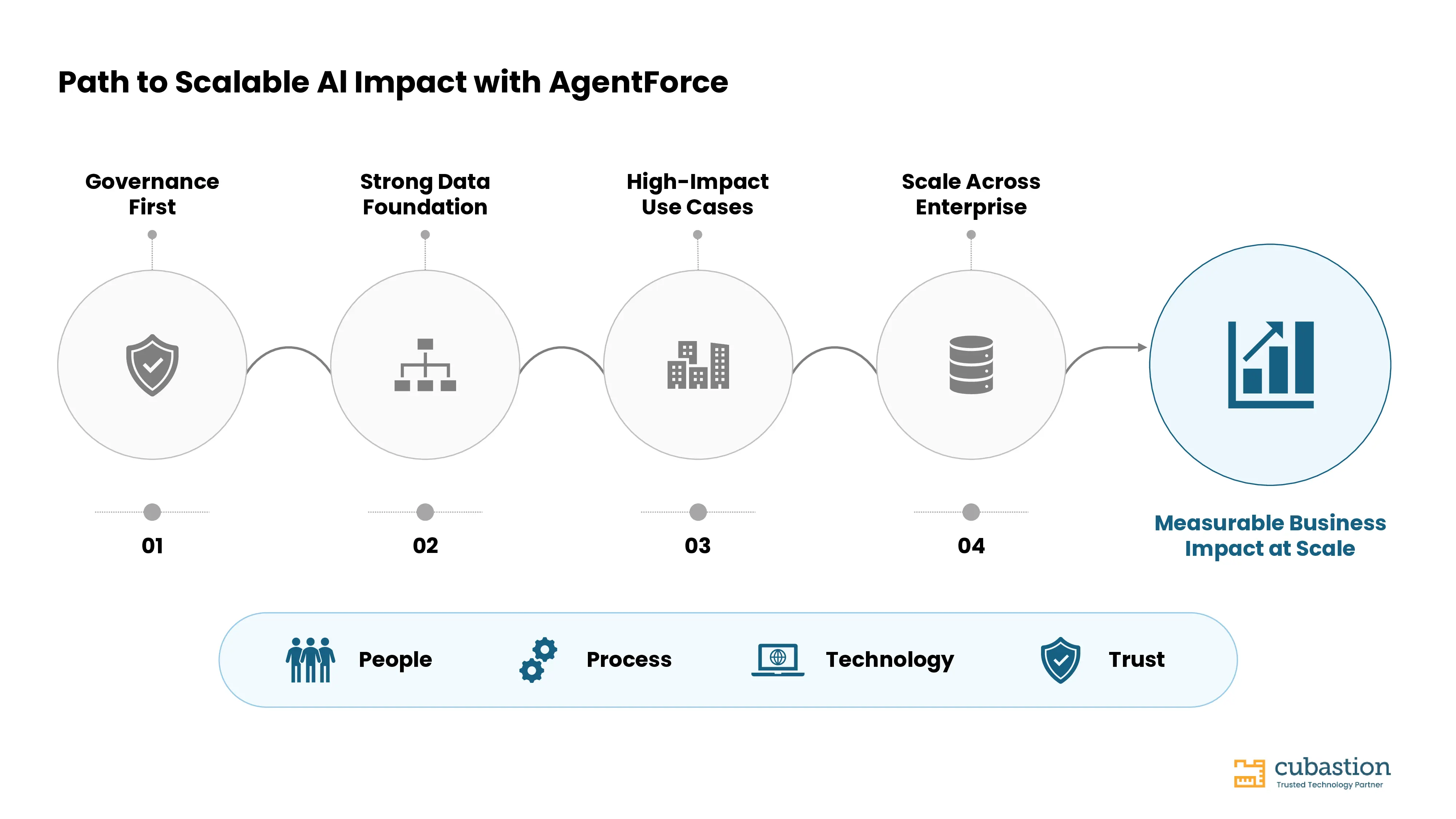
Organizations that successfully scale Salesforce AgentForce typically follow a structured operating model rather than expanding AI pilots in an ad hoc manner. Based on our experience supporting enterprise transformation initiatives, Cubastion recommends a four-pillar framework for scaling AgentForce from pilot programs to enterprise-wide adoption.
1.4.1 Pillar 1: Governance-First Deployment
Successful scaling begins with governance.
Organizations should establish:
§ Enterprise AI policies and guardrails
§ Defined ownership and accountability
§ Risk and compliance controls
§ Human oversight mechanisms
§ Performance monitoring processes
Governance creates the operational foundation required to scale AI safely, consistently, and responsibly across business functions.
1.4.2 Pillar 2: Data Readiness and Integration
AI performance is directly dependent on data quality.
Before scaling AgentForce, organizations should focus on:
§ CRM data standardization
§ Knowledge repository optimization
§ API-led integration architecture
§ Real-time data accessibility
§ Data governance and quality controls
Strong data foundations enable AI agents to deliver reliable, accurate, and scalable outcomes.
1.4.3 Pillar 3: High-Value Use Cases
Not every process should be automated first.
Organizations should prioritize use cases that demonstrate:
§ High operational volume
§ Repetitive decision patterns
§ Clear business KPIs
§ Measurable business impact
Customer service operations, employee support, sales assistance, and workflow automation often provide the fastest path to enterprise value realization.
1.4.4 Pillar 4: Enterprise Adoption and Continuous Optimization
Scaling AI is not solely a technology initiative; it is an organizational transformation effort.
Organizations should establish:
§ Change management programs
§ User adoption strategies
§ AI performance monitoring
§ Continuous model and process improvement
§ ROI measurement frameworks
This ensures AgentForce evolves alongside business requirements and continues delivering value as adoption expands.
When these four pillars work together, organizations create the conditions required for sustainable AI scale. Rather than treating AgentForce as a standalone pilot, enterprises establish an operating model that supports governance, data readiness, business alignment, and continuous value realization.
1.5 Business Impact of Successfully Scaling AgentForce
Organizations that successfully scale enterprise AI initiatives often achieve:
· Faster response times
· Improved productivity
· Reduced operational costs
· Better customer experience
· Increased workflow efficiency
Salesforce research highlights the growing business impact of AI adoption. According to Salesforce’s Trends in AI for CRM report, 70% of organizations using generative AI report measurable business value within the first 60 days of implementation.
Salesforce's customer service research also indicates that leading service organizations are increasingly investing in AI-powered automation to enhance service operations, improve employee productivity, and deliver more efficient customer experiences.
As organizations move from pilots to production, the focus is no longer on proving whether AI works, it is on building the governance, integration, security, and operational foundations required to scale successfully across the enterprise.
The difference between successful and failed AI initiatives is not pilot performance it is enterprise scalability readiness.
1.6 Outcomes Enterprises Can Expect From Scaled AI Operations
Enterprises that successfully scale Salesforce AgentForce beyond pilot stages typically achieve measurable improvements across operational efficiency, customer experience, and workforce productivity.
Key outcomes include:
· Faster customer response and resolution times
· Reduced manual workload through intelligent automation
· Improved employee productivity and decision-making
· Better workflow standardization across business units
· Enhanced customer satisfaction and service consistency
· Stronger visibility into operational performance through AI-driven insights
More importantly, organizations with structured governance and scalable AI operating models are able to transition from isolated AI experiments to enterprise-wide transformation initiatives.
The most successful enterprises do not treat AgentForce as a short-term automation project. They position it as a strategic capability that supports long-term digital transformation, operational scalability, and business growth.
1.7 Key Enterprise Lessons From Failed AI Pilots
The failure of Salesforce AgentForce pilots is rarely caused by limitations in AI capability.
The real barriers are:
· Weak governance
· Poor data maturity
· Limited operational integration
· Lack of measurable business alignment
· Low organizational adoption
Enterprises that approach AI as a long-term transformation initiative are more likely to achieve scalable and sustainable success.
1.8 Scaling Salesforce AgentForce Requires More Than Technology
Salesforce AgentForce has the potential to transform enterprise operations, but scaling AI successfully requires more than launching pilots. Organizations need strong governance, scalable architecture, operational alignment, and measurable business outcomes to unlock long-term AI value.
At Cubastion, we help enterprises design and scale AI-powered transformation programs with a consulting-led approach focused on governance, scalability, and measurable business impact.
If your organization is exploring Salesforce AgentForce adoption or facing challenges scaling AI initiatives, connect with Cubastion to build a scalable enterprise AI roadmap.